
Xanthan gum (E415): the thickener in sauces, gluten-free bread and dysphagia drinks
CAS 11138-66-2.Also known as E415, E 415, xanthan, and corn sugar gum.
Editorial draft Last reviewed 21 November 2026 About 721 words
CC INDEX
How it works48/100 Moderate
Xanthan gum is widely used and EFSA found no safety concern for the general population. Severity scores higher because of reported bowel disease in premature infants given a xanthan-based thickener, a narrow but serious signal.
An editorial summary of this article’s cited evidence. It isn’t medical advice or a personal risk estimate.
Age index
What is the age index?Which age groups are more affected by this chemical’s possible health issues, based on this article’s sources.
- Pregnancy Unborn babies Not well studied
- Infants 0 to 1 Higher concern
- Young children 1 to 5 Lower concern
- Children 6 to 12 Lower concern
- Teens 13 to 19 Lower concern
- Adults 20 to 64 Lower concern
- Older adults 65 and over Lower concern
- Infants (higher concern): Preterm babies: bowel disease after a xanthan thickener
- The infant concern rests on case reports in babies born early; EFSA found no safety concern for uses in special infant formulae.

Illustration of dressing, sauce and bread. Xanthan gum thickens and stabilises them.
Credit: Chemical Century; AI-generated illustration
License: CC0 1.0
Illustration, not a photograph of a specific product. Resized and cropped for the web.
Xanthan gum is a thickener made by bacteria, and a pinch of it keeps salad dressings from separating, gives gluten-free bread its stretch and thickens drinks for people who have trouble swallowing. It is not absorbed; gut bacteria ferment it, which can cause wind or mild discomfort in large amounts. European and US regulators consider it safe for the general population. The one serious warning concerns premature babies: a xanthan gum-based feed thickener was linked to a dangerous bowel condition, so thickeners for preterm infants should only be used on medical advice.
Everyday exposure: where you meet it and how much
Xanthan gum is used in dressings, sauces, baked goods and food supplements, and in thickened foods for people with swallowing difficulty. [2] EFSA's refined estimate for the general population was up to 64 mg per kg of body weight per day in children, and up to 115 mg/kg for infants fed special medical formulae. [2] Labels may say "xanthan gum" or "E415".
Known and suspected harms
Evidence labels are editorial summaries, not individual risk predictions: established means recognized under the stated conditions; probable means a likely contribution with uncertainty; possible means limited evidence; disputed means assessors disagree.
- Probable — bowel disease in premature infants: US adverse-event reports described 22 infants exposed to a commercial xanthan gum-based feed thickener with a distinct pattern of late-onset necrotizing enterocolitis (NEC), a life-threatening inflammation and death of bowel tissue. [4] In 2011 FDA advised that the product should not be fed to infants born before 37 weeks of pregnancy. [5] Causation was not proven in every case, but the warning stands.
- Established — tummy discomfort at high intakes: adults given up to 214 mg/kg a day for ten days tolerated it, though some had abdominal discomfort, which EFSA considered undesirable but not adverse. [2]
EFSA found no adverse effects at the highest doses in long-term and cancer studies, no genotoxicity concern, and no need for a numerical acceptable daily intake (ADI). Its 2023 follow-up found no safety concern for use in special formulae for infants under 16 weeks at reported levels. [2,3]
Reducing avoidable exposure
Do not add thickeners to a premature or young baby's feeds unless a clinician advises it. Adults who notice bloating can check labels for "xanthan gum" or "E415". [2,5]
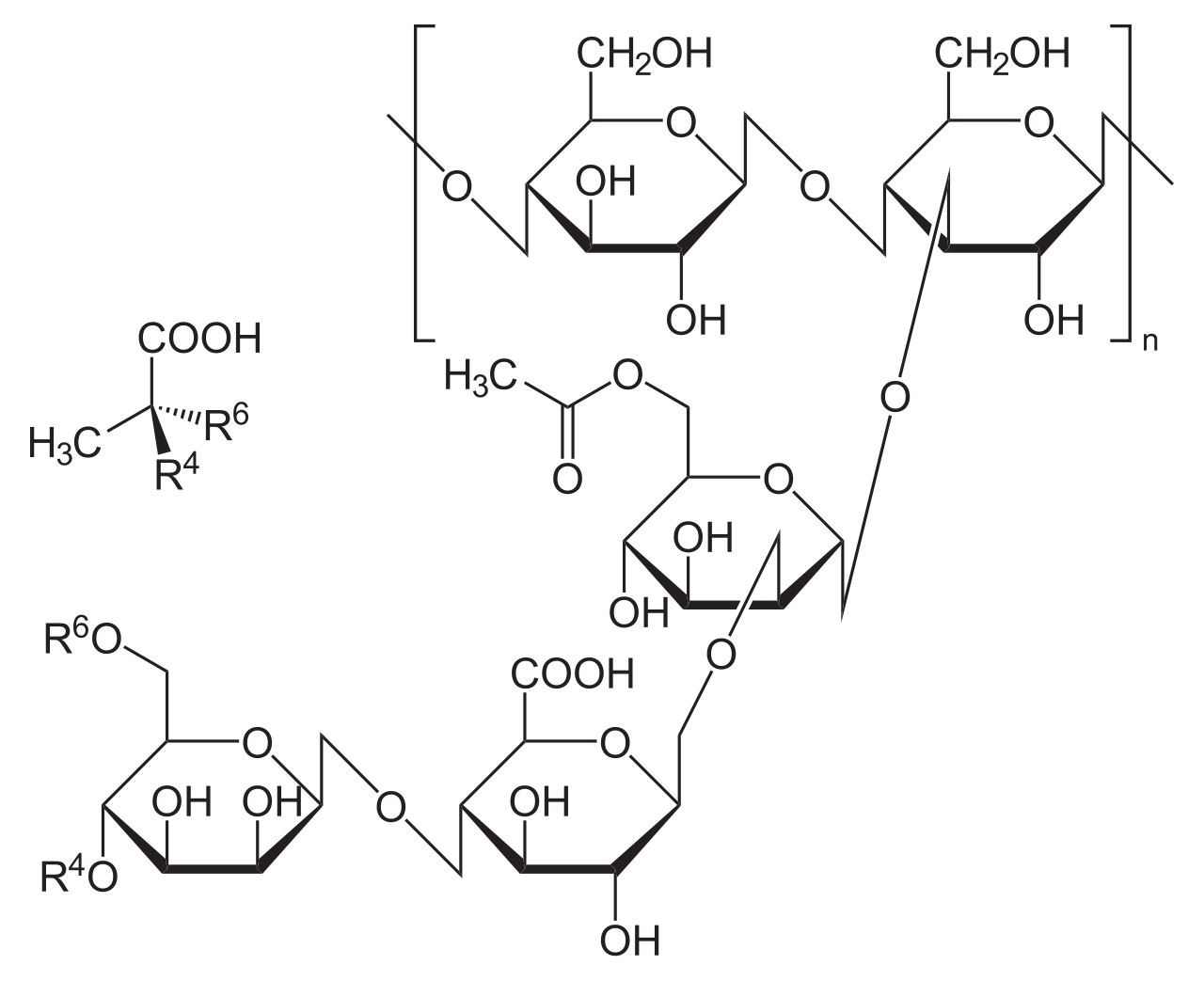
Structural formula of the xanthan gum repeating unit.
Credit: NEUROtiker / Wikimedia Commons

License: Public domain
Wikimedia-provided scaled PNG/JPEG rendering; no content edits
What it is
Xanthan gum is a polysaccharide made by fermenting sugars with the bacterium Xanthomonas campestris, then purifying it. Its main building blocks are glucose, mannose and glucuronic acid. [1]
What it does and why it is used
A small amount makes liquids thicker and keeps mixtures stable, so oil and water stay mixed and gluten-free doughs hold together. [1,2]
Regulatory status and health context
International
The sources used here do not include a separate international (WHO/JECFA) evaluation.
United States
FDA permits xanthan gum as a food additive under specified conditions. [1] FDA warned against a xanthan gum-based thickener for infants born before 37 weeks. [5]
European Union
E 415 is authorised. EFSA concluded in 2017 that no numerical ADI is needed and there is no safety concern for the general population; in 2023 it found no safety concern for special infant formulae and supported tighter purity specifications. [2,3]
Environmental notes
The sources used here do not provide enough environmental data for a rating.
Quick facts
- CAS: 11138-66-2.
- E number: E 415. [2]
- Made by: bacterial fermentation (Xanthomonas campestris). [1]
- EU ADI: not specified (no numerical ADI needed). [2]
- Key warning: not for premature babies' feeds without medical advice. [4,5]
Sources
Sources were accessed on 2026-11-21. Source publication dates differ from this draft's review date. Image licences are listed with each image.
- eCFR: 21 CFR 172.695, xanthan gum.
- EFSA ANS Panel. Re-evaluation of xanthan gum (E 415) as a food additive. EFSA Journal, 2017 (PubMed).
- EFSA FAF Panel. Re-evaluation of xanthan gum (E 415) as a food additive in foods for infants below 16 weeks of age and follow-up of its re-evaluation for all population groups. EFSA Journal, 2023 (PubMed).
- Beal J et al. Late onset necrotizing enterocolitis in infants following use of a xanthan gum-containing thickening agent. J Pediatr, 2012 (PubMed).
- CDC Health Alert Network: FDA warning on a xanthan gum-based thickening product and premature infants, 2011 (archived).