
Maltodextrin: why this "not sweet" additive can spike blood sugar
CAS 9050-36-6.Also known as maltodextrins, corn maltodextrin, potato maltodextrin, rice maltodextrin, MDX, and hydrolyzed starch.
Editorial draft Last reviewed 21 November 2026 About 639 words
CC INDEX
How it works44/100 Moderate
Maltodextrin is common in processed foods and digests quickly into glucose, which matters for blood sugar control. Gut effects are seen only in animal and laboratory studies. FDA affirms it as generally recognized as safe.
An editorial summary of this article’s cited evidence. It isn’t medical advice or a personal risk estimate.
Age index
What is the age index?Which age groups are more affected by this chemical’s possible health issues, based on this article’s sources.
- Pregnancy Unborn babies Not well studied
- Infants 0 to 1 Not well studied
- Young children 1 to 5 Not well studied
- Children 6 to 12 Lower concern
- Teens 13 to 19 Lower concern
- Adults 20 to 64 Moderate
- Older adults 65 and over Moderate
- Adults (moderate): Rapid blood sugar rise matters for diabetes
- The main concern is for anyone managing blood sugar, at any age.

Illustration of processed foods that may contain maltodextrin, a common bulking agent and stabiliser.
Credit: Chemical Century; AI-generated illustration
License: CC0 1.0
Illustration, not a photograph of a specific product. Resized and cropped for the web.
Maltodextrin is a white powder made from corn, potato or rice starch, and it is added to many processed foods as a bulking agent, stabiliser or thickener. It does not taste sweet, so many people do not think of it as sugar, yet the body breaks it down into glucose very quickly. For people managing diabetes or watching blood sugar, that can mean an unexpected spike from a product that seems savoury or sugar-free. Animal and laboratory studies also suggest it may affect the gut lining and bacteria, though this has not been shown in people.
Everyday exposure: where you meet it and how much
FDA describes maltodextrin as a nonsweet nutritive saccharide polymer made of glucose units, prepared as a white powder or concentrated solution by partly breaking down corn, potato or rice starch with acids and enzymes. [1] It is added to foods as a bulking agent, stabiliser or carrier. [3,4] Because it is not sweet, it can appear in savoury foods and products labelled low in sugar.
Known and suspected harms
Evidence labels are editorial summaries, not individual risk predictions: established means recognized under the stated conditions; probable means a likely contribution with uncertainty; possible means limited evidence; disputed means assessors disagree.
- Established — fast rise in blood glucose: maltodextrins are digested to glucose and maltose and then absorbed as glucose. A 2020 review lists their glycemic index as 110, compared with 100 for glucose itself. [2]
- Possible — gut inflammation in animals: in mice, diets enriched with maltodextrin made induced colitis and intestinal damage worse, through stress in mucus-producing cells and reduced protective mucus. These are animal findings. [4]
- Possible — bacteria linked to Crohn's disease: in laboratory experiments, maltodextrin markedly increased biofilm formation and adhesion to intestinal cells by a strain of E. coli associated with Crohn's disease. This does not show that maltodextrin causes Crohn's disease in people. [3]
Reducing avoidable exposure
If you manage diabetes or blood sugar, read ingredient lists for maltodextrin, including in savoury and "low sugar" processed foods, and check how your blood sugar responds. Choosing less processed foods lowers intake of many additives at once. [2]
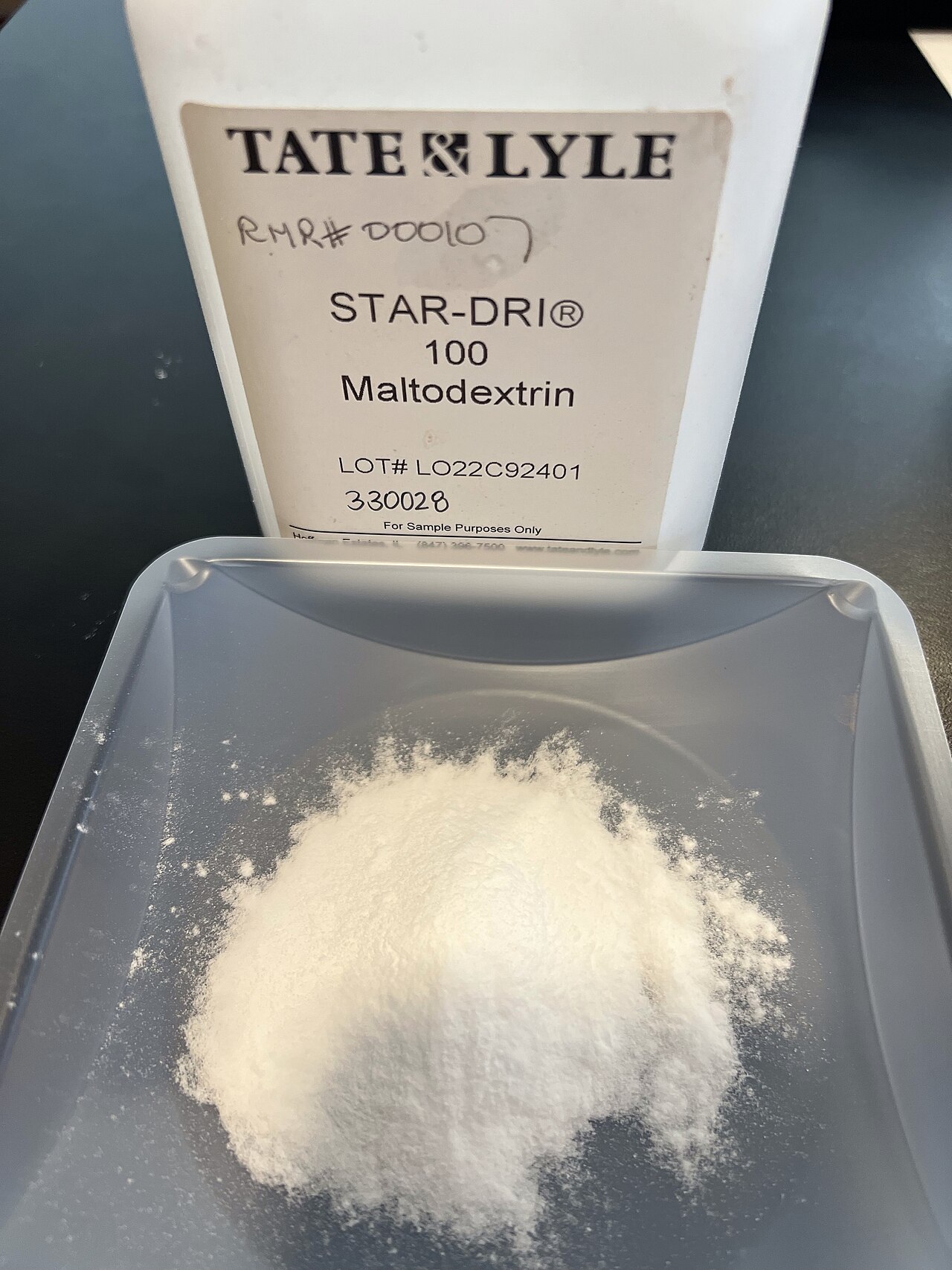
Maltodextrin powder.
Credit: Awkwafaba / Wikimedia Commons

License: CC BY-SA 4.0
Wikimedia-provided scaled PNG/JPEG rendering; no content edits
What it is
Maltodextrin (CAS 9050-36-6) is a polymer of glucose units linked mainly by alpha-1,4 bonds, with a dextrose equivalent (a measure of breakdown) of less than 20. [1] The amount of free glucose and maltose it contains depends on how far the starch was broken down. [2]
What it does and why it is used
It is used as a bulking agent, stabiliser or emulsifier in processed foods. [3,4]
Regulatory status and health context
Canada
The sources used here do not cover Canadian rules for maltodextrin.
United States
FDA affirms maltodextrin from corn, potato or rice starch as generally recognized as safe (GRAS) when used in food at levels consistent with good manufacturing practice. [1]
European Union
The sources used here do not cover EU rules for maltodextrin.
Environmental notes
The sources used here do not provide enough environmental data for a rating.
Quick facts
- CAS: 9050-36-6. [1]
- Made from: corn, potato or rice starch. [1]
- Glycemic index: 110 (glucose = 100). [2]
- Gut effects: animal and laboratory evidence only (possible). [3,4]
- US status: GRAS. [1]
Planning meals around fewer additives? See also The Low-Additive Family Meal Plan, a printable 7-day plan with recipes and a grocery list ($4 USD).
Sources
Sources were accessed on 2026-11-21. Source publication dates differ from this draft's review date. Image licences are listed with each image.
- eCFR: 21 CFR 184.1444, maltodextrin.
- Brouns F. Saccharide characteristics and their potential health effects in perspective. Front Nutr, 2020.
- Nickerson KP, McDonald C. Crohn's disease-associated adherent-invasive Escherichia coli adhesion is enhanced by exposure to the ubiquitous dietary polysaccharide maltodextrin. PLoS One, 2012 (PubMed).
- Laudisi F et al. The food additive maltodextrin promotes endoplasmic reticulum stress-driven mucus depletion and exacerbates intestinal inflammation. Cell Mol Gastroenterol Hepatol, 2019 (PubMed).