
Polysorbate 80: is this ice cream emulsifier bad for your gut?
CAS 9005-65-6.Also known as E433, polyoxyethylene (20) sorbitan monooleate, polysorbate, P80, and emulsifier 433.
Editorial draft Last reviewed 21 November 2026 About 625 words
CC INDEX
How it works42/100 Moderate
Polysorbate 80 is common in processed foods. EFSA found no concern for cancer or genotoxicity but noted toddlers' high exposure sits close to the safe daily intake. Gut effects are seen in mice, not yet confirmed in people.
An editorial summary of this article’s cited evidence. It isn’t medical advice or a personal risk estimate.
Age index
What is the age index?Which age groups are more affected by this chemical’s possible health issues, based on this article’s sources.
- Pregnancy Unborn babies Not well studied
- Infants 0 to 1 Not well studied
- Young children 1 to 5 Moderate
- Children 6 to 12 Lower concern
- Teens 13 to 19 Lower concern
- Adults 20 to 64 Lower concern
- Older adults 65 and over Not well studied
- Young children (moderate): Toddlers' high-end intake was near the EU safe daily limit
- Gut effects are documented in mice; human effects at dietary levels are not established for any age group.

Illustration of ice cream and dressing. Polysorbate 80 helps oil and water stay mixed.
Credit: Chemical Century; AI-generated illustration
License: CC0 1.0
Illustration, not a photograph of a specific product. Resized and cropped for the web.
Polysorbate 80 is an emulsifier that keeps ice cream smooth, stops oil and water separating in sauces and dressings, and helps flavours mix into drinks. Regulators consider it safe at permitted levels, and a single serving is a very small amount. The concern comes from mouse studies in which it thinned the gut's protective mucus, shifted gut bacteria and promoted low-grade inflammation and weight gain. Whether the same happens in people eating ordinary diets is not yet known, so for now it matters most to people curious about cutting back on ultra-processed foods.
Everyday exposure: where you meet it and how much
In the United States, polysorbate 80 may be used as an emulsifier in ice cream, frozen custard, sherbet and other frozen desserts at up to 0.1% of the finished product, and in a range of other foods under set conditions. [1] In the EU it is authorised as food additive E 433. [2] Labels may list it as "polysorbate 80" or "E433."
Known and suspected harms
Evidence labels are editorial summaries, not individual risk predictions: established means recognized under the stated conditions; probable means a likely contribution with uncertainty; possible means limited evidence; disputed means assessors disagree.
- Possible — gut inflammation and metabolic effects (animal studies): in mice, relatively low concentrations of polysorbate 80 and carboxymethylcellulose induced low-grade inflammation and obesity or metabolic syndrome, and promoted severe colitis in mice predisposed to it. The effects were associated with gut bacteria encroaching on the gut lining and depended on the gut bacteria. [3]
- Established — intake near the safe limit for some toddlers: EFSA set a group acceptable daily intake (ADI) of 25 mg per kg of body weight for polysorbates. In its refined estimate, toddlers with the highest intake were at 24.5 mg/kg, very close to the ADI, and EFSA said more usage data were needed to reduce uncertainty. [2,4]
EFSA found no concern regarding genotoxicity, cancer or developmental toxicity and very low acute toxicity. [2]
Reducing avoidable exposure
If you want to limit emulsifiers, read ingredient lists for "polysorbate 80" or "E433" and choose fewer ultra-processed foods. These are precautionary steps; harm in people at normal intakes has not been shown. [2,3]
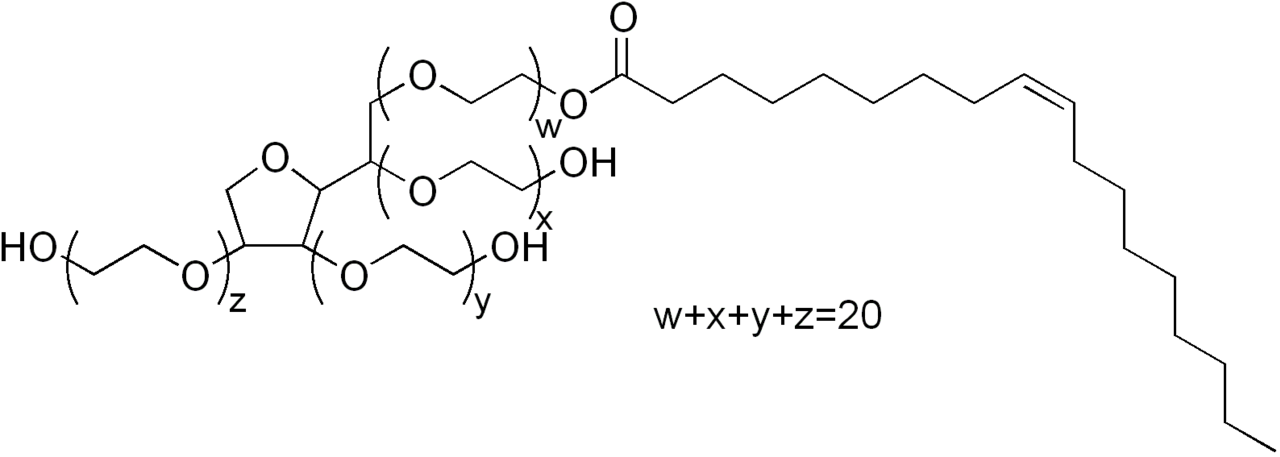
Structural formula of polysorbate 80.
Credit: Edgar181 / Wikimedia Commons

License: Public domain
Wikimedia-provided scaled PNG/JPEG rendering; no content edits
What it is
Polysorbate 80 (polyoxyethylene (20) sorbitan monooleate) is made by reacting oleic acid with sorbitol and then with ethylene oxide. [1]
What it does and why it is used
It is an emulsifier: a detergent-like molecule that keeps fat and water mixed, giving smooth texture to frozen desserts and other foods. [1,3]
Regulatory status and health context
Canada
The sources used here do not cover Canadian rules for polysorbate 80.
United States
FDA permits polysorbate 80 as a food additive under specific conditions, including up to 0.1% in frozen desserts. [1]
European Union
Polysorbates are authorised as E 432–E 436. EFSA's 2015 re-evaluation set a group ADI of 25 mg/kg body weight per day. [2,4]
Environmental notes
The sources used here do not provide enough environmental data for a rating.
Quick facts
- CAS: 9005-65-6.
- E number: E 433. [2]
- US limit in frozen desserts: 0.1%. [1]
- EU ADI: 25 mg/kg body weight per day (group). [2]
- Main open question: gut effects seen in mice. [3]
Planning meals around fewer additives? See also The Low-Additive Family Meal Plan, a printable 7-day plan with recipes and a grocery list ($4 USD).
Sources
Sources were accessed on 2026-11-21. Source publication dates differ from this draft's review date. Image licences are listed with each image.
- eCFR: 21 CFR 172.840, polysorbate 80.
- EFSA ANS Panel. Scientific opinion on the re-evaluation of polysorbates (E 432–E 436) as food additives. EFSA Journal, 2015.
- Chassaing B et al. Dietary emulsifiers impact the mouse gut microbiota promoting colitis and metabolic syndrome. Nature, 2015 (PubMed).
- European Commission: Regulation (EU) 2020/356 on specifications for polysorbates (EUR-Lex).