
Household materialsWater, air and residues
Volatile organic compounds (VOCs) at home: sources, symptoms and how to cut them
Also known as VOCs, VOC, indoor air pollutants, off-gassing, solvents, and low-VOC paint.
Editorial draft Last reviewed 21 November 2026 About 741 words
CC INDEX
How it works66/100 High
VOCs are present in almost every home. A few are established carcinogens and irritants, but effects of typical mixed low-level exposure are uncertain. Limits exist for some products and pollutants.
An editorial summary of this article’s cited evidence. It isn’t medical advice or a personal risk estimate.
Age index
What is the age index?Which age groups are more affected by this chemical’s possible health issues, based on this article’s sources.
- Pregnancy Unborn babies Not well studied
- Infants 0 to 1 Not well studied
- Young children 1 to 5 Moderate
- Children 6 to 12 Moderate
- Teens 13 to 19 Not well studied
- Adults 20 to 64 Moderate
- Older adults 65 and over Not well studied
- Young children (moderate): Formaldehyde linked to higher asthma risk in children
- Children (moderate): Formaldehyde linked to higher asthma risk in children
- Adults (moderate): Irritation and headaches; some VOCs cause cancer
- Effects depend on which VOC and how much; EPA says little is known about effects at levels usually found in homes.

Illustration of painting and new furniture, common sources of indoor VOCs. Ventilation helps.
Credit: Chemical Century; AI-generated illustration
License: CC0 1.0
Illustration, not a photograph of a specific product. Resized and cropped for the web.
Volatile organic compounds, or VOCs, are a large family of chemicals that evaporate at room temperature from paints, solvents, cleaners, air fresheners, glues, new furniture and building materials. Levels of many are consistently higher indoors than outdoors, and they can spike during jobs such as painting or paint stripping. Some cause eye, nose and throat irritation and headaches at high levels, and a few, such as formaldehyde and benzene, are linked to cancer. What everyday low levels do over time is less clear, but ventilation and choosing fewer, lower-emitting products are simple ways to lower exposure.
Everyday exposure: where you meet it and how much
EPA lists household sources including paints, paint strippers and solvents, wood preservatives, aerosol sprays, cleansers and disinfectants, moth repellents and air fresheners, stored fuels, hobby supplies and dry-cleaned clothing, plus building materials, furnishings, printers and glues. [1] Concentrations of many VOCs are consistently higher indoors, up to ten times higher than outdoors; EPA's TEAM studies found about a dozen common organic pollutants 2 to 5 times higher inside homes, and levels may reach 1,000 times outdoor background during and after paint stripping. [1] Pressed-wood products made with formaldehyde resins are often a significant indoor source of formaldehyde. [2,5]
Known and suspected harms
Evidence labels are editorial summaries, not individual risk predictions: established means recognized under the stated conditions; probable means a likely contribution with uncertainty; possible means limited evidence; disputed means assessors disagree.
- Established — short-term symptoms: EPA lists eye, nose and throat irritation, headaches, loss of coordination and nausea, and, for some chemicals, damage to the liver, kidney and central nervous system. EPA adds that "not much is known" about health effects at the levels usually found in homes. [1]
- Established — cancer for specific VOCs: the US National Toxicology Program names formaldehyde a known human carcinogen. [5] WHO states benzene is a genotoxic human carcinogen and no safe level of exposure can be recommended. [3]
- Possible — childhood asthma: a meta-analysis of 13 observational studies found each 10 µg/m³ increase in indoor formaldehyde was associated with a 10% higher risk of asthma in children (odds ratio 1.10, confidence interval 1.00–1.21). [4]
Reducing avoidable exposure
EPA advises increasing ventilation when using products that emit VOCs, following label precautions, never mixing household products unless the label says to, buying only what you will use soon, and safely disposing of old or partly used containers, because gases can leak even from closed containers. [1] Where possible, remove the source; otherwise seal exposed surfaces of formaldehyde-emitting panelling. [1]
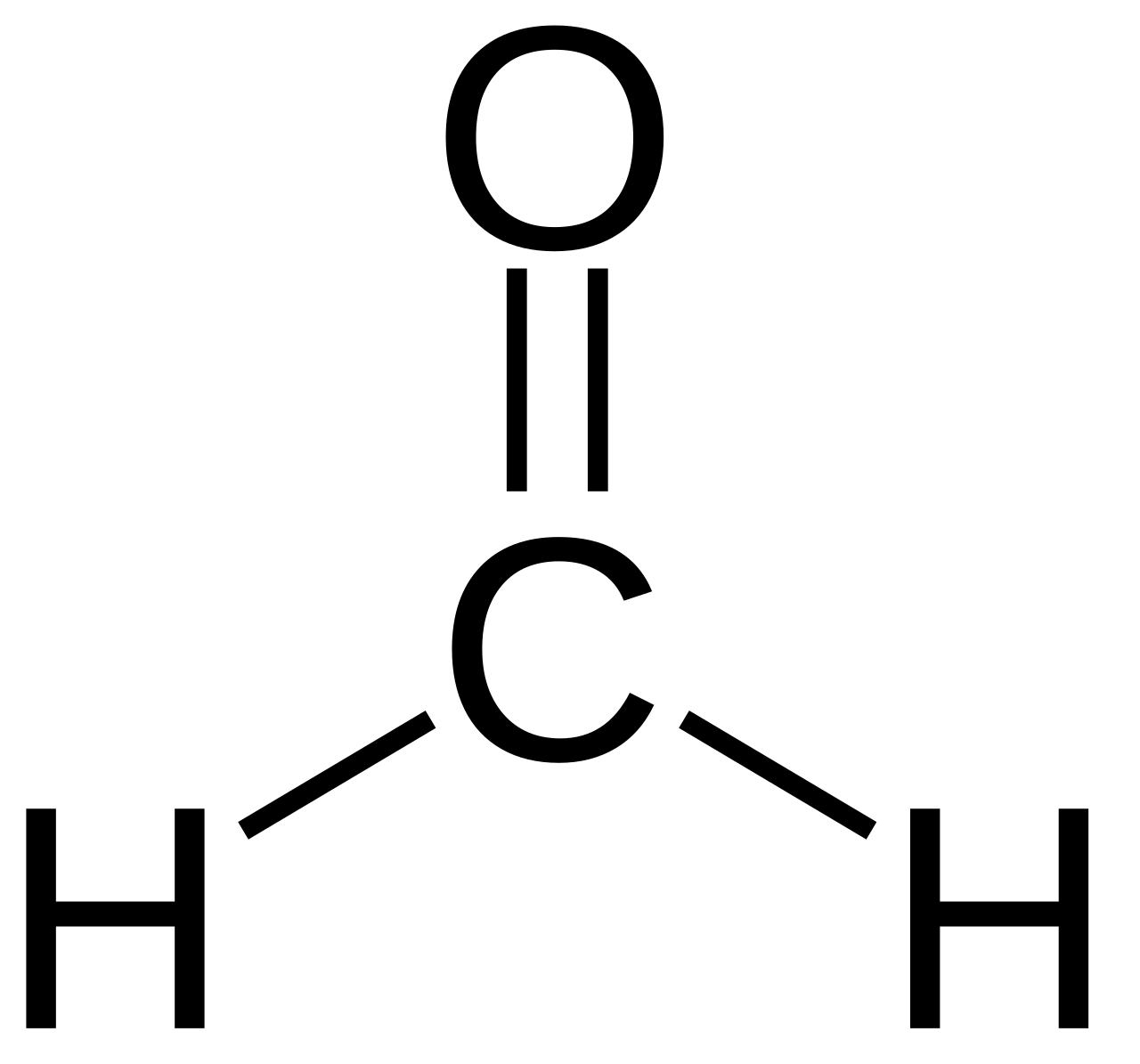
Structural formula of formaldehyde, one of the best-known VOCs.
Credit: Wereon / Wikimedia Commons

License: Public domain
Wikimedia-provided scaled PNG/JPEG rendering; no content edits
What it is
VOCs are organic chemicals emitted as gases from certain solids or liquids. The group includes thousands of compounds with very different toxicity. [1]
What it does and why it is used
Organic solvents and other VOCs are ingredients in paints, varnishes, waxes, cleaning, cosmetic, degreasing and hobby products, and fuels. [1]
Regulatory status and health context
International
WHO indoor air guidelines set a 30-minute guideline of 0.1 mg/m³ for formaldehyde, which it considers also protective against long-term effects including cancer, and recommend no safe level for benzene. [3]
United States
EPA has a regulation limiting formaldehyde emissions from composite wood products. [2] The sources used here do not give a general US indoor limit for VOCs.
European Union
Directive 2004/42/EC limits VOC content from organic solvents in certain paints, varnishes and vehicle refinishing products. [6]
Environmental notes
The EU limits VOCs in certain paints and varnishes to reduce air pollution from their contribution to the formation of ground-level (tropospheric) ozone. [6]
Quick facts
- Type: chemical group, no single CAS.
- Indoors vs outdoors: often 2–5 times higher indoors. [1]
- WHO formaldehyde guideline: 0.1 mg/m³ (30 minutes). [3]
- Top tip: ventilate during and after painting, cleaning and hobby work. [1]
Sources
Sources were accessed on 2026-11-21. Source publication dates differ from this draft's review date. Image licences are listed with each image.
- US EPA: Volatile organic compounds' impact on indoor air quality.
- US EPA: Facts about formaldehyde.
- WHO: WHO guidelines for indoor air quality: selected pollutants, 2010 (PDF).
- Yu L et al. Association between indoor formaldehyde exposure and asthma: a systematic review and meta-analysis of observational studies. Indoor Air, 2020 (PubMed).
- National Cancer Institute: Formaldehyde and cancer risk.
- EUR-Lex: Directive 2004/42/EC on the limitation of emissions of volatile organic compounds in certain paints, varnishes and vehicle refinishing products.