
Cleaning and laundryWater, air and residues
Paradichlorobenzene: the mothball and toilet-block chemical you mostly breathe
CAS 106-46-7.Also known as 1,4-dichlorobenzene, p-dichlorobenzene, and 1,4-DCB.
Editorial draft Last reviewed 15 November 2026 About 744 words
CC INDEX
How it works54/100 Moderate
Swallowed paradichlorobenzene is usually not life-threatening, but heavy long-term use has been linked to illness, and it is listed as a possible human carcinogen based on animal studies. Household exposure by breathing is common where mothballs or toilet blocks are used. The US limits it in drinking water, so the score sits in the moderate band.
An editorial summary of this article’s cited evidence. It isn’t medical advice or a personal risk estimate.
Age index
What is the age index?Which age groups are more affected by this chemical’s possible health issues, based on this article’s sources.
- Pregnancy Unborn babies Not well studied
- Infants 0 to 1 Not well studied
- Young children 1 to 5 Higher concern
- Children 6 to 12 Moderate
- Teens 13 to 19 Moderate
- Adults 20 to 64 Moderate
- Older adults 65 and over Moderate
- Young children (higher concern): Mothballs and toilet blocks can be played with or swallowed
- ATSDR says children may be at higher risk of exposure because they play with or swallow mothballs and toilet blocks, and likely show the same effects as adults, although this is not known for certain.

Illustration of a wardrobe. Paradichlorobenzene is used in some mothballs and toilet deodorizer blocks.
Credit: Chemical Century; AI-generated illustration
License: CC0 1.0
Illustration, not a photograph of a specific product. Resized and cropped for the web.
That sharp, unmistakable mothball smell in a closet or the scent from a toilet deodorizer block often comes from paradichlorobenzene. Most people meet it by breathing the vapour, and moderate household use has not been clearly shown to cause health problems. Heavy use over long periods has been linked to dizziness, headaches and liver problems in some people, and animal studies have raised cancer questions that are still not settled. Using fewer of these products, airing rooms and keeping them away from children can help.
Everyday exposure: where you meet it and how much
People are exposed to paradichlorobenzene (1,4-DCB) mainly by breathing vapours from mothballs and toilet-deodorizer blocks used at home. [1] ATSDR reports that indoor levels in some homes and public restrooms are much higher than outdoor levels. [1] MedlinePlus lists toilet bowl deodorizers, moth repellents and mothballs as products that contain it. [2]
It has also been found at low levels in some drinking water. [1]
Known and suspected harms
Evidence labels are editorial summaries, not individual risk predictions: established means recognized under the stated conditions; probable means a likely contribution with uncertainty; possible means limited evidence; disputed means assessors disagree. These labels do not describe how common an effect is.
- Established — effects of swallowing: symptoms can include a burning mouth, cough and breathing problems, muscle spasms, headache, slurred speech, changes in alertness, yellow skin, abdominal pain, diarrhea, nausea and vomiting. [2] MedlinePlus says this type of poisoning is usually not life-threatening, and little is likely to happen if a child puts a single mothball in the mouth unless it causes choking. [2]
- Probable — illness from very heavy home use: some people reported dizziness, headaches and liver problems after using very high amounts of these products for months or years even though they felt ill. [1] ATSDR says there is no clear evidence that moderate use of household products causes health problems. [1]
- Established — blood and skin effects from eating it for long periods: people who ate these products regularly for months to years developed skin blotches and red blood cell problems such as anemia. [1]
- Possible — cancer: lifetime exposure caused liver cancer in mice; the US Department of Health and Human Services has determined it might be a human carcinogen, and IARC lists it as possibly carcinogenic to humans. [1]
Reducing avoidable exposure and harm
Use mothballs and toilet blocks sparingly, or not at all, and air out rooms and stored clothing. Store these products in their original containers out of reach of young children, and discourage children from playing with or touching treated products. [1] If someone swallows paradichlorobenzene, get medical help; do not make them vomit unless told to. [2]
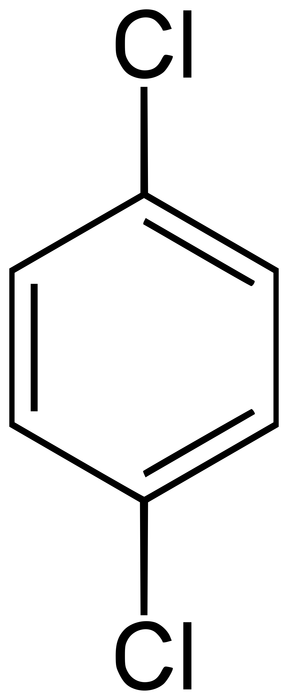
Skeletal structure of 1,4-dichlorobenzene (paradichlorobenzene).
Credit: Yikrazuul / Wikimedia Commons

License: Public domain
Rendered from SVG to PNG, whitespace trimmed and placed on white
What it is
Paradichlorobenzene (CAS 106-46-7), also called 1,4-dichlorobenzene, is a white solid with a very strong odour, and household exposure comes mainly from breathing its vapour. [1,2,3]
What it does and why it is used
It is the only dichlorobenzene commonly used in household products, mainly mothballs and toilet-deodorizer blocks, where its vapour repels moths or masks odours. [1] It is registered as a pesticide with the US EPA. [1]
Regulatory status and health context
Canada
The sources used for this review do not cover paradichlorobenzene's status in Canada, so we do not summarize it here.
United States
EPA has set a maximum level of 75 µg of 1,4-dichlorobenzene per litre of drinking water, and it is registered with EPA as a pesticide; OSHA sets a workplace air limit of 75 ppm for an 8-hour day. [1]
European Union
The EU law website was not fully available when this article was reviewed, so EU legal status was not checked and is not summarized here.
Environmental notes
ATSDR reports paradichlorobenzene in outdoor air at much lower levels than indoors, and in some surface water samples. [1]
Quick facts
- CAS: 106-46-7. [1,3]
- Where: mothballs, moth repellents and toilet-deodorizer blocks. [1,2]
- Main danger: illness after heavy, long-term use; possible carcinogen. [1]
- Most at risk: young children who handle or swallow mothballs and toilet blocks. [1]
Sources
All URLs were fetched on 2026-11-15. The EU law website was not fully available that day, so EU legislation could not be checked for this review. Source publication dates differ from this draft's review date.