
Water, air and residuesHousehold materials
Benzene: the fuel and smoke chemical linked to leukemia
CAS 71-43-2.Also known as benzol and cyclohexatriene.
Editorial draft Last reviewed 15 November 2026 About 782 words
CC INDEX
How it works74/100 High
Benzene is a well-established cause of leukemia, and large exposures can be fatal. Most people meet only low levels in outdoor air and smoke, while workers and smokers get more. Workplace, fuel, toy and air-quality rules limit exposure, so the score sits in the high band.
An editorial summary of this article’s cited evidence. It isn’t medical advice or a personal risk estimate.
Age index
What is the age index?Which age groups are more affected by this chemical’s possible health issues, based on this article’s sources.
- Pregnancy Unborn babies Not well studied
- Infants 0 to 1 Not well studied
- Young children 1 to 5 Not well studied
- Children 6 to 12 Not well studied
- Teens 13 to 19 Not well studied
- Adults 20 to 64 Moderate
- Older adults 65 and over Moderate
- The sources reviewed describe risks mainly for workers and smokers and give no age-specific data for children or pregnancy. Canada bans benzene in toys where a child could reach it.

Illustration of refuelling at a gas pump. Gasoline fumes are one everyday source of benzene.
Credit: Chemical Century; AI-generated illustration
License: CC0 1.0
Illustration, not a photograph of a specific product. Resized and cropped for the web.
If you have ever smelled fuel at a gas pump, you have probably breathed in a little benzene. It is a natural part of crude oil, and it also turns up in car exhaust, cigarette smoke and some paint strippers and solvents. Long-term exposure, mostly seen in workplaces, raises the risk of leukemia and other blood disorders. Everyday levels in outdoor air are low, and not smoking and limiting time around fuel fumes are the main ways to cut exposure.
Everyday exposure: where you meet it and how much
People are exposed to benzene mainly by breathing air that contains it. [1] It is a natural part of crude oil and is used in gasoline, as an industrial solvent and to make other chemicals. [1] Outdoor air contains low levels from secondhand tobacco smoke, gasoline fumes, motor vehicle exhaust and industrial emissions. [1]
Mainstream cigarette smoke accounts for about half of total US population exposure, and among smokers, 90% of benzene exposure comes from smoking. [1] Benzene may also be found in glues, adhesives, cleaning products, paint strippers, and paint, lacquer and varnish removers. [1,2] Workers in industries that make or use benzene can have the highest exposures. [1]
Known and suspected harms
Evidence labels are editorial summaries, not individual risk predictions: established means recognized under the stated conditions; probable means a likely contribution with uncertainty; possible means limited evidence; disputed means assessors disagree. These labels do not describe how common an effect is.
- Established — blood cancers and disorders: benzene exposure increases the risk of leukemia and other blood disorders. [1] MedlinePlus notes that people regularly exposed to low levels can develop leukemia, lymphoma and severe anemia. [2]
- Established — poisoning: swallowing or breathing large amounts can cause dizziness, drowsiness, headache, tremors, an irregular heartbeat, seizures and unconsciousness, and poisoning can cause rapid death. [2]
- Established — fuel siphoning: accidental swallowing or breathing of benzene and other hydrocarbons has occurred while siphoning gasoline by mouth. [2]
Reducing avoidable exposure and harm
Don't smoke, and avoid secondhand smoke. [1] Try to limit exposure to gasoline fumes, and never siphon fuel by mouth. [1,2] People who work with benzene products should do so only in areas with good air flow and with protective equipment. [2]
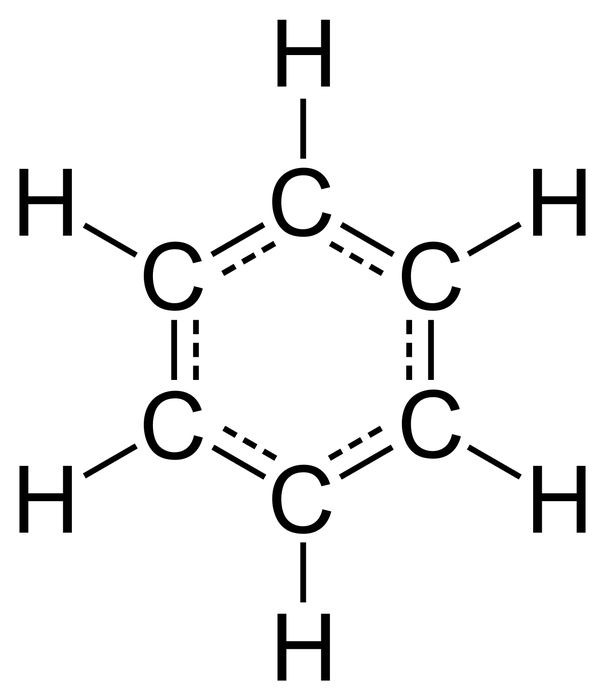
Structural formula of benzene.
Credit: Jynto / Wikimedia Commons

License: Public domain
Rendered from SVG to PNG, whitespace trimmed and placed on white
What it is
Benzene (CAS 71-43-2) is a colourless or light-yellow liquid at room temperature. [1,6] It is made by both natural and human processes; crude oil is the main source, and volcanoes and forest fires also release it. [1]
What it does and why it is used
It is used mainly as a solvent in the chemical and pharmaceutical industries, as a starting material for making many other chemicals, and in gasoline. [1]
Regulatory status and health context
Canada
Canada's Toys Regulations say a toy must not contain benzene if it could become accessible to a child or be released if the toy breaks or leaks. [3]
United States
NCI notes that US federal and state regulations have reduced workplace exposures in recent decades, and limits on benzene in gasoline have also reduced exposure. [1]
European Union
The EU air quality directive, as originally published in 2008, set an annual limit value of 5 µg/m³ for benzene in outdoor air, to be met by 1 January 2010. [4] Benzene is also on the EU cosmetics regulation's list of prohibited substances (Annex II), as originally published. [5] Later changes to these laws were not checked for this review.
Environmental notes
Benzene enters outdoor air from vehicle exhaust, gasoline fumes, industrial emissions and tobacco smoke, as well as from volcanoes and forest fires. [1] The sources used for this review do not assess its wider environmental effects, so we do not summarize them here.
Quick facts
- CAS: 71-43-2. [6]
- Where: gasoline fumes, exhaust, cigarette smoke and some solvents. [1,2]
- Main danger: leukemia and other blood disorders. [1,2]
- Most at risk: smokers and workers who handle benzene. [1]
Sources
All URLs were fetched on 2026-11-15, except the EU air quality directive and the EU cosmetics regulation: the EU law website was not fully available that day, so both were read from copies fetched for earlier Chemical Century articles in November 2026. Those copies are the texts as originally published, and later amendments or replacements were not checked. Source publication dates differ from this draft's review date.
- National Cancer Institute: Benzene.
- MedlinePlus: Benzene poisoning.
- Justice Laws Website: Toys Regulations (SOR/2011-17).
- EUR-Lex: Directive 2008/50/EC on ambient air quality and cleaner air for Europe, as originally published.
- EUR-Lex: Regulation (EC) No 1223/2009 on cosmetic products, as originally published.
- PubChem PUG REST: benzene synonyms.