
Fragrance and flavourCleaning and laundrySkin and personal careWater, air and residues
Synthetic musks (HHCB and AHTN): the lingering scent in laundry and perfume
CAS 1222-05-5.Also known as HHCB, AHTN, polycyclic musks, musk fragrance, musk ketone, and musk xylene.
Editorial draft Last reviewed 21 November 2026 About 675 words
CC INDEX
How it works36/100 Mild
Exposure to HHCB is widespread through scented products. Evidence of human harm is lacking and the US EPA's draft evaluation found no unreasonable risk; anti-oestrogen effects come from lab studies.
An editorial summary of this article’s cited evidence. It isn’t medical advice or a personal risk estimate.
Age index
What is the age index?Which age groups are more affected by this chemical’s possible health issues, based on this article’s sources.
- Pregnancy Unborn babies Not well studied
- Infants 0 to 1 Moderate
- Young children 1 to 5 Not well studied
- Children 6 to 12 Not well studied
- Teens 13 to 19 Not well studied
- Adults 20 to 64 Lower concern
- Older adults 65 and over Lower concern
- Infants (moderate): Present in breast milk; little toxicity data
- Breastfeeding remains recommended; the concern is a data gap, not demonstrated harm.

Illustration of laundry and fragrance. Synthetic musks give long-lasting scent to many products.
Credit: Chemical Century; AI-generated illustration
License: CC0 1.0
Illustration, not a photograph of a specific product. Resized and cropped for the web.
Synthetic musks are fragrance chemicals that give perfumes, detergents, air fresheners and cleaners their long-lasting clean scent. The most common, HHCB, is found in breast milk, and studies link higher levels to heavier use of perfume and scented laundry products. Laboratory studies show HHCB can block oestrogen signals, but evidence of harm in people is lacking, and in 2026 US regulators preliminarily found it does not pose an unreasonable risk. Choosing fragrance-free products is a simple way to cut exposure if you prefer.
Everyday exposure: where you meet it and how much
HHCB is mainly used as a synthetic musk in fragrances, including detergents, cleaners, air fresheners, perfumes, cosmetics and personal care products. People can be exposed through dust, mist or vapour while cleaning, doing laundry or using air fresheners, and HHCB reaches waterways when fragranced products go down the drain. [5] In US breast milk samples, HHCB was the most abundant synthetic musk, with a mean of 220 ng per gram of fat, about five times higher than levels reported a decade earlier in Germany and Denmark. [1]
Known and suspected harms
Evidence labels are editorial summaries, not individual risk predictions: established means recognized under the stated conditions; probable means a likely contribution with uncertainty; possible means limited evidence; disputed means assessors disagree.
- Established — transfer to breast milk, linked to scented products: in Swedish first-time mothers, those who used a lot of perfume during pregnancy had higher HHCB in their milk, and those who used perfumed laundry detergent had higher AHTN. The researchers said the lack of toxicity data makes it hard to judge safety for breastfed infants. [2]
- Possible — anti-oestrogen activity: in laboratory tests with human and trout oestrogen receptors, HHCB did not act like oestrogen but blocked oestrogen's effects, and it reduced an oestrogen-driven response in trout at doses found in fish from contaminated sites. [3]
In its 2026 draft risk evaluation, US EPA preliminarily determined that HHCB does not present an unreasonable risk to workers, consumers, the general population or the environment under the conditions of use it reviewed. The evaluation is not final. [4,5]
Reducing avoidable exposure
Choose fragrance-free detergents, cleaners and personal care products, use less perfume during pregnancy and breastfeeding if you wish, and ventilate when using air fresheners. [2,5]
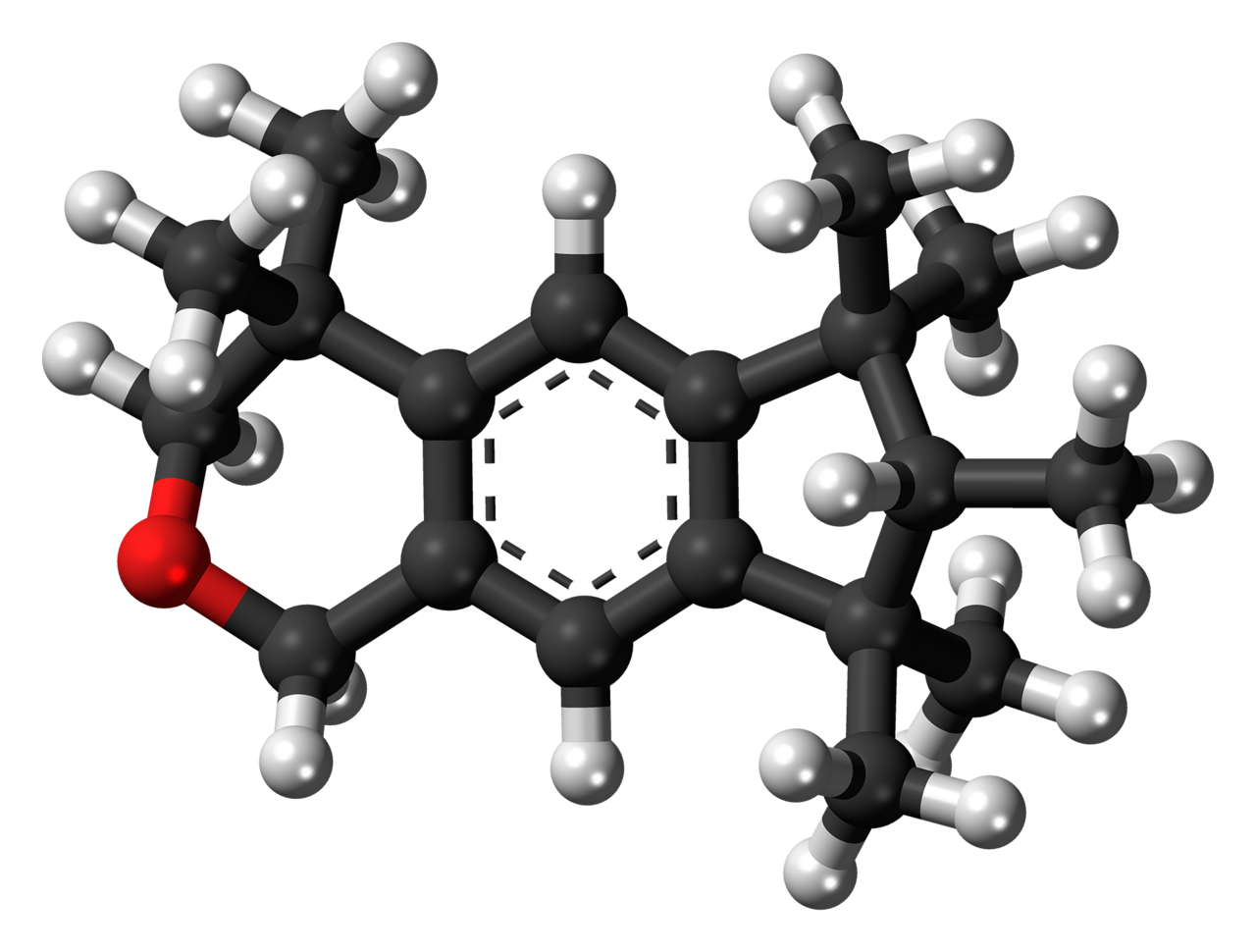
Ball-and-stick model of HHCB, a polycyclic musk.
Credit: Jynto / Wikimedia Commons

License: CC0
Wikimedia-provided scaled PNG/JPEG rendering; no content edits
What it is
HHCB and AHTN are polycyclic musks, ring-shaped fragrance molecules. Older nitro musks include musk xylene and musk ketone. [1]
What it does and why it is used
They provide a persistent musky scent in perfumes and household products. [1,5]
Regulatory status and health context
Canada
The sources used here do not cover Canadian rules for synthetic musks.
United States
EPA designated HHCB a high-priority substance in 2019 and released a draft risk evaluation in April 2026; a final evaluation is expected after a comment period ending 16 December 2026. [4,5]
European Union
The sources used here do not cover EU rules for synthetic musks.
Environmental notes
HHCB enters the environment mainly through wastewater, after fragrance products are washed down the drain. [5] Synthetic musks have been detected in sewage effluents, surface waters and fish. [3]
Quick facts
- CAS (HHCB): 1222-05-5. [5]
- Breast milk (US): mean HHCB 220 ng/g fat. [1]
- Main sources: perfume, scented detergents and cleaners. [2,5]
- US EPA draft: no unreasonable risk (not final). [4]
Sources
Sources were accessed on 2026-11-21. Source publication dates differ from this draft's review date. Image licences are listed with each image.
- Reiner JL et al. Synthetic musk fragrances in human milk from the United States. Environ Sci Technol, 2007 (PubMed).
- Lignell S et al. Temporal trends of synthetic musk compounds in mother's milk and associations with personal use of perfumed products. Environ Sci Technol, 2008 (PubMed).
- Simmons DB et al. Interaction of [HHCB] with the human and trout estrogen receptor-α. Sci Total Environ, 2010 (PubMed).
- US EPA: Risk evaluation for HHCB under TSCA.
- US EPA: HHCB risk evaluation, notice of data availability. Federal Register, 16 November 2026.