
Cleaning and laundrySkin and personal care
Benzisothiazolinone (BIT): the preservative behind a rise in detergent and paint allergies
CAS 2634-33-5.Also known as BIT, 1,2-benzisothiazol-3(2H)-one, 1,2-benzisothiazolin-3-one, and benzisothiazolone.
Editorial draft Last reviewed 21 November 2026 About 677 words
CC INDEX
How it works52/100 Moderate
Contact allergy to BIT is well documented and increasing as use shifts from other isothiazolinones. The harm is skin allergy, not systemic disease. The sources describe little product-specific regulation.
An editorial summary of this article’s cited evidence. It isn’t medical advice or a personal risk estimate.
Age index
What is the age index?Which age groups are more affected by this chemical’s possible health issues, based on this article’s sources.
- Pregnancy Unborn babies Not well studied
- Infants 0 to 1 Not well studied
- Young children 1 to 5 Not well studied
- Children 6 to 12 Not well studied
- Teens 13 to 19 Lower concern
- Adults 20 to 64 Moderate
- Older adults 65 and over Moderate
- Adults (moderate): Rising contact allergy; cleaners, detergents, paint
- Older adults (moderate): Rising contact allergy; cleaners, detergents, paint
- Allergy studies cover patients referred for patch testing, mostly adults.

Illustration of detergent and paint, two common sources of benzisothiazolinone.
Credit: Chemical Century; AI-generated illustration
License: CC0 1.0
Illustration, not a photograph of a specific product. Resized and cropped for the web.
Benzisothiazolinone, or BIT, is a preservative that stops bacteria and mould growing in water-based products such as dish soap, all-purpose cleaners, laundry liquids and paints. It is a relative of methylisothiazolinone, whose use in cosmetics was restricted after an allergy epidemic. Skin allergy to BIT is now rising: at one Danish clinic, positive patch tests climbed from 0.3% or less in 2014 to 5% in 2023. Household cleaners are the main everyday source, so people with hand eczema have the most to gain from checking labels.
Everyday exposure: where you meet it and how much
In a Swiss study combining people's product use with measured concentrations, the main sources of skin exposure to BIT were all-purpose cleaners, dishwashing detergent and kitchen cleaner. The study concluded that household cleaners are currently more important sources of isothiazolinone exposure than cosmetics. [2] BIT is also used in water-based paints: 16 of 19 Danish paints tested contained it, though BIT emissions into room air were around the limit of detection. [5]
Known and suspected harms
Evidence labels are editorial summaries, not individual risk predictions: established means recognized under the stated conditions; probable means a likely contribution with uncertainty; possible means limited evidence; disputed means assessors disagree.
- Established — allergic contact dermatitis, rising: among 6,435 patients patch tested at a Danish hospital, allergy to BIT rose from 0.3% or less in 2014 to 5.0% in 2023, while allergy to methylisothiazolinone fell after cosmetic restrictions. Painters, machine operators and assemblers were most often sensitised, and detergents and paints were the most common sources. [1]
- Established — allergy across regions: a meta-analysis of 115 studies with more than 1.5 million dermatitis patients found an overall BIT allergy rate of 2.09% and noted increasing use of BIT, calling for closer surveillance. [3]
- Probable — consumer sensitisation risk: a quantitative risk assessment estimated that around 1% of the Swiss population is at risk of becoming sensitised to BIT from cosmetics and household chemicals. [2]
BIT is less potent as a sensitiser than methylchloroisothiazolinone or methylisothiazolinone, but it is still frequently linked to allergy in consumers and workers. [4]
Reducing avoidable exposure
Wear gloves for washing dishes and cleaning, rinse hands after handling detergents or paint, and if you have unexplained hand or face eczema ask about patch testing. If you are allergic, read labels for "benzisothiazolinone" or "BIT." [1,2,4]
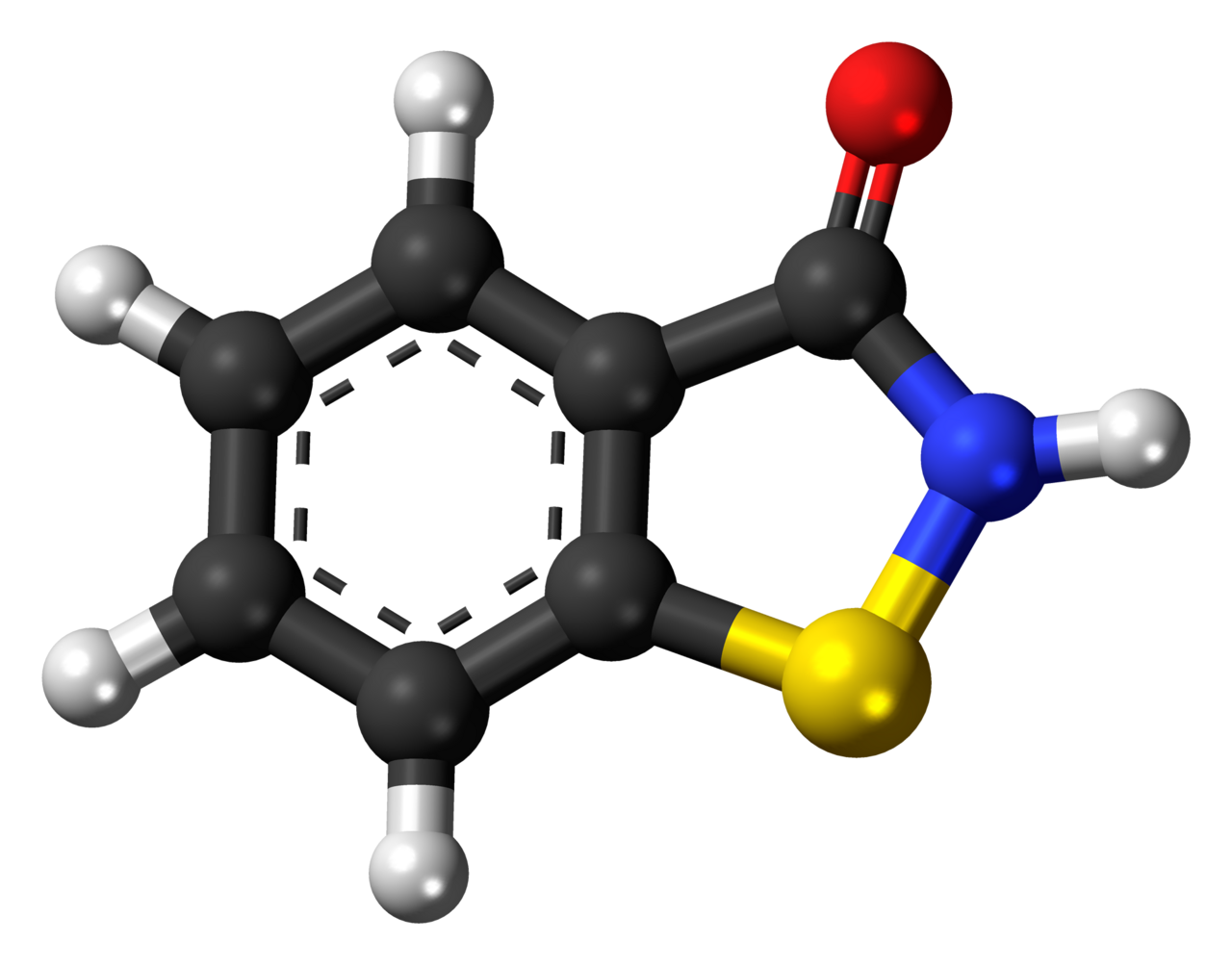
Ball-and-stick model of benzisothiazolinone (BIT).
Credit: Jynto / Wikimedia Commons

License: CC0
Wikimedia-provided scaled PNG/JPEG rendering; no content edits
What it is
BIT (CAS 2634-33-5) is 1,2-benzisothiazol-3(2H)-one, a member of the isothiazolinone family of preservatives. [2,4]
What it does and why it is used
It kills bacteria, fungi and algae, preventing spoilage in detergents, paints and industrial products. [4]
Regulatory status and health context
Canada
The sources used here do not cover Canadian rules for BIT.
United States
The sources used here do not cover US rules for BIT.
European Union
The sources used here describe restrictions on methylisothiazolinone in cosmetics but do not detail rules for BIT in household products. [1]
Environmental notes
The sources used here do not provide enough environmental data for a rating.
Quick facts
- CAS: 2634-33-5.
- Main sources: all-purpose cleaners, dish detergent, paints. [1,2]
- Allergy trend: ≤0.3% (2014) to 5.0% (2023) at one Danish clinic. [1]
- Meta-analysis allergy rate: 2.09%. [3]
Sources
Sources were accessed on 2026-11-21. Source publication dates differ from this draft's review date. Image licences are listed with each image.
- Søgaard R et al. Trends in contact allergy to preservatives from 2014 to 2023: benzisothiazolinone on the rise. Contact Dermatitis, 2025 (PubMed).
- Garcia-Hidalgo E et al. Aggregate consumer exposure to isothiazolinones via household care and personal care products: probabilistic modelling and benzisothiazolinone risk assessment. Environ Int, 2018 (PubMed).
- Isufi D et al. Prevalence of contact allergy to isothiazolinones in dermatitis patients from 2000 to 2025: a systematic review and meta-analysis. Contact Dermatitis, 2026 (PubMed).
- Aerts O et al. Contact allergy caused by isothiazolinone derivatives: an overview of non-cosmetic and unusual cosmetic sources. Eur J Dermatol, 2017 (PubMed).
- Lundov MD et al. Emission of isothiazolinones from water-based paints. Environ Sci Technol, 2014 (PubMed).