
Phenoxyethanol: is this paraben alternative safe for babies?
CAS 122-99-6.Also known as 2-phenoxyethanol, ethylene glycol monophenyl ether, phenoxetol, and 1-hydroxy-2-phenoxyethane.
Editorial draft Last reviewed 21 November 2026 About 645 words
CC INDEX
How it works44/100 Moderate
Phenoxyethanol is used very widely, but the EU's scientific committee found it safe at up to 1%, including for infants. France's medicines agency took a more cautious view for young children. Animal harms appeared only at high doses, and allergy is uncommon.
An editorial summary of this article’s cited evidence. It isn’t medical advice or a personal risk estimate.
Age index
What is the age index?Which age groups are more affected by this chemical’s possible health issues, based on this article’s sources.
- Pregnancy Unborn babies Not well studied
- Infants 0 to 1 Moderate
- Young children 1 to 5 Moderate
- Children 6 to 12 Lower concern
- Teens 13 to 19 Lower concern
- Adults 20 to 64 Lower concern
- Older adults 65 and over Lower concern
- Infants (moderate): Nappy-area products and wipes; France advises avoiding under age 3
- Young children (moderate): Higher dose per body weight from frequent use

Illustration of baby-care products. Phenoxyethanol is a common preservative in wipes and creams.
Credit: Chemical Century; AI-generated illustration
License: CC0 1.0
Illustration, not a photograph of a specific product. Resized and cropped for the web.
Phenoxyethanol is one of the most common preservatives in lotions, creams, baby wipes and other cosmetics. For most adults it causes no noticeable problems, and true skin allergy to it is uncommon. The questions are mostly about babies and toddlers, whose small bodies get a larger dose relative to their weight from wipes and creams used several times a day. European scientists judged it safe at up to 1%, while France's medicines agency recommended keeping it out of nappy-area products for children under three.
Everyday exposure: where you meet it and how much
Phenoxyethanol (2-phenoxyethanol) is used as a preservative in cosmetic products. In the EU it is authorised at a maximum concentration of 1.0%. [1] It is found in leave-on products such as lotions and creams; in one labelling study cited by EU scientists, 1,111 of 3,541 leave-on products contained it. [1] Babies can be exposed several times a day through wipes and creams.
Known and suspected harms
Evidence labels are editorial summaries, not individual risk predictions: established means recognized under the stated conditions; probable means a likely contribution with uncertainty; possible means limited evidence; disputed means assessors disagree.
- Disputed — safety margin for young children: in 2012, France's medicines agency (ANSM) concluded that the maximum concentration should be lowered to 0.4% in products for children under three and that phenoxyethanol should not be used in products for the nappy area. [1,3] The EU's Scientific Committee on Consumer Safety (SCCS) reviewed the evidence and concluded in 2016 that phenoxyethanol is safe as a preservative at up to 1.0%, and that its safety margin also covers infants and babies. [1,2]
- Possible — effects at high doses in animals: in animal studies reviewed by the SCCS, high oral doses caused haemolytic anaemia (destruction of red blood cells) in rabbits, with effects on the kidneys and spleen; at lower doses these effects were absent or slight. [1]
- Established — skin allergy, uncommon: the SCCS reported positive patch-test rates of 0 to 0.2% in people tested for allergies, and a few case reports of contact urticaria (hives). [1]
Reducing avoidable exposure
For babies and toddlers, especially in the nappy area, you can choose products without phenoxyethanol or use plain water and a soft cloth for some changes. Stop using any product that causes a rash. These are precautionary steps, not responses to a proven harm at permitted levels. [1,3,4]
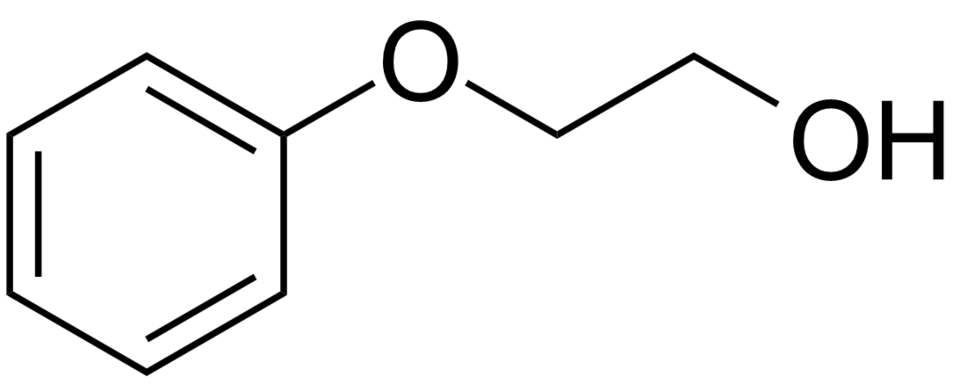
Structural formula of 2-phenoxyethanol.
Credit: created by User:Edgar181 / Wikimedia Commons

License: Public domain
Wikimedia-provided scaled PNG/JPEG rendering; no content edits
What it is
Phenoxyethanol (CAS 122-99-6) is a glycol ether: a benzene ring linked by an oxygen atom to a short alcohol chain. [1]
What it does and why it is used
It stops bacteria from growing in water-containing cosmetics, extending shelf life. [1]
Regulatory status and health context
Canada
The sources used here do not show a specific Canadian limit for phenoxyethanol in cosmetics.
United States
The sources used here do not show a US concentration limit for phenoxyethanol in cosmetics.
European Union
Phenoxyethanol is regulated in Annex V (entry 29) of the EU Cosmetics Regulation, with a maximum of 1.0%. The SCCS confirmed this level as safe in 2016. [1,2]
Environmental notes
The sources used here do not provide enough environmental data for a rating.
Quick facts
- CAS: 122-99-6. [1]
- Use: preservative in lotions, creams and other cosmetics. [1]
- EU limit: 1.0%, judged safe by the SCCS in 2016. [1]
- France (ANSM): recommended 0.4% for children under three and no use in nappy-area products. [1,3]
- Allergy: uncommon. [1]
Sources
Sources were accessed on 2026-11-21. Source publication dates differ from this draft's review date. Image licences are listed with each image.
- European Commission, Scientific Committee on Consumer Safety: Opinion on phenoxyethanol, SCCS/1575/16 (PDF).
- European Commission: Phenoxyethanol, SCCS opinion summary.
- ANSM (France): Evaluation of the risk related to the use of phenoxyethanol in cosmetic products (PDF, French).
- FDA: Allergens in cosmetics.