
Fragrance and flavourSkin and personal care
Diethyl phthalate (DEP): what's hiding behind “fragrance” on the label?
CAS 84-66-2.Also known as DEP, ethyl phthalate, diethyl 1,2-benzenedicarboxylate, phthalic acid diethyl ester, and monoethyl phthalate (MEP, its breakdown product).
Editorial draft Last reviewed 21 November 2026 About 772 words
CC INDEX
How it works38/100 Mild
DEP is the phthalate still commonly used in cosmetics, so everyday skin and inhalation exposure is frequent. ATSDR's summary shows low toxicity in animals and no cancer in rat skin studies, and human evidence on hormones is mixed. It is not banned in cosmetics in the sources reviewed.
An editorial summary of this article’s cited evidence. It isn’t medical advice or a personal risk estimate.
Age index
What is the age index?Which age groups are more affected by this chemical’s possible health issues, based on this article’s sources.
- Pregnancy Unborn babies Moderate
- Infants 0 to 1 Not well studied
- Young children 1 to 5 Not well studied
- Children 6 to 12 Not well studied
- Teens 13 to 19 Not well studied
- Adults 20 to 64 Lower concern
- Older adults 65 and over Not well studied
- Pregnancy (moderate): Observational studies of phthalates in pregnancy; evidence mixed

Illustration of scented products. A fragrance ingredient may be listed simply as “fragrance” or “parfum.”
Credit: Chemical Century; AI-generated illustration
License: CC0 1.0
Illustration, not a photograph of a specific product. Resized and cropped for the web.
That pleasant scent from a lotion, perfume, scented candle or air freshener often comes with a helper ingredient you will never see named: diethyl phthalate, used to make fragrances last longer. Because it is usually listed only as “fragrance” or “parfum,” it is hard for shoppers to know when they are using it. In animals it is far less toxic than some other phthalates, and studies in people have produced mixed results, so this is not a reason for alarm. Still, people who want to lower their exposure, especially during pregnancy, can do so easily by choosing fragrance-free products.
Everyday exposure: where you meet it and how much
FDA reports that diethyl phthalate is used as a solvent and fixative in fragrances and, based on its 2010 survey, appears to be the only phthalate still commonly used in cosmetics. [1] FDA also explains that fragrance ingredients can be listed collectively as "fragrance" on US cosmetic labels, so DEP is usually not named. [2]
Exposure is very common. In a 2019–2020 study of 600 teenagers and young adults in Czechia, monoethyl phthalate (MEP), the breakdown product of DEP, was found in the urine of more than 99% of participants, and levels varied with lifestyle factors and personal care product use. [4]
Known and suspected harms
Evidence labels are editorial summaries, not individual risk predictions: established means recognized under the stated conditions; probable means a likely contribution with uncertainty; possible means limited evidence; disputed means assessors disagree.
- Possible — mild irritation: ATSDR notes DEP can be mildly irritating to animal skin and slightly irritating to animal eyes. [3]
- Disputed — hormone and developmental effects: phthalates as a group are studied as possible hormone disruptors, and some observational studies in people report associations with MEP. Results are inconsistent, and DEP behaves differently from phthalates such as DEHP that are clearly linked to male reproductive effects in animals. [1,3]
- Not established — cancer: ATSDR reports that DEP placed on rat skin daily for two years did not cause cancer. Liver tumours were seen in mice, a common tumour type in mice, and DEP has not been classified as a human carcinogen. [3]
FDA states that, based on currently available safety information, it does not have safety concerns with DEP as currently used in cosmetics and fragrances, and suggests that people who want to avoid DEP choose products without "fragrance" or "flavor" in the ingredient list. [1]
Reducing avoidable exposure
Choose products labelled "fragrance-free" (FDA notes that even some "unscented" products contain a little masking fragrance), use fewer scented products such as plug-in air fresheners and candles, and ventilate rooms. These steps also reduce exposure to fragrance allergens. [2,4]
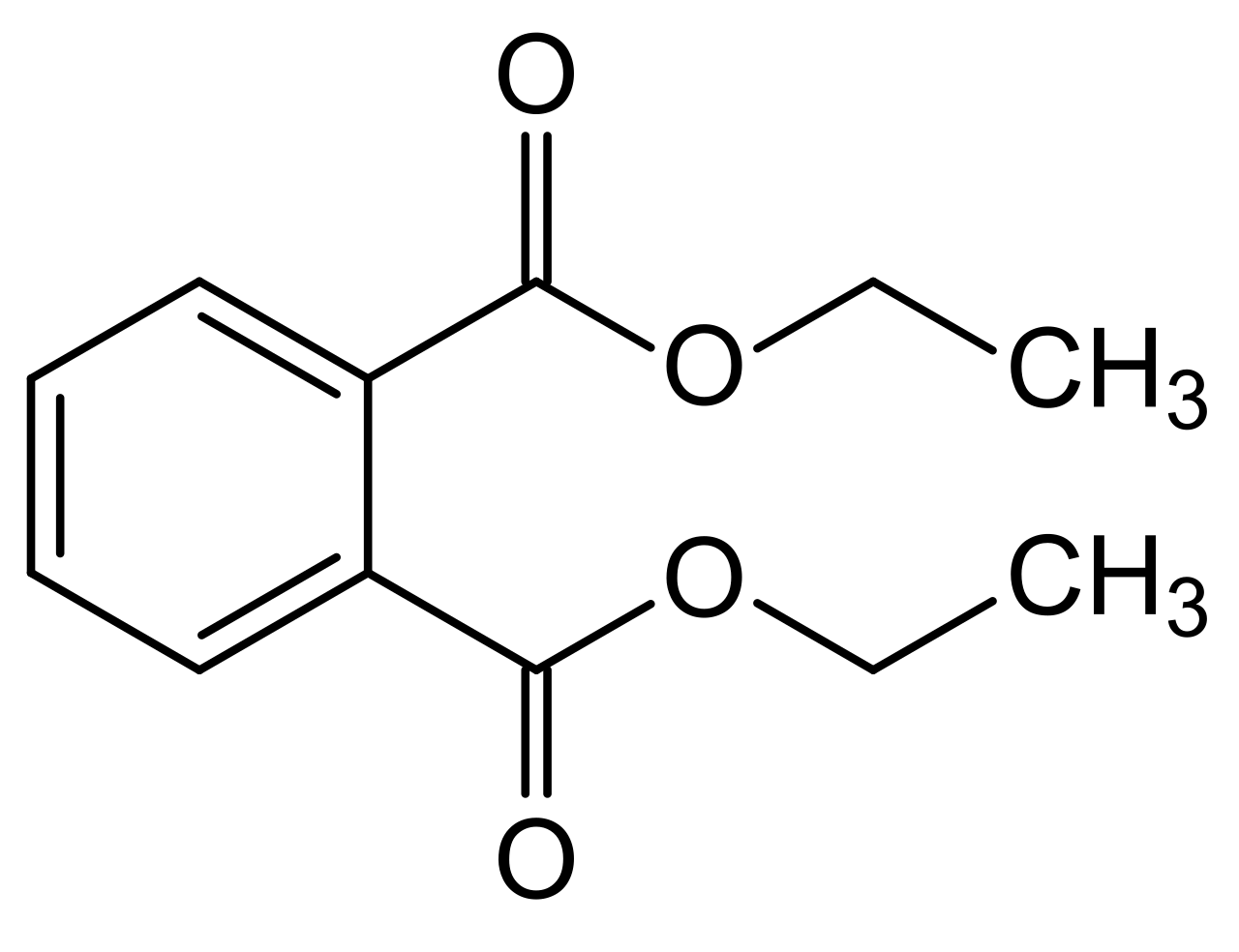
Structural formula of diethyl phthalate.
Credit: Dschanz (talk) / Wikimedia Commons

License: Public domain
Wikimedia-provided scaled PNG/JPEG rendering; no content edits
What it is
Diethyl phthalate (CAS 84-66-2) is a colourless, oily liquid made from phthalic acid and ethanol. In the body it breaks down to monoethyl phthalate (MEP), which is what urine tests measure. [3]
What it does and why it is used
DEP is used as a solvent and fixative in fragrances. ATSDR notes it is also used to make plastics more flexible, in products such as toothbrushes, tools, toys and food packaging, and in insecticides. [1,3]
Regulatory status and health context
Canada
Health Canada's Cosmetic Ingredient Hotlist lists prohibited and restricted ingredients. DEP was not identified as prohibited in the version consulted for this article. [5]
United States
FDA regulates cosmetics but allows fragrance ingredients to be listed as "fragrance." FDA says DEP is the phthalate still commonly used in cosmetics and that it does not have safety concerns with DEP as currently used. [1,2]
European Union
The sources used here do not cover EU-specific rules for DEP in cosmetics.
Environmental notes
ATSDR notes that DEP is found at waste sites and landfills from discarded plastics, is broken down by microorganisms in soil and water, and can build up in small amounts in fish and shellfish. [3]
Quick facts
- CAS: 84-66-2. [3]
- Main use: fragrance solvent and fixative in cosmetics; also plastics and other products. [1,3]
- Label clue: usually hidden under "fragrance" or "parfum." [2]
- Cancer: not established; rat skin studies negative. [3]
- Uncertainty: hormone effects in people are disputed. [1,3]
Sources
Sources were accessed on 2026-11-21. Source publication dates differ from this draft's review date. Image licences are listed with each image.
- FDA: Phthalates in cosmetics.
- FDA: Fragrances in cosmetics.
- ATSDR (CDC): ToxFAQs for diethyl phthalate.
- Stuchlík Fišerová P et al. Personal care product use and lifestyle affect phthalate and DINCH metabolite levels in teenagers and young adults. Environ Res, 2022 (PubMed).
- Health Canada: Cosmetic Ingredient Hotlist.