
Phosphoric acid (E338): what the acid in cola means for bones and kidneys
CAS 7664-38-2.Also known as E338, E 338, orthophosphoric acid, and phosphate additives.
Editorial draft Last reviewed 21 November 2026 About 665 words
CC INDEX
How it works52/100 Moderate
Phosphates are widespread in processed foods and drinks. EFSA set a group ADI that some children may exceed, and observational data link cola to lower bone density in older women; kidney patients are a clearly vulnerable group.
An editorial summary of this article’s cited evidence. It isn’t medical advice or a personal risk estimate.
Age index
What is the age index?Which age groups are more affected by this chemical’s possible health issues, based on this article’s sources.
- Pregnancy Unborn babies Not well studied
- Infants 0 to 1 Moderate
- Young children 1 to 5 Moderate
- Children 6 to 12 Moderate
- Teens 13 to 19 Moderate
- Adults 20 to 64 Lower concern
- Older adults 65 and over Moderate
- Infants (moderate): EFSA: average intake may exceed the phosphate ADI
- Young children (moderate): EFSA: average intake may exceed the phosphate ADI
- Children (moderate): EFSA: average intake may exceed the phosphate ADI
- Teens (moderate): High-phosphate diets may exceed the ADI
- Older adults (moderate): Cola linked to lower hip bone density in older women
- The phosphate ADI does not apply to people with moderate to severe kidney impairment, who are more vulnerable at any age.

Illustration of cola and milk. Phosphoric acid is the main acid in colas.
Credit: Chemical Century; AI-generated illustration
License: CC0 1.0
Illustration, not a photograph of a specific product. Resized and cropped for the web.
Phosphoric acid gives cola its sharp tang, and related phosphate additives turn up in processed meats, cheese, baked goods and many ready meals. For most people the amount in food is safe, but European assessors found that total phosphate intake, from natural foods and additives combined, can exceed their safe daily level in children and heavy consumers. Older women who drank cola daily had slightly lower hip bone density in one large study. People with reduced kidney function are the group for whom extra phosphate matters most.
Everyday exposure: where you meet it and how much
Phosphoric acid and phosphate salts are authorised food additives in the EU and are added to many foods for functions such as acidity control and emulsifying. [2,3] EFSA estimated that additives contribute roughly 6% to 30% of average total phosphorus intake. EFSA's whole-diet estimates, based mainly on analytical data, ranged from 251 mg phosphorus a day in infants to 1,625 mg in adults. [2,3]
Known and suspected harms
Evidence labels are editorial summaries, not individual risk predictions: established means recognized under the stated conditions; probable means a likely contribution with uncertainty; possible means limited evidence; disputed means assessors disagree.
- Established — intake may exceed the safe level: EFSA set a group acceptable daily intake (ADI) of 40 mg phosphorus per kg body weight per day, about 2.8 g a day for a 70 kg adult. Estimated intake exceeded it for infants, toddlers and children at average consumption, and for adolescents with high-phosphate diets. Phosphate food supplements could also exceed it. [2,3]
- Established — kidney impairment: EFSA says the ADI does not apply to people with moderate to severe reduction in kidney function, because of the recognised effect of high phosphate intake on the kidney. [3]
- Possible — bone density: in 1,413 women and 1,125 men, cola intake was associated with lower hip bone mineral density in women but not men. Daily cola drinkers had 3.7% lower density at the femoral neck than those drinking less than one serving a month. Other fizzy drinks showed no link. This is observational and cannot prove that phosphoric acid is the cause. [4]
EFSA found phosphates of low acute toxicity, with no genotoxicity or cancer concern. [2]
Reducing avoidable exposure
Drinking fewer colas and eating fewer heavily processed foods lowers phosphate additive intake. People with kidney disease should follow their care team's advice on phosphate. [2,3,4]
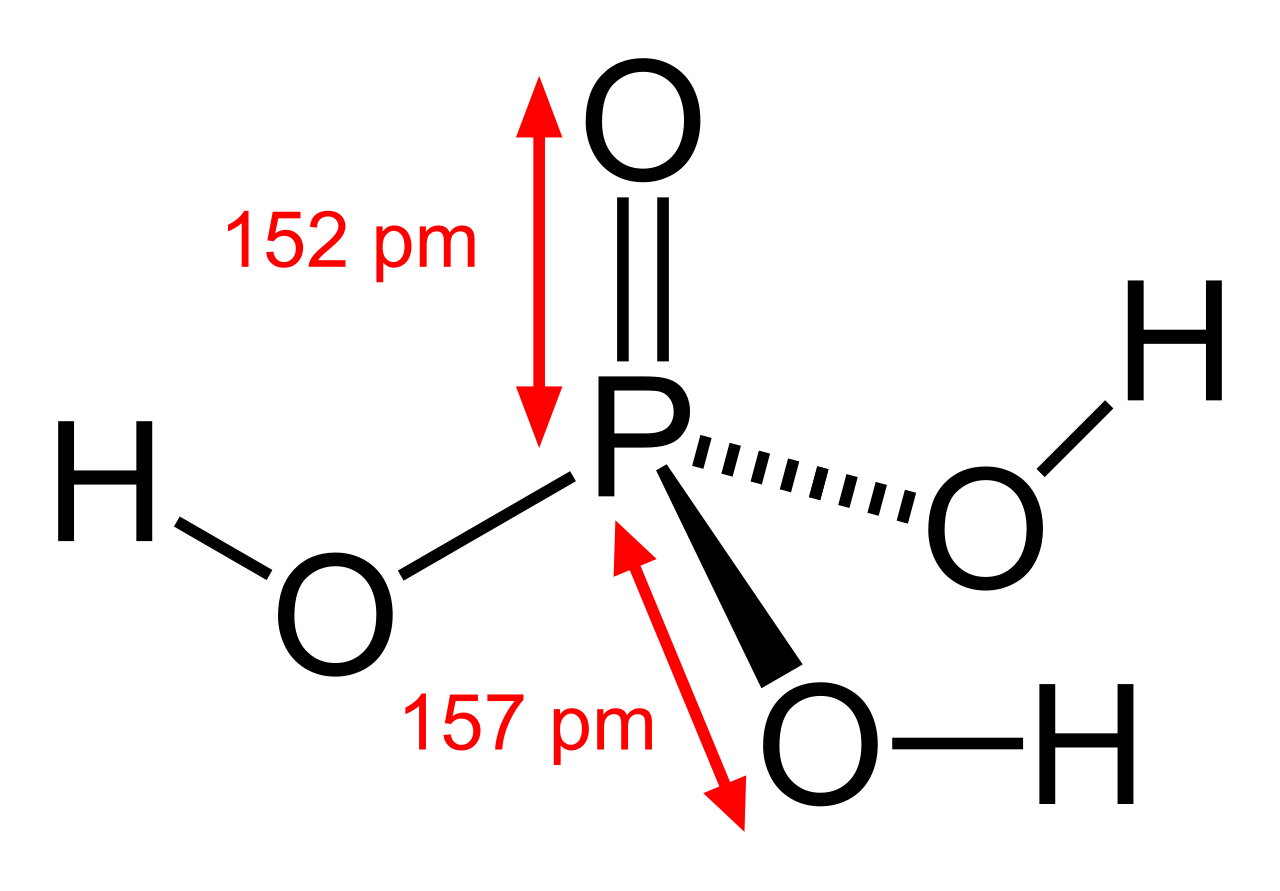
Structure of phosphoric acid with bond dimensions.
Credit: Unknown / Wikimedia Commons

License: Public domain
Wikimedia-provided scaled PNG/JPEG rendering; no content edits
What it is
Phosphoric acid (H3PO4) is a mineral acid; its salts are the phosphates. [1,2]
What it does and why it is used
It acidifies and flavours drinks, and phosphate salts help with texture, moisture and emulsifying in processed foods. [2,3]
Regulatory status and health context
International
The sources used here do not include a separate international (WHO/JECFA) evaluation.
United States
Phosphoric acid is GRAS when used under good manufacturing practice. [1]
European Union
E 338 and related phosphates are authorised. EFSA set a group ADI of 40 mg phosphorus/kg body weight per day in 2019 and recommended maximum levels for phosphates in food supplements. [2,3]
Environmental notes
The sources used here do not provide enough environmental data for a rating.
Quick facts
- CAS: 7664-38-2.
- E number: E 338. [2]
- EU group ADI: 40 mg phosphorus/kg body weight per day. [2]
- Additives' share of phosphorus intake: about 6–30%. [3]
- Most vulnerable: people with kidney impairment. [3]
Planning meals around fewer additives? See also The Low-Additive Family Meal Plan, a printable 7-day plan with recipes and a grocery list ($4 USD).
Sources
Sources were accessed on 2026-11-21. Source publication dates differ from this draft's review date. Image licences are listed with each image.
- eCFR: 21 CFR 182.1073, phosphoric acid.
- EFSA FAF Panel. Re-evaluation of phosphoric acid–phosphates – di-, tri- and polyphosphates (E 338–341, E 343, E 450–452) as food additives. EFSA Journal, 2019 (PubMed).
- EFSA: EFSA issues new advice on phosphates, 2019.
- Tucker KL et al. Colas, but not other carbonated beverages, are associated with low bone mineral density in older women: the Framingham Osteoporosis Study. Am J Clin Nutr, 2006 (PubMed).