
Citric acid (E330): the sour additive in drinks, sweets and jars
CAS 77-92-9.Also known as E330, E 330, 2-hydroxy-1,2,3-propanetricarboxylic acid, sour salt, and manufactured citric acid.
Editorial draft Last reviewed 21 November 2026 About 624 words
CC INDEX
How it works32/100 Mild
Citric acid is one of the most widely used additives, so exposure is high, but regulators allow it without numerical limits. The main documented downside is the acidity of frequent drinks; reports of reactions to the manufactured form come from a handful of uncontrolled cases.
An editorial summary of this article’s cited evidence. It isn’t medical advice or a personal risk estimate.
Age index
What is the age index?Which age groups are more affected by this chemical’s possible health issues, based on this article’s sources.
- Pregnancy Unborn babies Not well studied
- Infants 0 to 1 Not well studied
- Young children 1 to 5 Not well studied
- Children 6 to 12 Lower concern
- Teens 13 to 19 Lower concern
- Adults 20 to 64 Lower concern
- Older adults 65 and over Not well studied
- The sources used here do not rate any age group differently; tooth erosion depends on how often acidic drinks are consumed.

Illustration of lemonade, lemons and jam. Citric acid gives sourness and helps preserve many foods.
Credit: Chemical Century; AI-generated illustration
License: CC0 1.0
Illustration, not a photograph of a specific product. Resized and cropped for the web.
Citric acid is the sharp, sour taste of lemons, and a manufactured version of it is one of the most common ingredients on food labels, from fizzy drinks and sweets to jams, sauces and canned foods. Regulators treat it as safe for general use. The everyday concern is not poisoning but teeth: frequent sipping of acidic drinks is linked to tooth erosion over time. A small case series has also suggested that some people react to the manufactured form, but that idea has not been tested in controlled studies.
Everyday exposure: where you meet it and how much
Citric acid occurs naturally in plant and animal tissues and can be recovered from juices such as lemon or pineapple, but most food-grade citric acid is made by fermentation, including with the mould Aspergillus niger. [1,3] A case-series paper estimated that about 2.3 million tonnes of manufactured citric acid were produced in 2016, roughly 70% of it for food and drink. [3] In the EU it appears on labels as E 330. [2]
Known and suspected harms
Evidence labels are editorial summaries, not individual risk predictions: established means recognized under the stated conditions; probable means a likely contribution with uncertainty; possible means limited evidence; disputed means assessors disagree.
- Probable — dental erosion from frequent acidic drinks: a review notes that frequent consumption of acidic beverages is related to excessive tooth wear (dental erosion). Citric acid is one of the acids involved, though erosion depends on the whole drink and drinking habits, not on one ingredient. [4]
- Possible — reactions to manufactured citric acid: four patients described repeated respiratory, joint, bowel and muscle symptoms after foods, drinks or vitamins containing manufactured citric acid. The authors suggested a reaction linked to its mould-based production and called for studies. Four uncontrolled case reports cannot show cause and effect. [3]
US regulations recognise citric acid as safe (GRAS) for food use with no limit other than good manufacturing practice. [1]
Reducing avoidable exposure
To protect teeth, limit how often you sip sour or fizzy drinks between meals. People who suspect a reaction should keep a food diary and talk to a clinician rather than self-diagnose. [3,4]
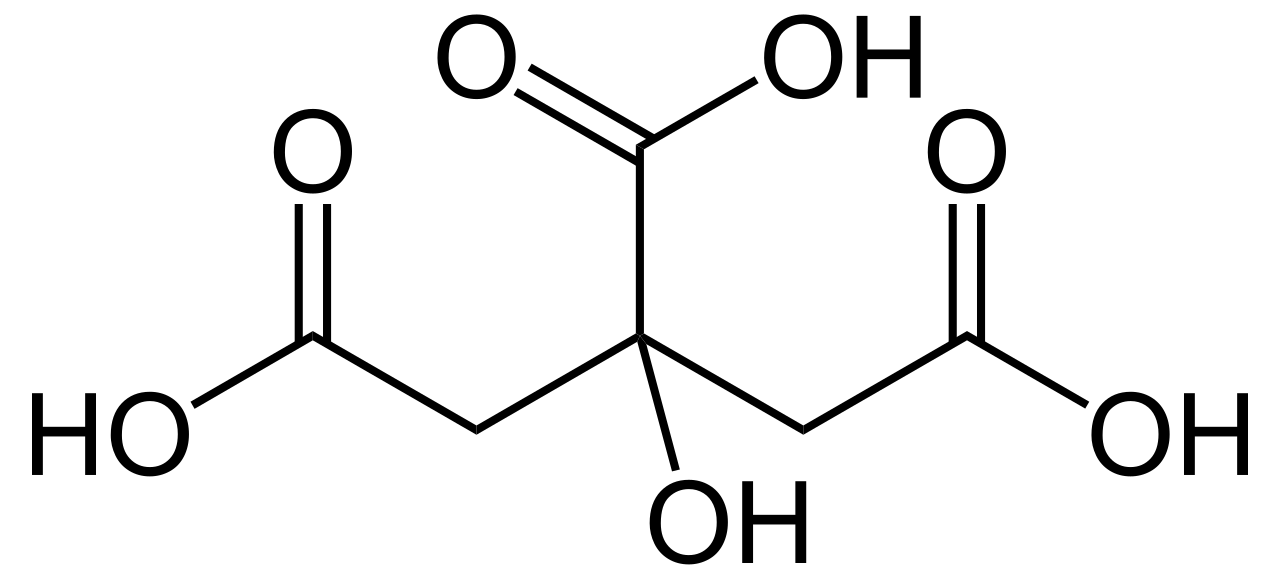
Skeletal formula of citric acid.
Credit: NEUROtiker / Wikimedia Commons

License: Public domain
Wikimedia-provided scaled PNG/JPEG rendering; no content edits
What it is
Citric acid (2-hydroxy-1,2,3-propanetricarboxylic acid) is a small organic acid that occurs as colourless crystals or a white powder. [1]
What it does and why it is used
It adds sourness, controls acidity and helps stabilise and preserve foods and drinks. [1,2]
Regulatory status and health context
International
The sources used here do not include a separate international (WHO/JECFA) evaluation.
United States
FDA affirms citric acid as generally recognized as safe, used with no limitation other than current good manufacturing practice. [1]
European Union
Citric acid is an authorised food additive, E 330, in the EU Union list. [2]
Environmental notes
The sources used here do not provide enough environmental data for a rating.
Quick facts
- CAS: 77-92-9.
- E number: E 330. [2]
- Made by: mostly fermentation, including with Aspergillus niger. [1,3]
- US status: GRAS. [1]
- Open question: whether manufactured citric acid triggers reactions in some people. [3]
Sources
Sources were accessed on 2026-11-21. Source publication dates differ from this draft's review date. Image licences are listed with each image.
- eCFR: 21 CFR 184.1033, citric acid.
- European Union: Regulation (EC) No 1333/2008 on food additives, consolidated text with the Union list (EUR-Lex).
- Sweis IE, Cressey BC. Potential role of the common food additive manufactured citric acid in eliciting significant inflammatory reactions contributing to serious disease states: a series of four case reports. Toxicol Rep, 2018 (PubMed).
- Stefański T, Postek-Stefańska L. Possible ways of reducing dental erosive potential of acidic beverages. Aust Dent J, 2014 (PubMed).