
Food and drinkMedicines and healthWater, air and residues
Nitrosamines (NDMA): cancer-linked impurities in food, water and medicines
Also known as NDMA, N-nitrosodimethylamine, NDEA, N-nitrosodiethylamine, N-nitroso compounds, and nitrosamine impurities.
Editorial draft Last reviewed 21 November 2026 About 700 words
CC INDEX
How it works81/100 Very high
Several nitrosamines are potent animal carcinogens and NDMA is a probable human carcinogen. Exposure comes from food, water and some medicines, EFSA judged dietary levels a health concern, and regulators set strict limits for water, medicines and baby teats.
An editorial summary of this article’s cited evidence. It isn’t medical advice or a personal risk estimate.
Age index
What is the age index?Which age groups are more affected by this chemical’s possible health issues, based on this article’s sources.
- Pregnancy Unborn babies Not well studied
- Infants 0 to 1 Moderate
- Young children 1 to 5 Moderate
- Children 6 to 12 Moderate
- Teens 13 to 19 Moderate
- Adults 20 to 64 Moderate
- Older adults 65 and over Moderate
- Infants (moderate): EU limits nitrosamines from rubber teats and soothers
- Young children (moderate): EFSA: dietary levels a health concern for all age groups
- Adults (moderate): Diet, water and some medicine impurities

Illustration of nitrosamine sources: cured and grilled meats, water and some medicines.
Credit: Chemical Century; AI-generated illustration
License: CC0 1.0
Illustration, not a photograph of a specific product. Resized and cropped for the web.
Nitrosamines are a family of chemicals that form when nitrites react with amines, and they show up in cured and grilled meats, some water supplies, rubber products and, in recent years, certain medicines. Several, including NDMA, cause cancer in animals and are classed as probable human carcinogens. Nobody can avoid them entirely, and the risk comes from long-term exposure above acceptable levels, not from occasional contact. Impurities found in some blood pressure, diabetes and heartburn medicines brought nitrosamines into the news, but FDA advises people not to stop prescription drugs without talking to a health professional.
Everyday exposure: where you meet it and how much
FDA states that nitrosamines are common in water and foods, including cured and grilled meats, dairy products and vegetables, and that everyone is exposed to some level. [1] In drinking water, NDMA can form as a by-product of disinfection with chlorine or chloramine. [4] Rubber teats and soothers can release nitrosamines, which led the EU to limit them. [5] Nitrosamine impurities have also been found in some medicines, including certain angiotensin receptor blockers (such as valsartan and losartan), metformin, ranitidine, rifampin and varenicline. [1]
Known and suspected harms
Evidence labels are editorial summaries, not individual risk predictions: established means recognized under the stated conditions; probable means a likely contribution with uncertainty; possible means limited evidence; disputed means assessors disagree.
- Established classification — cancer: IARC classifies NDMA as probably carcinogenic to humans (Group 2A). [2] Health Canada bases its drinking water limit for NDMA on liver cancer and considers it a probable human carcinogen. [4]
- Established regulatory concern — dietary levels: in 2023, the European Food Safety Authority concluded that the levels of nitrosamines in food raise a health concern for all age groups in the EU. [3]
- Established — risk from medicine impurities depends on dose and duration: FDA says nitrosamine impurities may increase cancer risk if people are exposed above acceptable levels over long periods, but taking a drug at or below the acceptable daily intake every day for 70 years is not expected to increase cancer risk. Drugs above the limits are recalled. [1]
Reducing avoidable exposure
Do not stop a prescription medicine because of nitrosamine concerns; FDA advises talking to your health professional about options. Eating less cured and grilled meat is one way to reduce dietary exposure. If your water comes from a public system, your supplier can tell you whether NDMA is monitored. [1,3,4]
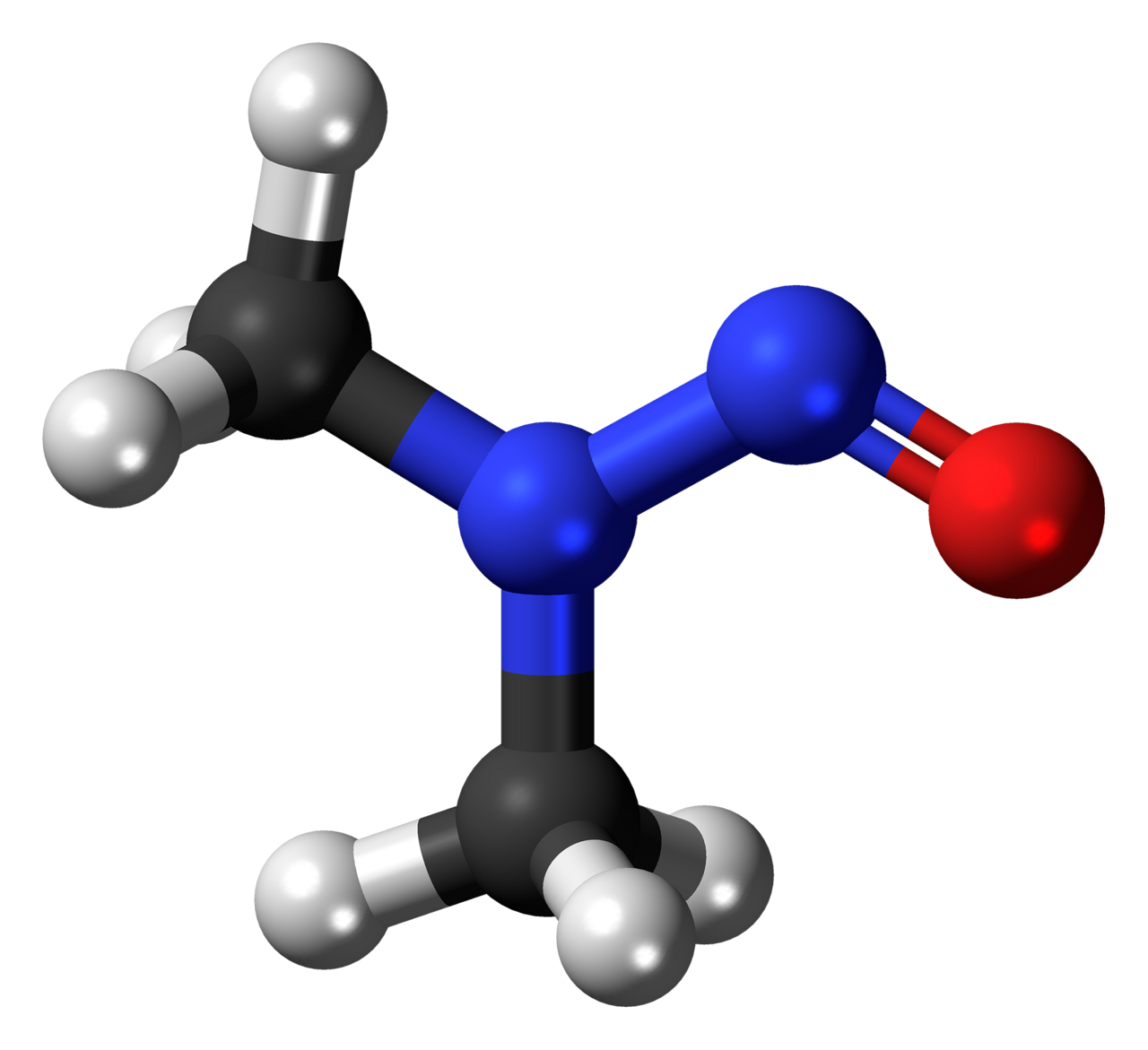
Ball-and-stick model of N-nitrosodimethylamine (NDMA).
Credit: Jynto (talk) / Wikimedia Commons

License: CC0
Wikimedia-provided scaled PNG/JPEG rendering; no content edits
What it is
Nitrosamines are compounds with a nitroso group (N=O) bonded to an amine nitrogen. NDMA (CAS 62-75-9) is the simplest and most studied. [2,4]
What it does and why it is used
Nitrosamines have no intended use in food, water or medicines. They form as by-products when nitrites or other nitrosating agents react with amines, for example during meat curing, water treatment, rubber manufacture or drug manufacturing. [1,3,4,5]
Regulatory status and health context
Canada
Health Canada's maximum acceptable concentration for NDMA in drinking water is 0.00004 mg/L (40 ng/L). [4]
United States
FDA has set acceptable daily intake limits for nitrosamines in medicines, together with international regulators, and issued revised guidance for drug manufacturers in September 2024. [1]
European Union
Directive 93/11/EEC limits the release of nitrosamines from rubber teats and soothers to below detectable levels (0.01 mg/kg). EFSA judged dietary nitrosamine levels a health concern in 2023. [3,5]
Environmental notes
The sources used here do not provide an environmental rating.
Quick facts
- Best known: NDMA (CAS 62-75-9). [2]
- Sources: cured and grilled meats, water, rubber, some medicine impurities. [1,4,5]
- IARC: NDMA Group 2A, probably carcinogenic to humans. [2]
- Canada: 40 ng/L NDMA in drinking water. [4]
- Medicines: do not stop without medical advice. [1]
Sources
Sources were accessed on 2026-11-21. Source publication dates differ from this draft's review date. Image licences are listed with each image.
- FDA: Information about nitrosamine impurities in medications.
- IARC: List of classifications, Agents classified by the IARC Monographs.
- EFSA: Nitrosamines in food raise a health concern.
- Health Canada: Guidelines for Canadian Drinking Water Quality, summary tables.
- European Commission: Directive 93/11/EEC on N-nitrosamines released from elastomer or rubber teats and soothers (EUR-Lex).