
Skin and personal careCleaning and laundry
Diethanolamine (DEA): is it safe in shampoos, soaps and cleaners?
CAS 111-42-2.Also known as DEA, 2,2'-iminodiethanol, diolamine, cocamide DEA (related ingredient), and lauramide DEA (related ingredient).
Editorial draft Last reviewed 21 November 2026 About 684 words
CC INDEX
How it works44/100 Moderate
The NTP linked topical DEA to cancer in laboratory animals and IARC classifies it as possibly carcinogenic, but no human link has been established and use in cosmetics has fallen. Canada prohibits DEA in cosmetics because of nitrosamine formation.
An editorial summary of this article’s cited evidence. It isn’t medical advice or a personal risk estimate.
Age index
What is the age index?Which age groups are more affected by this chemical’s possible health issues, based on this article’s sources.
- Pregnancy Unborn babies Not well studied
- Infants 0 to 1 Not well studied
- Young children 1 to 5 Not well studied
- Children 6 to 12 Not well studied
- Teens 13 to 19 Not well studied
- Adults 20 to 64 Lower concern
- Older adults 65 and over Not well studied
- The sources do not identify an age group at special risk; concern rests on animal cancer findings and nitrosamine formation.

Illustration of foaming personal care products. DEA-related ingredients have been used as foaming agents and emulsifiers.
Credit: Chemical Century; AI-generated illustration
License: CC0 1.0
Illustration, not a photograph of a specific product. Resized and cropped for the web.
Diethanolamine and related ingredients help shampoos, body washes and some cleaners foam up and stay smooth. The concern is not foam but chemistry: in animal studies, DEA rubbed on the skin was linked to cancer, and DEA can react with other ingredients to form nitrosamines, a group of chemicals that cause cancer in animals. No study has shown that using these products causes cancer in people, and they are used much less than they once were. Canada does not allow DEA itself in cosmetics, and reading labels makes it easy to avoid.
Everyday exposure: where you meet it and how much
FDA explains that DEA and DEA-related ingredients act as emulsifiers or foaming agents in cosmetics, or adjust a product's acidity. Based on industry filings, FDA says they appear to be used much less often in cosmetics than when the key animal study was done in 1998. [1] Related ingredients on labels include names ending in "DEA," such as cocamide DEA. Exposure is mainly through the skin during washing.
Known and suspected harms
Evidence labels are editorial summaries, not individual risk predictions: established means recognized under the stated conditions; probable means a likely contribution with uncertainty; possible means limited evidence; disputed means assessors disagree.
- Possible — cancer, from animal studies: a 1998 National Toxicology Program (NTP) study found an association between applying DEA and certain DEA-related ingredients to the skin and cancer in laboratory animals. For the related ingredients, the effect was linked to leftover (residual) DEA. FDA notes the study did not establish a link to cancer in humans. [1]
- Established classification — IARC Group 2B: IARC lists diethanolamine as possibly carcinogenic to humans. This is a hazard classification, not a measure of risk from normal product use. [2]
- Possible — nitrosamine formation: DEA can react with nitrosating agents in a product to form N-nitrosodiethanolamine (NDELA), a nitrosamine. A Korean study of cosmetics found that the presence of DEA and triethanolamine significantly influenced nitrosamine formation. The levels it measured raised no apparent safety concern, but the authors advised keeping these amines and nitrosating agents as low as technically feasible. [3]
Reducing avoidable exposure
If you prefer to avoid DEA, read ingredient lists for "diethanolamine" and names ending in "DEA." Rinse-off products such as shampoo have shorter skin contact than leave-on products. These are precautionary choices, not steps proven to prevent disease. [1,3]
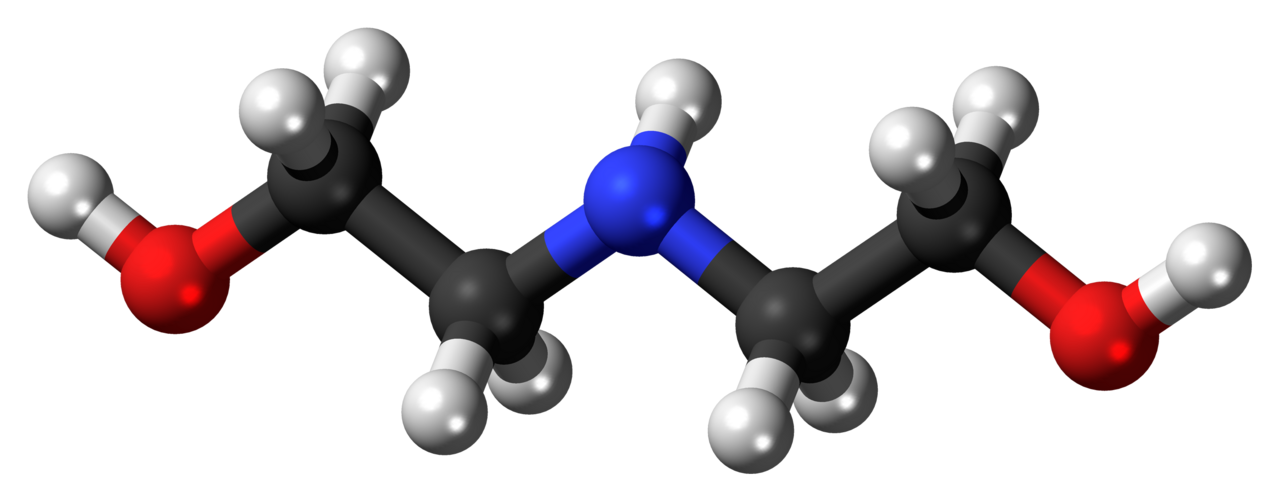
Ball-and-stick model of diethanolamine.
Credit: Jynto (talk) / Wikimedia Commons

License: CC0
Wikimedia-provided scaled PNG/JPEG rendering; no content edits
What it is
Diethanolamine (CAS 111-42-2) is an organic compound with one nitrogen atom joined to two short alcohol chains. It is a secondary amine, the type of amine that can form nitrosamines. [3,5]
What it does and why it is used
DEA and its derivatives make products foam, help oil and water mix, and adjust pH in cosmetics, soaps and cleaners. [1]
Regulatory status and health context
Canada
Health Canada's Cosmetic Ingredient Hotlist prohibits secondary alkyl- and alkanolamines and their salts, which covers DEA, because they can form nitrosamines. Some fatty-acid DEA derivatives are allowed under conditions. [4,5]
United States
FDA states that, apart from colour additives and prohibited or restricted ingredients, manufacturers may use any ingredient if the product is safe under labelled or customary use, and that DEA-related ingredients are now used less often. [1]
European Union
The sources used here do not cover EU-specific rules for DEA.
Environmental notes
The sources used here do not provide enough environmental data for a rating.
Quick facts
- CAS: 111-42-2. [5]
- Use: foaming agent, emulsifier and pH adjuster. [1]
- Animal finding: skin application linked to cancer in a 1998 NTP study (possible). [1]
- IARC: Group 2B, possibly carcinogenic to humans. [2]
- Canada: prohibited in cosmetics. [4]
Sources
Sources were accessed on 2026-11-21. Source publication dates differ from this draft's review date. Image licences are listed with each image.
- FDA: Diethanolamine.
- IARC: List of classifications, Agents classified by the IARC Monographs.
- Lim DS et al. Risk assessment of N-nitrosodiethylamine (NDEA) and N-nitrosodiethanolamine (NDELA) in cosmetics. J Toxicol Environ Health A, 2018 (PubMed).
- Health Canada: Cosmetic Ingredient Hotlist.
- Health Canada: Alkanolamines and fatty alkanolamides group, information sheet.