
Skin and personal careCleaning and laundryWater, air and residues
1,4-Dioxane: the trace contaminant in some shampoos and detergents
CAS 123-91-1.Also known as dioxane, p-dioxane, and diethylene dioxide.
Editorial draft Last reviewed 15 November 2026 About 699 words
CC INDEX
How it works46/100 Moderate
1,4-Dioxane causes cancer in animals and is considered a likely or reasonably anticipated human carcinogen, but human data are inadequate. Exposure is widespread at trace levels and generally far below animal-study doses. Water guidelines exist, so the score sits in the moderate band.
An editorial summary of this article’s cited evidence. It isn’t medical advice or a personal risk estimate.
Age index
What is the age index?Which age groups are more affected by this chemical’s possible health issues, based on this article’s sources.
- Pregnancy Unborn babies Not well studied
- Infants 0 to 1 Not well studied
- Young children 1 to 5 Moderate
- Children 6 to 12 Moderate
- Teens 13 to 19 Moderate
- Adults 20 to 64 Moderate
- Older adults 65 and over Moderate
- ATSDR says no data describe effects in children, though they would likely show the same effects as adults, and it is not known whether it can harm an unborn child. ATSDR suggests limiting children's exposure to products that may contain it.

Illustration of everyday cleaning and personal care products. 1,4-Dioxane can occur as a trace by-product in some of their ingredients.
Credit: Chemical Century; AI-generated illustration
License: CC0 1.0
Illustration, not a photograph of a specific product. Resized and cropped for the web.
1,4-Dioxane is not an ingredient anyone adds on purpose, but it can form in tiny amounts when some foaming and cleaning ingredients are made. That means traces may turn up in shampoos, body washes and detergents. It has caused cancer in laboratory animals, so regulators keep an eye on it, although the amounts found in products have dropped over the years. For most people, levels are likely far below those used in animal studies.
Everyday exposure: where you meet it and how much
1,4-Dioxane forms as a by-product when certain detergents, foaming agents, emulsifiers and solvents are made, so traces may occur in some cosmetics, detergents, shampoos and some pharmaceuticals. [1,2] These ingredients can often be identified on labels by names containing PEG, polyethylene, polyethylene glycol, polyoxyethylene, -eth- or -oxynol-. [1,2]
FDA surveys found an average of 50 ppm in finished cosmetics in 1981, and the number of products above 10 ppm declined through the 1990s. [1] People can also be exposed through contaminated air or tap water. [2]
Known and suspected harms
Evidence labels are editorial summaries, not individual risk predictions: established means recognized under the stated conditions; probable means a likely contribution with uncertainty; possible means limited evidence; disputed means assessors disagree. These labels do not describe how common an effect is.
- Probable — cancer: the US National Toxicology Program says it is reasonably anticipated to be a human carcinogen and EPA classifies it as likely carcinogenic, based on animal studies; human data are not adequate. [1] Rats and mice that drank it for most of their lives developed liver cancer. [2]
- Established — irritation and high doses: short-term exposure to low levels caused eye and nose irritation, and very high levels may cause severe kidney and liver effects and possibly death. [2]
- Established — low consumer exposure: ATSDR says the levels the general public meets are generally much lower than those used in animal studies, and an international regulators' group found reported cosmetic levels within acceptable margins. [1,2]
Reducing avoidable exposure and harm
If you want to avoid it, check ingredient lists for the name fragments listed above. [1,2] FDA notes that 1,4-dioxane evaporates readily, which further reduces the small amount available to be absorbed through skin. [1]
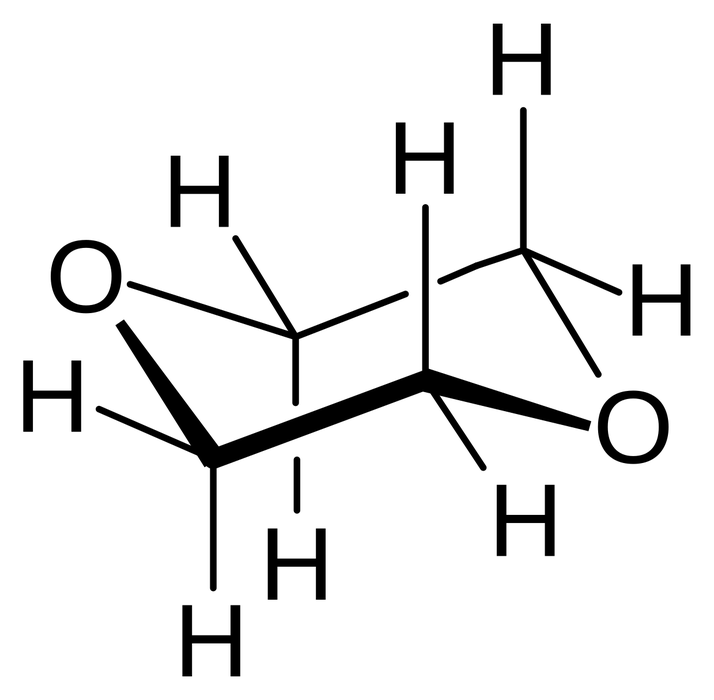
Structure of 1,4-dioxane in its chair form.
Credit: Dschanz / Wikimedia Commons

License: Public domain
Rendered from SVG to PNG, whitespace trimmed and placed on white
What it is
1,4-Dioxane (CAS 123-91-1) is a solvent and trace contaminant; it is not used as an ingredient in cosmetics. [1,2,4]
What it does and why it is used
It has no intended role in consumer products; it is an unintended by-product of making certain ingredients. [1]
Regulatory status and health context
Canada
Canada's drinking water guideline sets a maximum acceptable concentration of 0.050 mg/L, based on liver effects; Health Canada notes it is generally not detected in Canadian water supplies but has contaminated supplies near landfills and industrial sites. [3]
United States
FDA monitors 1,4-dioxane in cosmetics and says manufacturing changes have greatly lowered levels over time. [1]
European Union
FDA cites the European Commission's Scientific Committee on Consumer Safety, which concluded that trace levels of 10 ppm or less in cosmetics are safe. [1] The EU law website was not fully available when this article was reviewed, so EU legal status was not checked.
Environmental notes
1,4-Dioxane does not stick to soil, so it can move into groundwater, and it is stable in water. [2] In air it breaks down rapidly. [2]
Quick facts
- CAS: 123-91-1. [4]
- Where: traces in some shampoos, body washes and detergents; some contaminated water. [1,2,3]
- Main danger: cancer in animal studies. [1,2]
- Most at risk: people drinking contaminated water near industrial sites. [3]
Sources
All URLs were fetched on 2026-11-15; Health Canada pages were read with a separate web-reading tool because they did not respond to this review's direct requests. The EU law website was not fully available that day, so EU legislation could not be checked for this review. Source publication dates differ from this draft's review date.