
Trihalomethanes (THMs): what are chlorine by-products in tap water?
Also known as THMs, TTHM, total trihalomethanes, chloroform, bromodichloromethane, disinfection by-products, and DBPs.
Editorial draft Last reviewed 21 November 2026 About 690 words
CC INDEX
How it works74/100 High
THMs are present in most chlorinated tap water. Pooled studies link higher long-term levels to bladder cancer in men, and EPA cites liver, kidney and nervous system effects and cancer risk. Both Canada and the US set limits, and the benefits of disinfection are large.
An editorial summary of this article’s cited evidence. It isn’t medical advice or a personal risk estimate.
Age index
What is the age index?Which age groups are more affected by this chemical’s possible health issues, based on this article’s sources.
- Pregnancy Unborn babies Moderate
- Infants 0 to 1 Not well studied
- Young children 1 to 5 Not well studied
- Children 6 to 12 Not well studied
- Teens 13 to 19 Not well studied
- Adults 20 to 64 Moderate
- Older adults 65 and over Moderate
- Pregnancy (moderate): Small increase in small-for-gestational-age births in a meta-analysis
- Adults (moderate): Bladder cancer risk with decades of higher exposure (men)

Illustration of tap water at home. THMs can be swallowed, breathed in shower steam and absorbed through skin.
Credit: Chemical Century; AI-generated illustration
License: CC0 1.0
Illustration, not a photograph of a specific product. Resized and cropped for the web.
Chlorine keeps tap water free of germs that once caused deadly outbreaks, but it also reacts with natural plant matter in water to form trihalomethanes, a family of chemicals that includes chloroform. People take them in by drinking water and also by breathing steam and absorbing them through skin in long hot showers and baths. Decades of exposure at higher levels have been linked to bladder cancer in some studies, and drinking water limits exist in both Canada and the US. Disinfection is still essential, so the goal is keeping these by-products low, not avoiding treated water.
Everyday exposure: where you meet it and how much
Trihalomethanes (THMs) are by-products of drinking water disinfection. [2,3] They form when chlorine reacts with natural organic matter in water. Health Canada's guideline accounts for exposure from drinking water and also from breathing and skin contact while showering and bathing. [1] Your water supplier can tell you recent THM results for your system.
Known and suspected harms
Evidence labels are editorial summaries, not individual risk predictions: established means recognized under the stated conditions; probable means a likely contribution with uncertainty; possible means limited evidence; disputed means assessors disagree.
- Probable — bladder cancer with long-term exposure: a pooled analysis of studies from France, Finland and Spain (2,381 cases, 3,086 controls) found that men whose home tap water averaged more than 50 µg/L of total THMs had 1.47 times the odds of bladder cancer compared with men at 5 µg/L or less. No significant link was found in women. [4]
- Established regulatory basis — liver, kidney and nervous system effects: EPA lists "liver, kidney or central nervous system problems; increased risk of cancer" as potential effects of long-term exposure above its limit. Health Canada bases its guideline on liver effects of chloroform, which it considers a possible human carcinogen. [1,2]
- Possible — small-for-gestational-age births: a 2021 meta-analysis of 19 study populations found a small increased risk (odds ratio 1.07) of babies being small for gestational age with higher maternal exposure to the four regulated THMs. [5]
Reducing avoidable exposure
Do not stop drinking treated water; disinfection prevents serious waterborne illness. Because Health Canada counts shower and bath exposure, running the bathroom fan and keeping showers shorter may reduce what you breathe. If you want to lower THMs in drinking water, ask your supplier for recent results and look for a home filter independently certified to reduce THMs; the sources used here do not evaluate specific filters. [1]
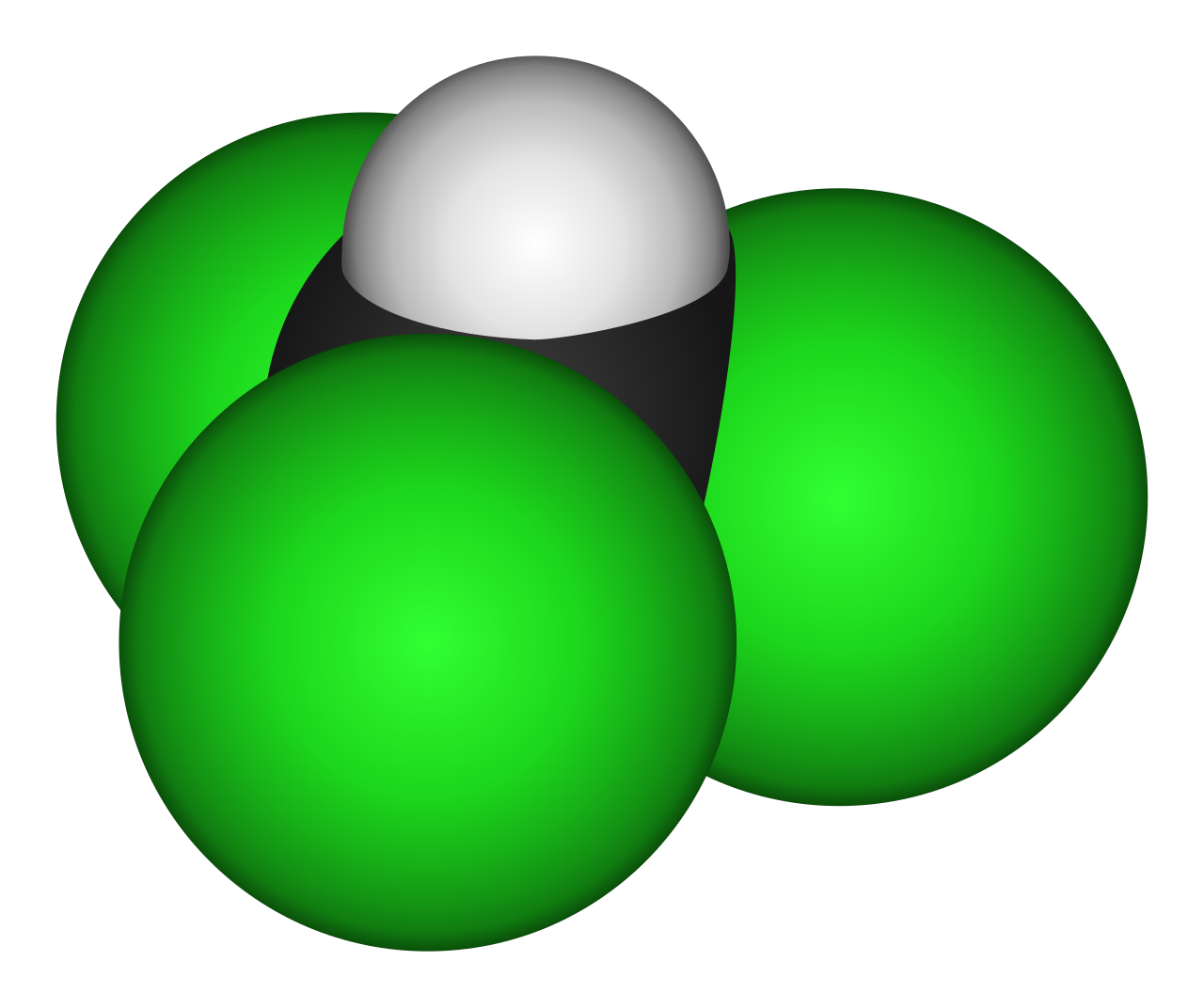
Ball-and-stick model of chloroform, the most common trihalomethane.
Credit: User:Benjah-bmm27, Mysid / Wikimedia Commons

License: Public domain
Wikimedia-provided scaled PNG/JPEG rendering; no content edits
What it is
THMs are small molecules with one carbon atom bonded to three halogen atoms (chlorine or bromine). The four regulated THMs are chloroform, bromodichloromethane, dibromochloromethane and bromoform. [2,3]
What it does and why it is used
THMs have no purpose in water. They are unintended by-products of disinfection with chlorine. [2,3]
Regulatory status and health context
Canada
Health Canada's maximum acceptable concentration for total THMs is 0.1 mg/L (100 µg/L). [1]
United States
EPA's maximum contaminant level for total THMs is 0.080 mg/L (80 µg/L) and for five haloacetic acids, another group of by-products, 0.060 mg/L. [2,3]
European Union
The sources used here do not cover EU limits.
Environmental notes
The sources used here focus on drinking water and do not provide an environmental rating.
Quick facts
- Members: chloroform, bromodichloromethane, dibromochloromethane, bromoform. [2]
- Source: chlorine reacting with natural matter in water. [2,3]
- Exposure routes: drinking, shower steam, skin. [1]
- Canada: 0.1 mg/L. US: 0.080 mg/L. [1,2]
- Main concern: bladder cancer with long-term higher exposure (probable). [4]
Sources
Sources were accessed on 2026-11-21. Source publication dates differ from this draft's review date. Image licences are listed with each image.
- Health Canada: Guidelines for Canadian Drinking Water Quality, summary tables.
- US EPA: National primary drinking water regulations.
- US EPA: Stage 1 and Stage 2 disinfectants and disinfection byproducts rules.
- Costet N et al. Water disinfection by-products and bladder cancer: is there a European specificity? Occup Environ Med, 2011 (PubMed).
- Summerhayes RJ et al. Meta-analysis of small for gestational age births and disinfection byproduct exposures. Environ Res, 2021 (PubMed).