
Nutrients and supplementsSkin and personal careWater, air and residues
Fluoride: the cavity fighter in toothpaste and tap water, and how much is enough
CAS 7681-49-4.Also known as sodium fluoride, fluoride ion, and community water fluoridation.
Editorial draft Last reviewed 15 November 2026 About 960 words
CC INDEX
How it works60/100 Moderate
Fluoride's benefits for teeth are well established, and its common side effect, mild dental fluorosis, is cosmetic; higher exposures carry rarer risks and an unsettled IQ question. Nearly everyone is exposed through toothpaste, water or food. Water levels and oral-care products are regulated in Canada, the US and EU, so the score sits in the moderate band.
An editorial summary of this article’s cited evidence. It isn’t medical advice or a personal risk estimate.
Age index
What is the age index?Which age groups are more affected by this chemical’s possible health issues, based on this article’s sources.
- Pregnancy Unborn babies Lower concern
- Infants 0 to 1 Moderate
- Young children 1 to 5 Moderate
- Children 6 to 12 Lower concern
- Teens 13 to 19 Lower concern
- Adults 20 to 64 Lower concern
- Older adults 65 and over Lower concern
- Dental fluorosis can develop only while permanent teeth are forming, so infants and young children are rated moderate; Health Canada says optimal water fluoridation is safe in pregnancy and breastfeeding.

Illustration of a bathroom sink. Fluoride is found in toothpaste and in many community water supplies.
Credit: Chemical Century; AI-generated illustration
License: CC0 1.0
Illustration, not a photograph of a specific product. Resized and cropped for the web.
Fluoride is the ingredient in toothpaste and many town water supplies that helps teeth resist decay, and it has been used this way for generations. For most families the benefits are well established, and the most common side effect of a little too much in early childhood is faint white flecks on the adult teeth. Researchers are still debating whether much higher exposures, well above the levels used in Canadian water, might affect children's development. Using the right amount of toothpaste for a child's age is the simplest way to get the benefit without the extra.
Everyday exposure: where you meet it and how much
Fluoride is a mineral found naturally in water, air, food and soil. [3] Many community water systems add it, and food prepared in fluoridated water also contains it; well water often does not contain enough to prevent tooth decay. [1] Toothpastes, some mouthwashes and fluoride supplements are other sources, and fluoride also appears in some etching creams and roach powders. [2,3]
In Canada, the optimal level of fluoride in drinking water is 0.7 mg per litre, and the maximum acceptable concentration is 1.5 mg per litre. [3]
Known and suspected harms
Evidence labels are editorial summaries, not individual risk predictions: established means recognized under the stated conditions; probable means a likely contribution with uncertainty; possible means limited evidence; disputed means assessors disagree. These labels do not describe how common an effect is.
- Established — fewer cavities: MedlinePlus says fluoridation reduces cavities in children by more than half, and Health Canada calls community water fluoridation a safe, effective and equitable way to prevent tooth decay at all ages. [1,3]
- Established — dental fluorosis: too much fluoride while permanent teeth are forming under the gums can cause white lines or flecks on the teeth; in its mild form this is cosmetic only. [3,4] Health Canada's survey found very mild or mild fluorosis in 16% of children and moderate or severe forms in fewer than 0.3%. [3]
- Established — skeletal fluorosis at very high intakes: swallowing very high amounts every day for a long time can harden bones and joints; this is extremely rare in Canada. [3,4]
- Possible — children's IQ at higher exposures: the US National Toxicology Program concluded with moderate confidence that higher exposures, such as drinking water above 1.5 mg per litre, are associated with lower IQ in children, but found insufficient data to judge the 0.7 mg per litre level. [5]
- Established — acute overdose: swallowing a large amount can cause stomach pain, vomiting, diarrhea, tremors and, in severe cases, heart problems; the amount in toothpaste is usually not swallowed in large enough amounts to cause harm. [2]
Reducing avoidable exposure and harm
Use the right amount of toothpaste for a child's age: Health Canada advises a rice-grain-sized smear for children under 3 who are at risk of decay and a small pea-sized amount for ages 3 to 6, with an adult helping. [3] Do not give fluoride mouth rinses to children under 6, and use fluoride supplements only if an oral health professional advises them. [1,3] If you use well water, have it tested, and if natural fluoride is above 1.5 mg per litre, use lower-fluoride water for infant formula. [3]
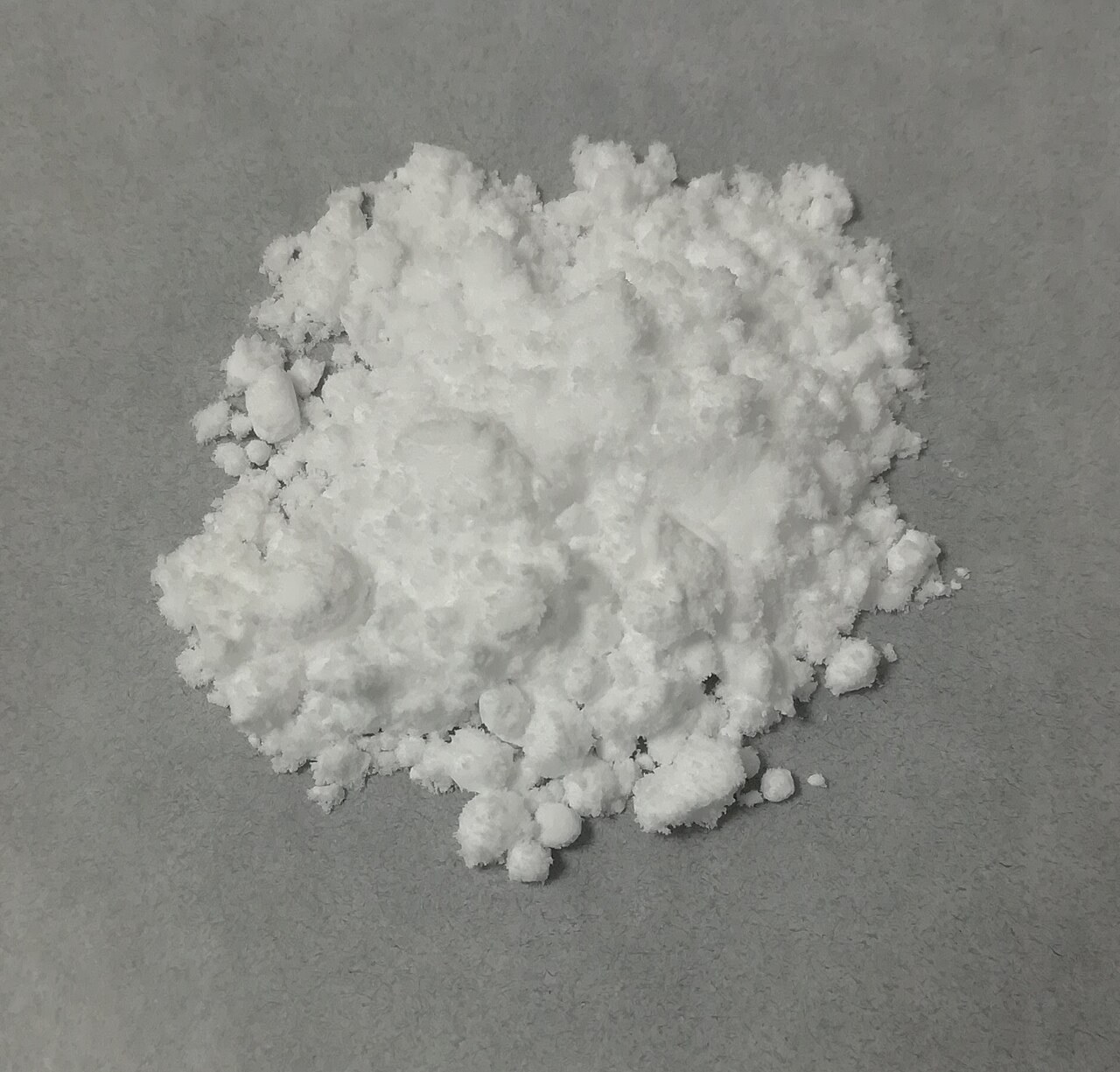
Sodium fluoride, one of the compounds used to supply fluoride.
Credit: Leiem / Wikimedia Commons

License: CC BY-SA 4.0
Resized for the web; no content edits
What it is
Fluoride is the ion of the element fluorine; sodium fluoride (CAS 7681-49-4) is one of the compounds used to supply it. [4,8]
What it does and why it is used
Fluoride strengthens tooth enamel, lowers acid in the mouth and helps rebuild minerals in teeth. [3] Most fluoride kept in the body is stored in bones and teeth. [4]
Regulatory status and health context
Canada
Health Canada supports community water fluoridation at an optimal level of 0.7 mg per litre and sets a maximum acceptable concentration of 1.5 mg per litre in drinking water. [3] Canada's Consumer Chemicals and Containers Regulations ban very corrosive consumer products but make an exception for some glass-etching products that contain fluoride. [7]
United States
EPA's maximum allowed fluoride in drinking water is 4.0 mg per litre, according to ATSDR. [4] ATSDR notes that FDA requires toothpaste labels to advise a pea-sized amount and supervised brushing for children. [4]
European Union
The EU cosmetics regulation limits fluoride in oral-care products to 0.15% and requires toothpastes with 0.1 to 0.15% fluoride, unless labelled for adults, to carry a warning that children aged 6 and younger should use a pea-sized amount under supervision. [6]
Environmental notes
Fluoride occurs naturally in soil and groundwater, and well water in some areas contains more than the optimal level. [3,4]
Quick facts
- CAS: 7681-49-4 (sodium fluoride). [8]
- Where: toothpaste, fluoridated water, some mouthwashes and supplements. [1,2,3]
- Main concern: dental fluorosis from too much during early childhood. [3]
- Most at risk: infants and young children whose permanent teeth are forming. [3,4]
Sources
All URLs were fetched on 2026-11-15; Health Canada pages were read with a separate web-reading tool because they did not respond to this review's direct requests. The EU law website was not fully available that day, so the EU cosmetics regulation was read from a copy fetched for earlier Chemical Century articles in November 2026; that copy is the regulation as originally published, and later amendments were not checked. Source publication dates differ from this draft's review date.
- MedlinePlus: Fluoride in diet.
- MedlinePlus: Fluoride overdose.
- Health Canada: Fluoride and oral health.
- ATSDR: Public Health Statement for fluorides, hydrogen fluoride and fluorine.
- National Toxicology Program: Fluoride exposure, neurodevelopment and cognition.
- EUR-Lex: Regulation (EC) No 1223/2009 on cosmetic products, as originally published.
- Justice Laws Website: Consumer Chemicals and Containers Regulations, 2001 (SOR/2001-269).
- PubChem PUG REST: sodium fluoride synonyms.