
Microcystins: the toxins from green algae blooms in lakes and drinking water
CAS 101043-37-2.Also known as microcystin-LR, cyanotoxins, blue-green algae toxins, cyanobacterial toxins, and harmful algal bloom toxins.
Editorial draft Last reviewed 21 November 2026 About 626 words
CC INDEX
How it works68/100 High
Microcystins are potent liver toxins with deaths documented after dialysis exposure. Drinking-water exposure is seasonal and local. Canada sets a limit and the US has health advisories rather than an enforceable standard.
An editorial summary of this article’s cited evidence. It isn’t medical advice or a personal risk estimate.
Age index
What is the age index?Which age groups are more affected by this chemical’s possible health issues, based on this article’s sources.
- Pregnancy Unborn babies Not well studied
- Infants 0 to 1 Higher concern
- Young children 1 to 5 Higher concern
- Children 6 to 12 Moderate
- Teens 13 to 19 Moderate
- Adults 20 to 64 Moderate
- Older adults 65 and over Moderate
- Infants (higher concern): Lowest advisory level; use another water for formula
- Young children (higher concern): EPA advisory 0.3 µg/L for preschool children
- Children (moderate): Liver toxin; school-age advisory 1.6 µg/L
- Teens (moderate): Liver toxin; school-age advisory 1.6 µg/L
- Adults (moderate): Liver toxin; dialysis patients at special risk
- Older adults (moderate): Liver toxin; dialysis patients at special risk

Illustration of an algae bloom. Some cyanobacteria release microcystins.
Credit: Chemical Century; AI-generated illustration
License: CC0 1.0
Illustration, not a photograph of a specific product. Resized and cropped for the web.
Microcystins are liver toxins made by cyanobacteria, often called blue-green algae, which can bloom in lakes and reservoirs. They can get into drinking water drawn from affected sources and are also found in recreational waters. In 1996, dozens of dialysis patients in Brazil died after microcystins in their treatment water entered their blood. Babies and young children are the most protected group in drinking-water advice because they drink more water for their size.
Everyday exposure: where you meet it and how much
Microcystins are the most commonly reported cyanotoxins in nutrient-rich fresh waters. [2] They contaminate bloom-affected lakes, drinking-water sources, aquatic food webs and recreational waters. [5] Health Canada notes they are released from cyanobacteria in planktonic blooms and bottom mats. [4]
Known and suspected harms
Evidence labels are editorial summaries, not individual risk predictions: established means recognized under the stated conditions; probable means a likely contribution with uncertainty; possible means limited evidence; disputed means assessors disagree.
- Established — acute liver failure (dialysis): in February 1996, at a haemodialysis clinic in Caruaru, Brazil, 116 of 131 patients developed visual disturbances, nausea, vomiting and muscle weakness after treatment; 100 developed acute liver failure, and 52 deaths were attributed to the syndrome by December 1996. Investigators concluded the main cause was microcystins entering patients' blood from contaminated treatment water. [1]
- Possible — liver damage from chronic exposure: fishermen at a Chinese lake with frequent blooms had microcystins in their blood, with estimated intakes at or above the WHO tolerable daily intake, and liver enzyme levels rose with blood microcystin levels. [2]
- Possible — liver, kidney and metabolic effects: a 2026 systematic review found human evidence most consistent for liver outcomes, but based on only two independent studies; kidney and metabolic findings remain limited. [5]
Reducing avoidable exposure
Follow local advisories about blooms and drinking water. Health Canada advises using another suitable water source for infant formula if total microcystins in treated water exceed 0.4 µg/L. [4]
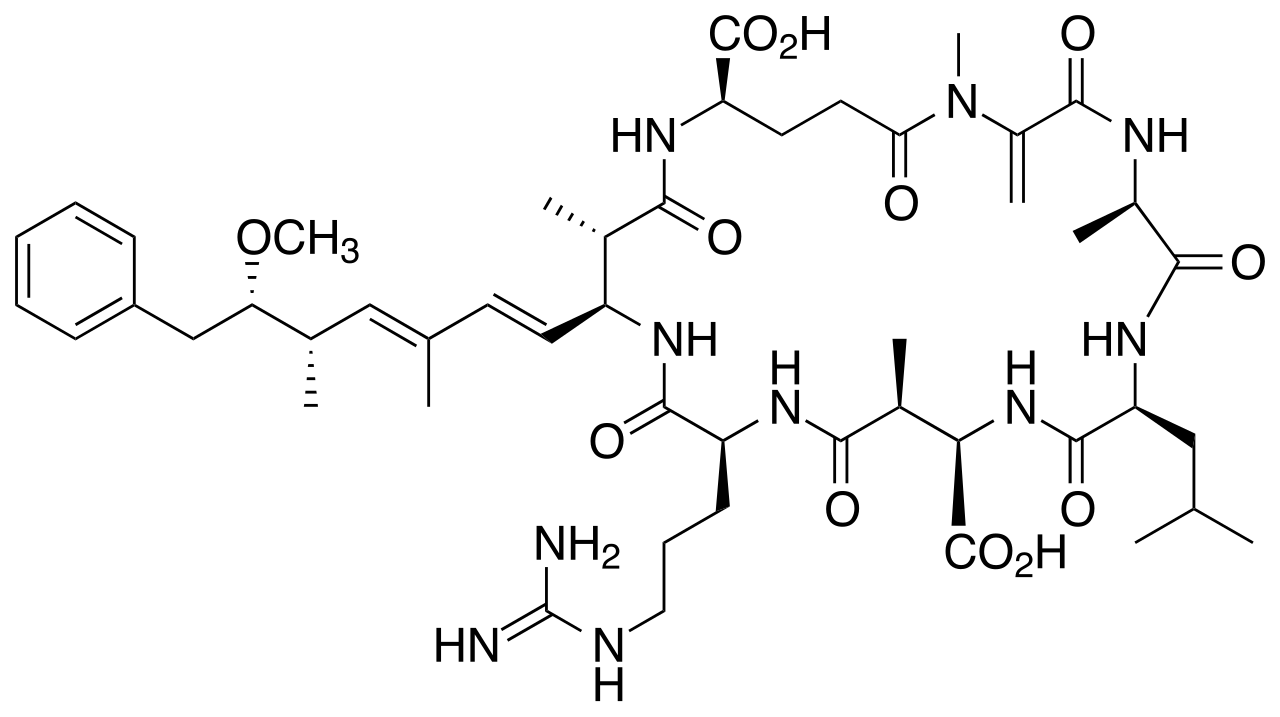
Structural formula of microcystin-LR.
Credit: Charlesy / Wikimedia Commons

License: Public domain
Wikimedia-provided scaled PNG/JPEG rendering; no content edits
What it is
Microcystins are cyclic peptides (rings of seven amino acids) made by cyanobacteria; microcystin-LR is the best studied. [1]
What it does and why it is used
They are natural toxins, not added chemicals; they occur when cyanobacteria bloom. [4]
Regulatory status and health context
Canada
The maximum acceptable concentration for total microcystins is 0.0015 mg/L (1.5 µg/L), based on liver effects, with a 0.4 µg/L reference value for preparing infant formula. [4]
United States
EPA 10-day health advisories for microcystins are 0.3 µg/L for bottle-fed infants and preschool children and 1.6 µg/L for school-age children and adults. These are non-enforceable guidance. [3]
European Union
The sources used here do not cover EU limits for microcystins.
Environmental notes
Blooms are favoured by nutrient-rich water. Brazil added cyanobacteria and cyanotoxins to its drinking-water monitoring rules after the Caruaru outbreak. [1,2]
Quick facts
- Canada MAC: 1.5 µg/L total microcystins. [4]
- US advisory: 0.3 µg/L (infants, preschoolers); 1.6 µg/L (others). [3]
- Target organ: liver. [1,4]
- Caruaru, 1996: 52 deaths attributed among dialysis patients. [1]
Sources
Sources were accessed on 2026-11-21. Source publication dates differ from this draft's review date. Image licences are listed with each image.
- Azevedo SM et al. Human intoxication by microcystins during renal dialysis treatment in Caruaru-Brazil. Toxicology, 2002 (PubMed).
- Chen J et al. First identification of the hepatotoxic microcystins in the serum of a chronically exposed human population together with indication of hepatocellular damage. Toxicol Sci, 2009 (PubMed).
- US EPA: Drinking water health advisories for cyanotoxins.
- Health Canada: Guidelines for Canadian drinking water quality: summary tables, December 2025.
- Moon SD et al. Human health effects of chronic microcystin exposure: a systematic review and meta-analysis of hepatic, renal, and metabolic outcomes. Toxins, 2026 (PubMed).