
Chloramine in tap water: safe to drink, but not for fish tanks or dialysis
CAS 10599-90-3.Also known as monochloramine, chloramines, combined chlorine, and NH2Cl.
Editorial draft Last reviewed 21 November 2026 About 639 words
CC INDEX
How it works52/100 Moderate
Chloramine is common in tap water and has low toxicity for drinking. Harm is established for dialysis patients and fish when it is not removed, and the US sets a 4.0 mg/L limit.
An editorial summary of this article’s cited evidence. It isn’t medical advice or a personal risk estimate.
Age index
What is the age index?Which age groups are more affected by this chemical’s possible health issues, based on this article’s sources.
- Pregnancy Unborn babies Lower concern
- Infants 0 to 1 Lower concern
- Young children 1 to 5 Lower concern
- Children 6 to 12 Lower concern
- Teens 13 to 19 Lower concern
- Adults 20 to 64 Lower concern
- Older adults 65 and over Lower concern
- Adults (lower concern): Dialysis patients: must be removed from dialysis water
- Older adults (lower concern): Dialysis patients: must be removed from dialysis water
- The serious risk is to people on dialysis when water is not properly treated, not to people drinking it.

Illustration of tap water and an aquarium. Chloraminated water is safe to drink but must be treated for fish tanks.
Credit: Chemical Century; AI-generated illustration
License: CC0 1.0
Illustration, not a photograph of a specific product. Resized and cropped for the web.
Chloramine is a disinfectant many cities add to tap water instead of, or after, chlorine, because it lasts longer in pipes and forms fewer regulated disinfection by-products. More than one in five Americans drinks chloraminated water, and US and Canadian regulators consider it safe for drinking, cooking and bathing at normal levels. It must, however, be removed from water used in kidney dialysis machines and fish tanks, because it damages red blood cells and harms fish. If you use home dialysis or keep fish, check whether your utility uses chloramine.
Everyday exposure: where you meet it and how much
Chloramines are formed when ammonia is added to chlorine to treat drinking water, giving longer-lasting disinfection as water moves through pipes. They have been used since the 1930s, and more than one in five Americans uses chloraminated water. Some systems switched to chloramines to meet disinfection by-product rules. [1] Health Canada notes that chloramine levels in most Canadian distribution systems are typically below 4 mg/L. [5]
Known and suspected harms
Evidence labels are editorial summaries, not individual risk predictions: established means recognized under the stated conditions; probable means a likely contribution with uncertainty; possible means limited evidence; disputed means assessors disagree.
- Established — dialysis: chlorine and chloramine must be removed from water used in kidney dialysis machines because this water comes into direct contact with blood. Dialysis patients can safely drink chloraminated water. [3] Two home haemodialysis patients developed severe oxidative haemolysis (destruction of red blood cells) because of high chloramine levels in mains water; the authors recommend double carbon filters for home dialysis. [4]
- Established — fish: chloramine can harm fish because it enters their bloodstream directly through the gills, and it can stop beneficial bacteria growing in tanks. Water conditioners from aquarium stores make it safe to use. [3]
- Established — drinking water at regulated levels: EPA says water with chloramines that meets its standards is safe for drinking, cooking and bathing. [1] Its limit lists possible effects above that level as eye and nose irritation, stomach discomfort and anaemia. [2]
Reducing avoidable exposure
If you are on home dialysis, tell your care team if your utility uses chloramine and follow their water-treatment advice. For aquariums, use a dechloraminating conditioner. [3,4]
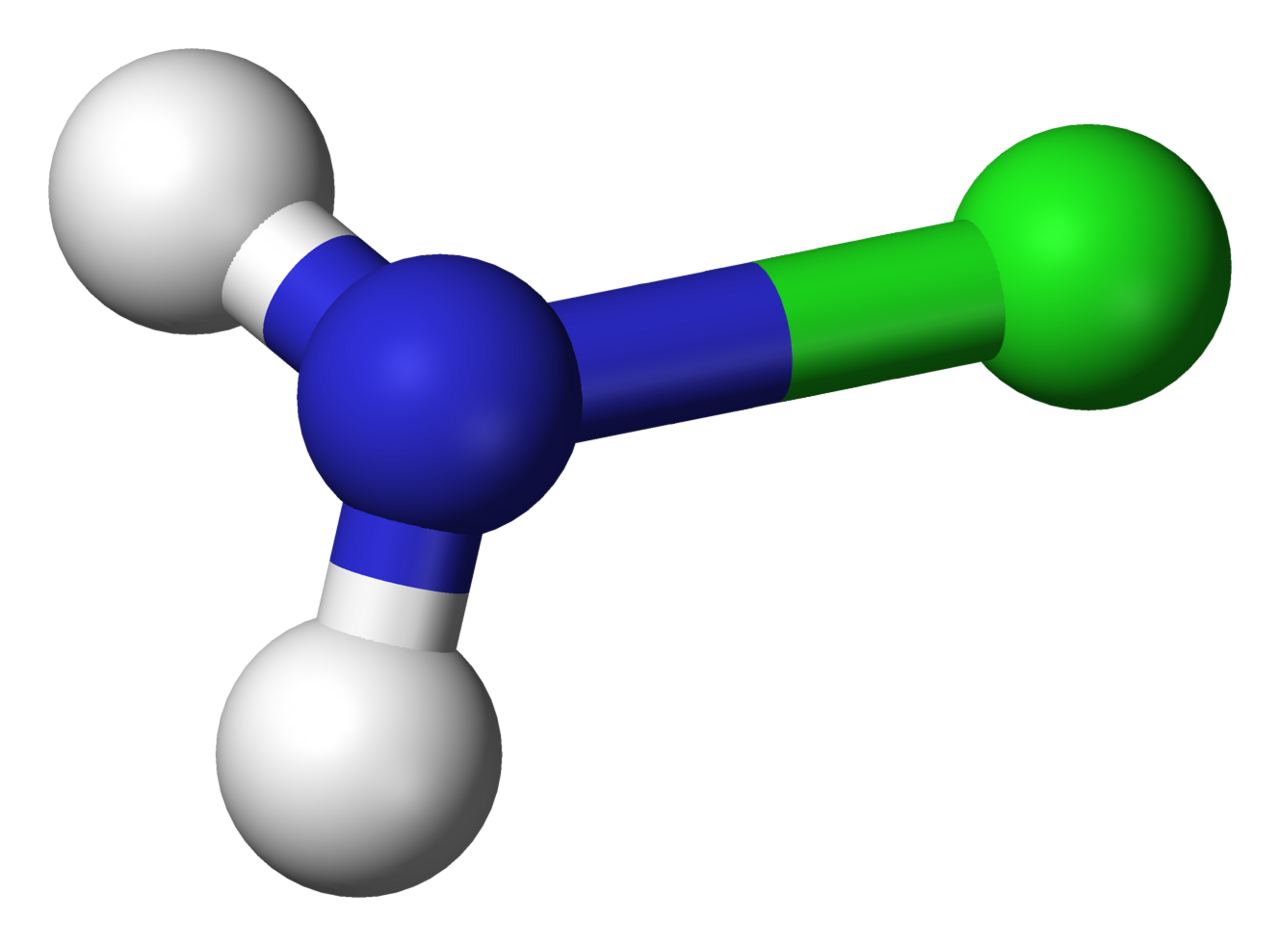
Ball-and-stick model of monochloramine.
Credit: Jynto and Ben Mills / Wikimedia Commons

License: Public domain
Wikimedia-provided scaled PNG/JPEG rendering; no content edits
What it is
Monochloramine (CAS 10599-90-3) is a small molecule of nitrogen, chlorine and hydrogen formed when chlorine is added in the presence of ammonia. [5]
What it does and why it is used
It is a secondary disinfectant that keeps killing microbes throughout the distribution system. [1,5]
Regulatory status and health context
Canada
Health Canada says a guideline value is not necessary because of low toxicity at concentrations found in drinking water. [5]
United States
EPA sets a maximum residual disinfectant level of 4.0 mg/L for chloramines (as chlorine). [2]
European Union
The sources used here do not cover EU rules for chloramine.
Environmental notes
Chloramine is harmful to fish, so chloraminated water must be treated before use in aquariums. [3]
Quick facts
- US limit: 4.0 mg/L (as Cl2). [2]
- Canada: no guideline needed; typical residuals below 4 mg/L. [5]
- Use: more than 1 in 5 Americans. [1]
- Must be removed for: dialysis and aquariums. [3]
Sources
Sources were accessed on 2026-11-21. Source publication dates differ from this draft's review date. Image licences are listed with each image.
- US EPA: Chloramines in drinking water.
- US EPA: National primary drinking water regulations.
- US EPA: Common health questions related to monochloramine: can chloraminated or chlorinated water be used for dialysis or in an aquarium? (PDF), 2009.
- Junglee NA et al. When pure is not so pure: chloramine-related hemolytic anemia in home hemodialysis patients. Hemodial Int, 2010 (PubMed).
- Health Canada: Guidelines for Canadian drinking water quality: summary tables, December 2025.