
Water, air and residuesMedicines and health
Chlorine dioxide: a water disinfectant, and why drinking 'MMS' is dangerous
CAS 10049-04-4.Also known as ClO2, MMS, sodium chlorite drops, chlorite, and chlorate.
Editorial draft Last reviewed 21 November 2026 About 683 words
CC INDEX
How it works64/100 High
Properly controlled water treatment leaves low residues that are regulated. Severity is high because people swallow concentrated chlorine dioxide products sold as cures, which FDA links to serious harm.
An editorial summary of this article’s cited evidence. It isn’t medical advice or a personal risk estimate.
Age index
What is the age index?Which age groups are more affected by this chemical’s possible health issues, based on this article’s sources.
- Pregnancy Unborn babies Not well studied
- Infants 0 to 1 Moderate
- Young children 1 to 5 Higher concern
- Children 6 to 12 Higher concern
- Teens 13 to 19 Not well studied
- Adults 20 to 64 Higher concern
- Older adults 65 and over Not well studied
- Infants (moderate): Higher TSH in low-birth-weight newborns in one study
- Young children (higher concern): MMS products marketed for autism; harmful if swallowed
- Children (higher concern): MMS products marketed for autism; harmful if swallowed
- Adults (higher concern): Drinking MMS can cause severe vomiting and liver failure
- The higher ratings refer to drinking concentrated sodium chlorite or chlorine dioxide products, not to properly treated tap water.

Illustration of water treatment. Chlorine dioxide is used by some utilities as a disinfectant.
Credit: Chemical Century; AI-generated illustration
License: CC0 1.0
Illustration, not a photograph of a specific product. Resized and cropped for the web.
Chlorine dioxide is a strong disinfectant that some water utilities use instead of, or alongside, chlorine, and it leaves behind chlorite and chlorate, which are limited in drinking water. At those controlled levels the main open question is subtle effects on thyroid function in sensitive newborns. A very different and dangerous use is products sold online as 'miracle' cures: concentrated sodium chlorite that turns into chlorine dioxide when mixed with acid. Regulators warn these can cause severe vomiting, diarrhoea, dangerously low blood pressure and liver failure, and they are not a treatment for any disease.
Everyday exposure: where you meet it and how much
Some water systems use chlorine dioxide as a disinfectant or to control taste and odour. It leaves chlorite and chlorate as by-products; when used as the final disinfectant at typical doses, chlorite is normally below 0.2 mg/L. [3] The other route of exposure is deliberate: websites sell so-called "mineral solution" products (often abbreviated MMS) as 28% sodium chlorite with an acid "activator" that turns it into chlorine dioxide when mixed. [5]
Known and suspected harms
Evidence labels are editorial summaries, not individual risk predictions: established means recognized under the stated conditions; probable means a likely contribution with uncertainty; possible means limited evidence; disputed means assessors disagree.
- Established — harm from drinking "miracle" products: FDA has received reports of severe vomiting, severe diarrhoea, life-threatening low blood pressure caused by dehydration, and acute liver failure after people drank these products. FDA says it knows of no research showing they are safe or effective for any illness, including autism, cancer, HIV/AIDS, hepatitis or flu, and that using them may delay effective treatment. FDA first warned consumers in 2010. [5]
- Possible — newborn thyroid function: among 32,978 newborns in Quebec, those from towns using chlorine dioxide had no overall rise in thyroid-stimulating hormone (TSH) or congenital hypothyroidism, but low-birth-weight newborns had significantly higher average TSH than those in chlorinated-water towns. [6]
WHO did not set a guideline value for chlorine dioxide itself, because any left at the tap is reduced to chlorite and chloride when swallowed; its provisional values for chlorite and chlorate are considered protective. [3]
Reducing avoidable exposure
Do not drink, or give anyone, any sodium chlorite or chlorine dioxide product sold as a remedy. If you are worried about tap-water by-products, check your water provider's report. [3,5]
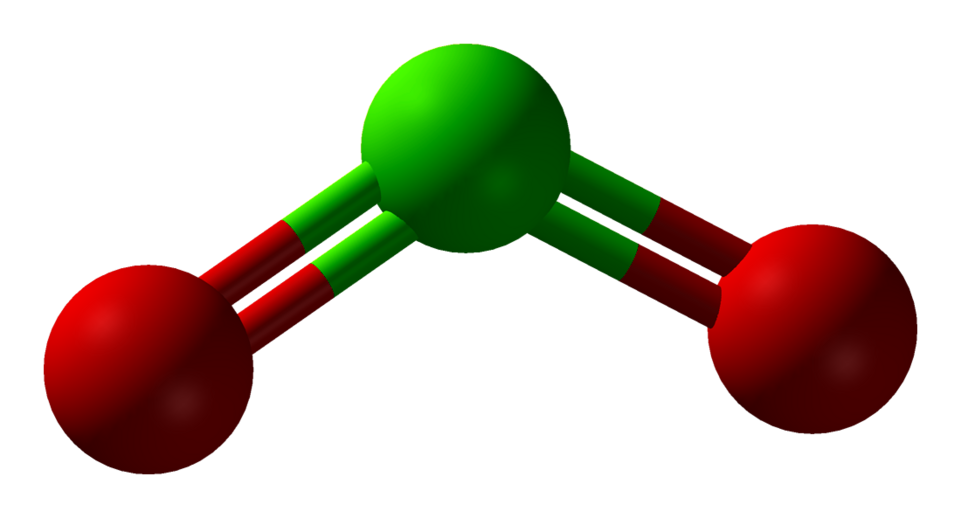
Ball-and-stick model of chlorine dioxide.
Credit: Ben Mills and Jynto / Wikimedia Commons

License: Public domain
Wikimedia-provided scaled PNG/JPEG rendering; no content edits
What it is
Chlorine dioxide (ClO2) is a powerful bleaching and disinfecting agent. [3,5]
What it does and why it is used
It disinfects water and controls taste and odour; sodium chlorite and chlorine dioxide are also active ingredients in disinfectants. [3,5]
Regulatory status and health context
International
WHO provisional guideline values: chlorite 0.7 mg/L and chlorate 0.7 mg/L; no value for chlorine dioxide itself. [3]
United States
EPA's maximum residual disinfectant level for chlorine dioxide is 0.8 mg/L, and the maximum contaminant level for chlorite is 1.0 mg/L. [1,2] FDA warns consumers not to drink sodium chlorite products. [5]
European Union
The Drinking Water Directive sets 0.25 mg/L each for chlorite and chlorate, or 0.70 mg/L where a disinfection method such as chlorine dioxide that generates them is used. [4]
Environmental notes
The sources used here do not provide enough environmental data for a rating.
Quick facts
- CAS: 10049-04-4.
- US limits: chlorine dioxide 0.8 mg/L; chlorite 1.0 mg/L. [1,2]
- WHO: chlorite and chlorate 0.7 mg/L (provisional). [3]
- Never drink: "miracle" sodium chlorite products. [5]
Sources
Sources were accessed on 2026-11-21. Source publication dates differ from this draft's review date. Image licences are listed with each image.
- eCFR: 40 CFR 141.65, maximum residual disinfectant levels.
- eCFR: 40 CFR 141.64, maximum contaminant levels for disinfection byproducts.
- WHO: Chlorine dioxide, chlorite and chlorate in drinking-water, chemical fact sheet, 2022 (PDF).
- European Union: Directive (EU) 2020/2184 on the quality of water intended for human consumption (EUR-Lex).
- FDA: Danger: Don't drink Miracle Mineral Solution or similar products (archived).
- Ouhoummane N et al. Thyroid function of newborns and exposure to chlorine dioxide by-products. Arch Environ Health, 2004 (PubMed).