
Uranium in well water: kidney risks and how to test
CAS 7440-61-1.Also known as natural uranium, uranium in drinking water, U-238, and depleted uranium.
Editorial draft Last reviewed 21 November 2026 About 707 words
CC INDEX
How it works62/100 High
Uranium's kidney toxicity is established, and a large cohort linked low-level water exposure to chronic kidney disease. Exposure is mostly limited to areas with high natural uranium. Both the US and Canada regulate it in drinking water.
An editorial summary of this article’s cited evidence. It isn’t medical advice or a personal risk estimate.
Age index
What is the age index?Which age groups are more affected by this chemical’s possible health issues, based on this article’s sources.
- Pregnancy Unborn babies Not well studied
- Infants 0 to 1 Not well studied
- Young children 1 to 5 Not well studied
- Children 6 to 12 Not well studied
- Teens 13 to 19 Not well studied
- Adults 20 to 64 Moderate
- Older adults 65 and over Moderate
- Adults (moderate): Kidney effects; CKD risk linked even below US limit
- Older adults (moderate): Kidney effects; CKD risk linked even below US limit
- ATSDR expects effects in children to be similar to those in adults at toxic levels.

Illustration of a private well. Uranium occurs naturally in some groundwater.
Credit: Chemical Century; AI-generated illustration
License: CC0 1.0
Illustration, not a photograph of a specific product. Resized and cropped for the web.
Uranium is a naturally occurring, mildly radioactive metal found in rocks and soil, and it can dissolve into groundwater, especially in private wells drilled into certain bedrock. In drinking water its main concern is chemical damage to the kidneys rather than radiation. Studies of people drinking well water with high uranium found subtle changes in kidney function, and a large California study linked higher uranium in community water to more chronic kidney disease, even below the US limit. If you have a private well, testing is the only way to know.
Everyday exposure: where you meet it and how much
Food and drinking water are the main sources of uranium for the general public. Root vegetables such as potatoes, parsnips and turnips contribute the most from food. Most US drinking water has low levels, but higher levels occur where rocks and soil are naturally rich in uranium, and near uranium mining and processing sites. [1] In Finnish households using drilled wells, median uranium in water was 25 to 28 µg/L, with maximums above 1,500 µg/L. [5,6]
Known and suspected harms
Evidence labels are editorial summaries, not individual risk predictions: established means recognized under the stated conditions; probable means a likely contribution with uncertainty; possible means limited evidence; disputed means assessors disagree.
- Established — kidney damage: kidney damage has been seen in humans and animals after inhaling or ingesting uranium compounds. Its health effects come from its chemical toxicity, not its radiation. [1] Canada's limit is based on kidney effects, and the US limit cites kidney toxicity and increased cancer risk. [2,3]
- Probable — chronic kidney disease at lower levels: among 88,185 California teachers, higher uranium in community water was linked to more moderate to end-stage chronic kidney disease. Compared with less than 2 µg/L, risk was more than 30% higher at 10 to 15 µg/L, even though most exposures were below the US limit. [4]
- Disputed — kidney damage from well water: in Finland, uranium in urine was associated with changes in how kidney tubules handle calcium and phosphate, without a clear threshold, but not with filtration function. [5] A later Finnish study found no signs of kidney cell damage, though uranium was linked to higher blood pressure and urinary glucose. [6]
NTP, IARC and EPA have not classified natural or depleted uranium as to whether it causes cancer. [1]
Reducing avoidable exposure
If you have a private well, especially in an area with uranium-rich rock, have your water tested; if levels are high, consider treatment or bottled water. ATSDR also suggests peeling root vegetables grown in high-uranium soil. [1]
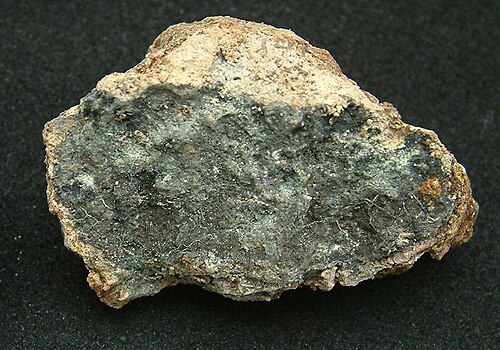
Uraninite, a uranium ore mineral.
Credit: Chris Popham / Wikimedia Commons

License: Public domain
Wikimedia-provided scaled PNG/JPEG rendering; no content edits
What it is
Uranium is a naturally occurring radioactive element present in nearly all rocks, soils and air. Over 99% of natural uranium is the isotope uranium-238, which has a half-life of 4.5 billion years. [1]
What it does and why it is used
In drinking water it is a natural contaminant from the erosion of rocks and soils. [2,3]
Regulatory status and health context
Canada
The maximum acceptable concentration is 0.02 mg/L (20 µg/L) for total uranium, based on kidney effects. [3]
United States
The maximum contaminant level is 30 µg/L, and the health goal is zero. [2]
European Union
The sources used here do not cover EU limits for uranium.
Environmental notes
Uranium can be redistributed in the environment by wind and water erosion. [1]
Quick facts
- US limit: 30 µg/L. [2]
- Canada limit: 20 µg/L. [3]
- Main health concern in water: kidneys. [1,3]
- Private wells: test to know your level. [1]
Sources
Sources were accessed on 2026-11-21. Source publication dates differ from this draft's review date. Image licences are listed with each image.
- ATSDR: ToxFAQs for uranium.
- US EPA: National primary drinking water regulations.
- Health Canada: Guidelines for Canadian drinking water quality: summary tables, December 2025.
- Medgyesi DN et al. Long-term exposure to uranium and arsenic in community drinking water and CKD risk among California women. Am J Kidney Dis, 2025 (PubMed).
- Kurttio P et al. Renal effects of uranium in drinking water. Environ Health Perspect, 2002 (PubMed).
- Kurttio P et al. Kidney toxicity of ingested uranium from drinking water. Am J Kidney Dis, 2006 (PubMed).