
Isomalt (E953): the sweetener in sugar-free sweets and its laxative warning
CAS 64519-82-0.Also known as E953, E 953, isomaltitol, and isomalt sweetener.
Editorial draft Last reviewed 21 November 2026 About 548 words
CC INDEX
How it works34/100 Mild
Isomalt is used in sugar-free sweets. Its main documented effect is digestive and dose-related, which EU law addresses with a mandatory warning.
An editorial summary of this article’s cited evidence. It isn’t medical advice or a personal risk estimate.
Age index
What is the age index?Which age groups are more affected by this chemical’s possible health issues, based on this article’s sources.
- Pregnancy Unborn babies Not well studied
- Infants 0 to 1 Not well studied
- Young children 1 to 5 Moderate
- Children 6 to 12 Lower concern
- Teens 13 to 19 Lower concern
- Adults 20 to 64 Lower concern
- Older adults 65 and over Not well studied
- Young children (moderate): Laxative effects at lower amounts for small bodies
- The sources used here do not set age-specific limits; the laxative warning applies to everyone. The young-children rating is an editorial judgement based on body size.

Illustration of sugar-free hard sweets and sugar work, common uses of isomalt.
Credit: Chemical Century; AI-generated illustration
License: CC0 1.0
Illustration, not a photograph of a specific product. Resized and cropped for the web.
Isomalt is a sugar alcohol used as a sugar replacer in sugar-free hard sweets, lozenges, chewing gum and chocolate. Like other polyols, it is only partly digested, which is why it is used in products marketed as sugar-free. The trade-off is the gut: like other polyols, large amounts can cause wind, bloating or loose stools, and EU labels must warn that excessive consumption may have a laxative effect. That makes it relevant for people with diabetes and older adults choosing sugar-free sweets.
Everyday exposure: where you meet it and how much
Isomalt is an authorised sweetener in the EU, E 953. [1] It is a disaccharide polyol, used in food manufacturing along with maltitol and lactitol. [4] On labels it may appear as "isomalt", "E953" or under "polyols" in the nutrition table. [2]
Known and suspected harms
Evidence labels are editorial summaries, not individual risk predictions: established means recognized under the stated conditions; probable means a likely contribution with uncertainty; possible means limited evidence; disputed means assessors disagree.
- Probable — gut symptoms at high intake: disaccharide polyols such as isomalt may cause gastrointestinal disturbances, at least in people not used to them; the gut can adapt over time. Polyol-related diarrhoea is osmotic and research has found no damage to the gut lining except in extreme cases. [4]
- Established — tolerated at moderate intake: in a randomised, double-blind crossover trial, 19 healthy adults ate 30 g of isomalt or sugar a day for 4 weeks. Isomalt was well tolerated; stool frequency rose moderately without changes in consistency, and blood fats, calcium and phosphate balance were not affected. [3]
EU law requires foods containing more than 10% added polyols to state "excessive consumption may produce laxative effects". [2]
Reducing avoidable exposure
Eat sugar-free sweets in small amounts, especially if you are not used to them, and watch children's portions. [2,4]
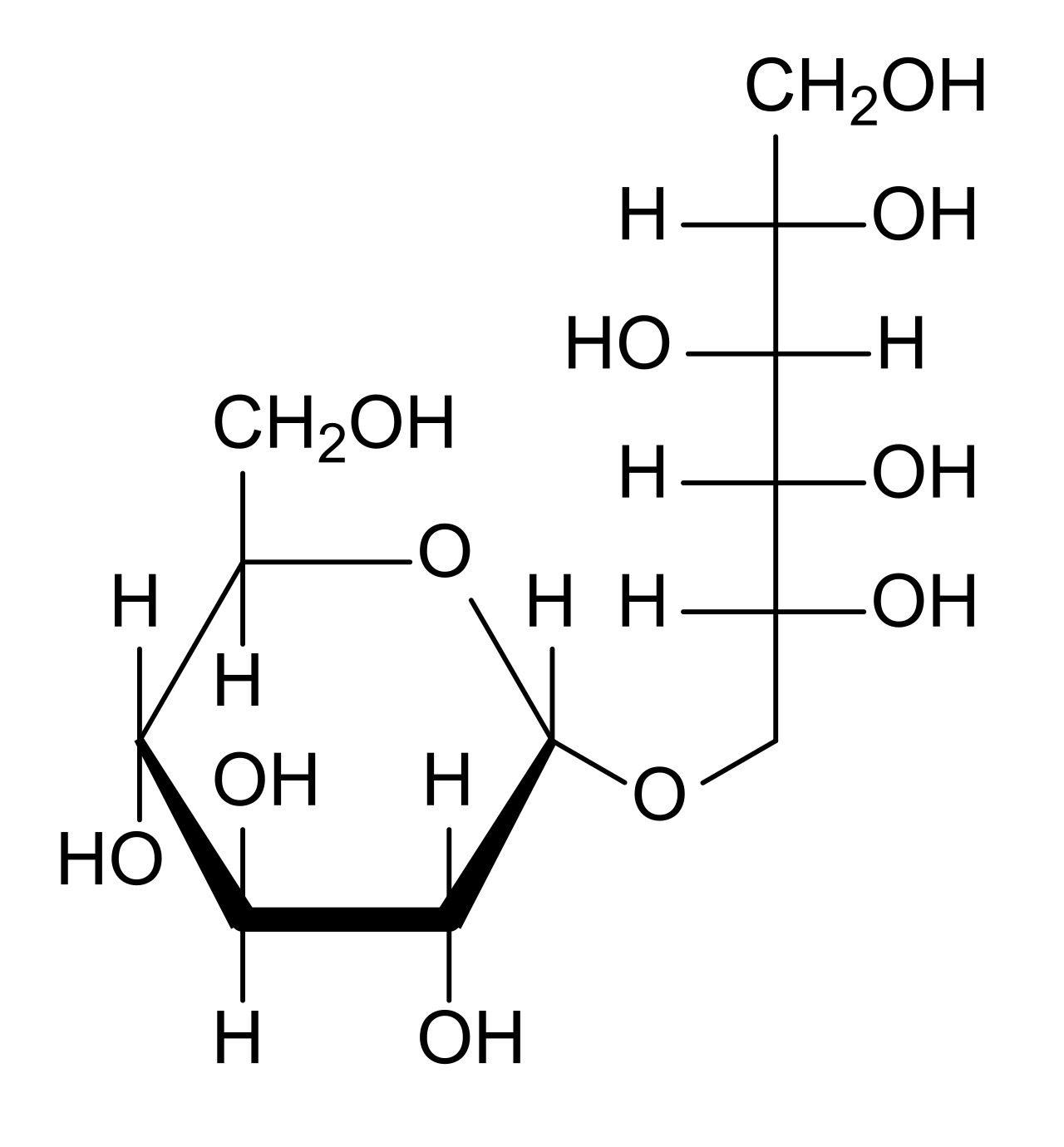
Structural formula of isomalt.
Credit: Artur Disk / Wikimedia Commons

License: Public domain
Wikimedia-provided scaled PNG/JPEG rendering; no content edits
What it is
Isomalt is a sugar alcohol (polyol) made of glucose linked to sorbitol or mannitol. [3,4]
What it does and why it is used
It replaces sugar, providing bulk and sweetness in sugar-free products. [3,4]
Regulatory status and health context
International
The sources used here do not include an international evaluation.
United States
The sources used here do not cover US rules for isomalt.
European Union
E 953 is an authorised sweetener, and foods with more than 10% added polyols carry a laxative warning. [1,2]
Environmental notes
The sources used here do not provide enough environmental data for a rating.
Quick facts
- CAS: 64519-82-0.
- E number: E 953. [1]
- Type: disaccharide polyol (sugar alcohol). [4]
- EU label warning: "excessive consumption may produce laxative effects" above 10% added polyols. [2]
Sources
Sources were accessed on 2026-11-21. Source publication dates differ from this draft's review date. Image licences are listed with each image.
- European Union: Regulation (EC) No 1333/2008 on food additives, consolidated text with the Union list (EUR-Lex).
- European Union: Regulation (EU) No 1169/2011 on food information to consumers (EUR-Lex).
- Gostner A et al. Effects of isomalt consumption on gastrointestinal and metabolic parameters in healthy volunteers. Br J Nutr, 2005 (PubMed).
- Mäkinen KK. Gastrointestinal disturbances associated with the consumption of sugar alcohols with special consideration of xylitol. Int J Dent, 2016 (PubMed).