
HFPO-DA: the PFOA replacement 'forever chemical' in drinking water
CAS 13252-13-6.Also known as hexafluoropropylene oxide dimer acid, HFPO dimer acid, and short-chain PFAS.
Editorial draft Last reviewed 21 November 2026 About 593 words
CC INDEX
How it works52/100 Moderate
HFPO-DA is persistent and mobile, with clear animal toxicity. Human evidence is limited and exposure is local. US regulation is in flux, while Canada includes it in a combined PFAS objective.
An editorial summary of this article’s cited evidence. It isn’t medical advice or a personal risk estimate.
Age index
What is the age index?Which age groups are more affected by this chemical’s possible health issues, based on this article’s sources.
- Pregnancy Unborn babies Moderate
- Infants 0 to 1 Moderate
- Young children 1 to 5 Moderate
- Children 6 to 12 Moderate
- Teens 13 to 19 Lower concern
- Adults 20 to 64 Moderate
- Older adults 65 and over Moderate
- Pregnancy (moderate): Developmental effects in animal studies
- Infants (moderate): Developmental effects in animal studies
- Young children (moderate): Higher water intake per body weight
- Children (moderate): Liver effects in animals
- Adults (moderate): Liver most sensitive in animal studies
- Older adults (moderate): Liver most sensitive in animal studies
- Evidence comes from animal studies; exposure depends on local water contamination.

Illustration of a river near industry. HFPO-DA has been found in surface water and drinking water.
Credit: Chemical Century; AI-generated illustration
License: CC0 1.0
Illustration, not a photograph of a specific product. Resized and cropped for the web.
HFPO-DA (hexafluoropropylene oxide dimer acid) is a PFAS 'forever chemical' developed to replace PFOA in making non-stick and other high-performance fluoropolymers. It has been found in rivers, groundwater, drinking water, rain and air near where it is made or used. Animal studies show effects on the liver, kidneys, immune system and developing offspring, with the liver most sensitive. The US set a drinking-water limit in 2024 but has since proposed rescinding it, while Canada counts it in a combined PFAS objective.
Everyday exposure: where you meet it and how much
HFPO-DA and its ammonium salt were developed as a processing aid to make high-performance fluoropolymers without PFOA. They have been found in surface water, groundwater, drinking water, rainwater and air emissions. People can be exposed by drinking contaminated water and breathing contaminated air. EPA says it does not have specific information on which consumer products rely on the chemicals. [1]
Known and suspected harms
Evidence labels are editorial summaries, not individual risk predictions: established means recognized under the stated conditions; probable means a likely contribution with uncertainty; possible means limited evidence; disputed means assessors disagree.
- Established — organ toxicity in animals: animal studies with oral exposure have shown effects on the liver, kidneys, immune system and development of offspring; the liver appears particularly sensitive. [1]
- Possible — cancer: animal studies have shown an association with cancer. [1]
HFPO-DA is as persistent in the environment as older PFAS such as PFOA and PFOS and more mobile, so it can travel further in groundwater, but it does not appear to build up in people as much. [1] The sources used here do not include human health studies of HFPO-DA.
Reducing avoidable exposure
If you live near a fluorochemical plant or your utility reports PFAS, check its water quality report and consider a home treatment system certified for PFAS reduction. [2,3]
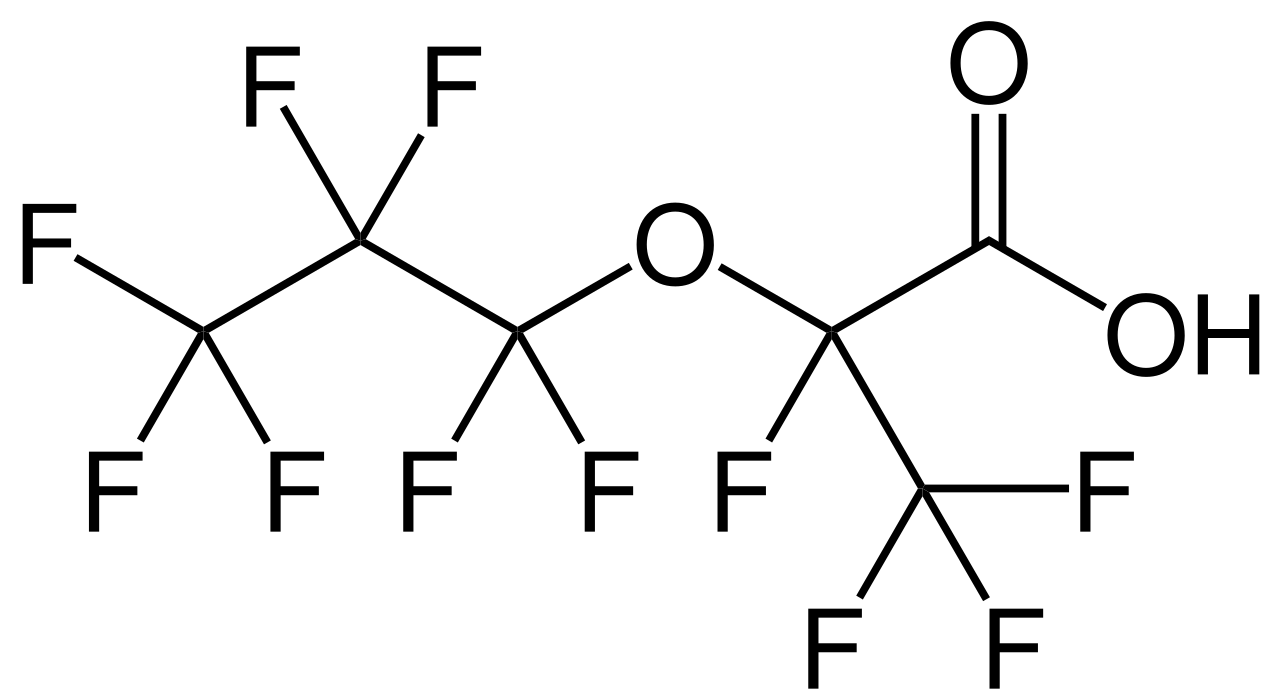
Structural formula of HFPO-DA.
Credit: Edgar181 / Wikimedia Commons

License: Public domain
Wikimedia-provided scaled PNG/JPEG rendering; no content edits
What it is
HFPO-DA (CAS 13252-13-6) is a six-carbon, "shorter chain" PFAS, compared with eight-carbon PFOA. [1]
What it does and why it is used
It is used as a processing aid in fluoropolymer manufacturing, replacing PFOA. [1]
Regulatory status and health context
Canada
HFPO-DA is one of 25 PFAS included in Health Canada's 2024 drinking-water objective of 30 ng/L for their combined total, with levels to be kept as low as reasonably achievable. [3]
United States
In April 2024 EPA set an enforceable limit of 10 parts per trillion for HFPO-DA and included it in a hazard-index limit for PFAS mixtures. In May 2026 EPA proposed rescinding the limits for HFPO-DA, PFHxS, PFNA and the mixture, while keeping the PFOA and PFOS limits. [2]
European Union
HFPO-DA, its salts and acyl halides are on the EU Candidate List of substances of very high concern. [4]
Environmental notes
HFPO-DA is highly persistent and more mobile in groundwater than longer-chain PFAS. [1]
Quick facts
- CAS: 13252-13-6.
- US limit (2024): 10 ppt, proposed for rescission in 2026. [2]
- Canada: part of a 30 ng/L objective for 25 PFAS. [3]
- Most sensitive organ in animals: liver. [1]
Sources
Sources were accessed on 2026-11-21. Source publication dates differ from this draft's review date. Image licences are listed with each image.
- US EPA: Fact sheet: human health toxicity assessment for [HFPO-DA] chemicals, March 2023 update (PDF).
- US EPA: Per- and polyfluoroalkyl substances (PFAS): final PFAS national primary drinking water regulation.
- Health Canada: Objective for Canadian drinking water quality: per- and polyfluoroalkyl substances, 2024.
- ECHA: Candidate List of substances of very high concern: HFPO-DA entry.