
Plastics & packagingHousehold materials
Polytetrafluoroethylene (PTFE): are nonstick pans safe to cook with?
CAS 9002-84-0.Also known as PTFE, nonstick coating, non-stick coating, fluoropolymer, and polytetrafluoroethene.
Editorial draft Last reviewed 21 November 2026 About 865 words
CC INDEX
How it works48/100 Moderate
The coating is stable in normal use, but overheating can release fumes that cause polymer fume fever and are lethal to birds. PFOA, formerly used to make PTFE, is a Group 1 carcinogen and was phased out under an EPA stewardship programme. Particle shedding from damaged pans is documented, but its health meaning is unknown.
An editorial summary of this article’s cited evidence. It isn’t medical advice or a personal risk estimate.
Age index
What is the age index?Which age groups are more affected by this chemical’s possible health issues, based on this article’s sources.
- Pregnancy Unborn babies Not well studied
- Infants 0 to 1 Not well studied
- Young children 1 to 5 Not well studied
- Children 6 to 12 Not well studied
- Teens 13 to 19 Not well studied
- Adults 20 to 64 Moderate
- Older adults 65 and over Not well studied
- The main documented risk, fume fever from an overheated pan, depends on how a pan is used rather than on age; pet birds are far more sensitive than people.

Illustration of a nonstick pan with cast iron and stainless steel alternatives. Never heat a nonstick pan empty on high heat.
Credit: Chemical Century; AI-generated illustration
License: CC0 1.0
Illustration, not a photograph of a specific product. Resized and cropped for the web.
A nonstick frying pan makes breakfast easier, and for most home cooking the coating itself is very stable. The trouble starts when an empty pan is left on high heat: the coating can break down and give off fumes that cause a short flu-like illness in people and can kill pet birds within minutes. Older pans were also made with a related chemical, PFOA, that is now classed as a human carcinogen, although makers phased it out. Scratched or flaking pans may also shed tiny plastic particles into food, an area where the health meaning is still unknown.
Everyday exposure: where you meet it and how much
PTFE is the most familiar nonstick coating on frying pans, baking trays and other cookware. FDA lists nonstick coatings as one of four authorized PFAS food-contact uses. Of those uses, FDA says current data show only grease-proofing agents for paper and paperboard result in dietary PFAS exposure of potential safety concern, not nonstick coatings. [1]
Most contact happens when food touches an intact coating. Exposure can rise when a pan is overheated, which can release fumes, or when the coating is scratched or flaking. [4,5]
Known and suspected harms
Evidence labels are editorial summaries, not individual risk predictions: established means recognized under the stated conditions; probable means a likely contribution with uncertainty; possible means limited evidence; disputed means assessors disagree.
- Established — fumes from overheating: in one report, five pet cockatiels died within 30 minutes of fumes from an accidentally overheated PTFE-coated pan, and their owner developed "polymer fume fever," a flu-like illness, within an hour before recovering. In another, a man who fell asleep with a pan on the heat for four hours developed fluid in the lungs and recovered with treatment. [5,6]
- Established — PFOA, a former processing aid, is a human carcinogen: IARC classified PFOA as carcinogenic to humans (Group 1) in 2023, citing sufficient evidence in animals, strong mechanistic evidence in exposed people and limited evidence for kidney and testicular cancer. PFOA was used to make some fluoropolymers. Eight major companies committed under an EPA programme to eliminate PFOA from emissions and product content by 2015. [2,3]
- Possible — micro- and nanoplastic particles from damaged pans: a 2022 study used Raman imaging to show that scratched nonstick surfaces can release PTFE micro- and nanoplastics. Whether eating these particles harms people is not known. [4]
Intact PTFE itself is a very stable, inert plastic. The sources used here do not show harm from normal cooking with an undamaged pan at ordinary temperatures. [1]
Reducing avoidable exposure
Never preheat an empty nonstick pan on high heat, use low to medium heat, run the range hood, and keep pet birds out of the kitchen. Use wooden or silicone utensils, and replace pans whose coating is deeply scratched or flaking. Stainless steel, cast iron and enamelled cast iron are alternatives for high-heat cooking. [4,5,6]
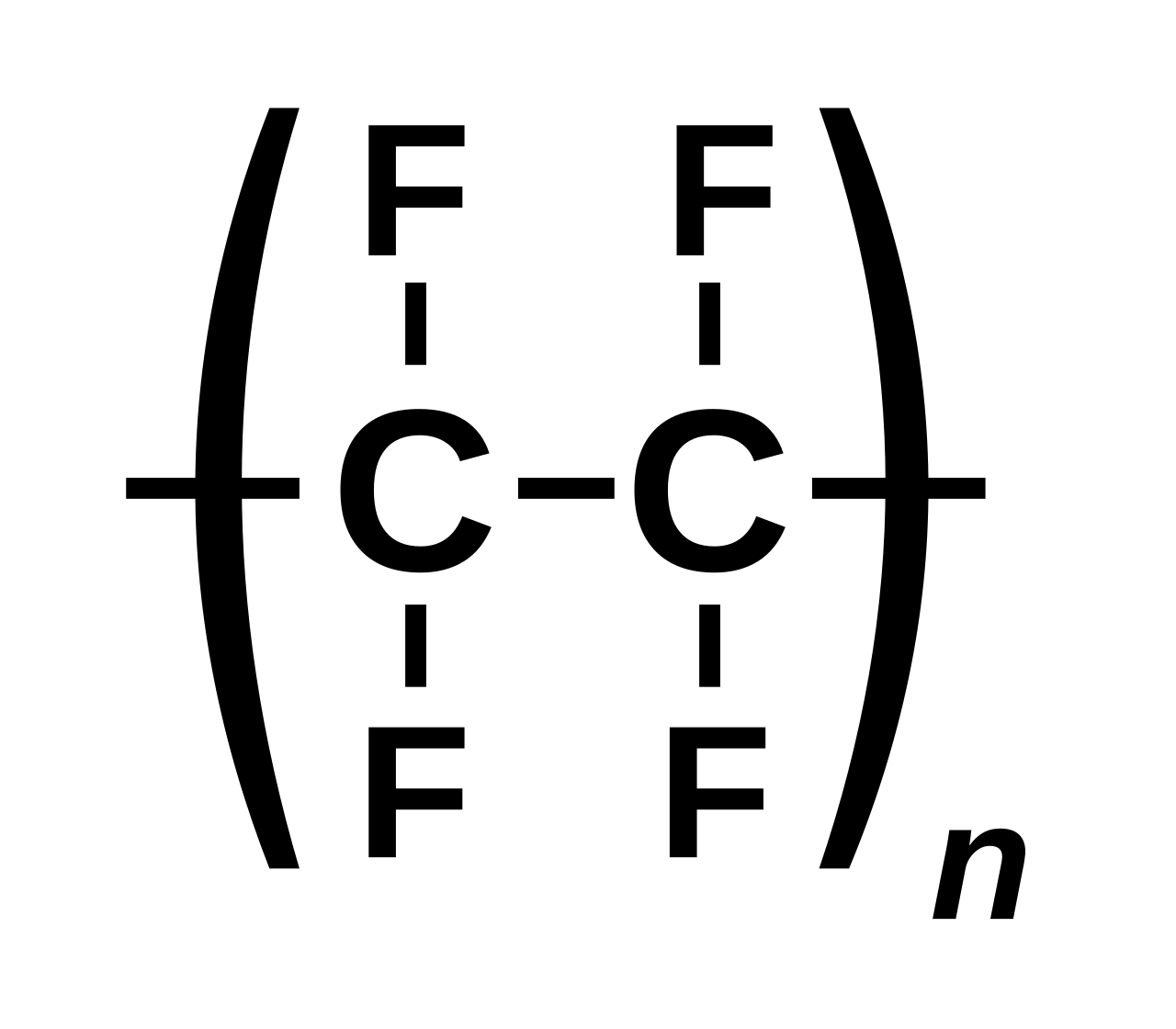
Repeating unit of polytetrafluoroethylene (PTFE).
Credit: Vectorization: Alhadis / Wikimedia Commons

License: Public domain
Wikimedia-provided scaled PNG/JPEG rendering; no content edits
What it is
Polytetrafluoroethylene (CAS 9002-84-0) is a fluoropolymer: a long chain of carbon atoms fully surrounded by fluorine atoms. It belongs to the broad PFAS family, but as a large polymer it behaves very differently from small PFAS such as PFOA. [1,3]
What it does and why it is used
The carbon–fluorine bonds make PTFE slippery, heat-resistant and water- and grease-repellent, which is why it is used for nonstick cookware, gaskets and industrial parts. [1]
Regulatory status and health context
Canada
The sources used here do not include a Canadian rule specific to PTFE cookware. Canada's broader PFAS work is described in the Chemical Century PFAS article.
United States
FDA authorizes PTFE-type nonstick coatings for food contact and states that, of authorized PFAS uses, only paper and paperboard grease-proofing agents raise a potential dietary concern on current data. EPA's stewardship programme set a goal of eliminating PFOA from product content by 2015. [1,2]
European Union
The sources used here do not cover EU cookware rules. IARC, part of WHO, classified PFOA as Group 1 and PFOS as Group 2B. [3]
Environmental notes
PFOA and similar PFAS are very persistent in the environment, which drove the industry phase-out. [2,3]
Quick facts
- CAS: 9002-84-0. [1]
- Main use: nonstick cookware coatings. [1]
- Clear hazard: fumes from overheated pans (established), highly toxic to pet birds. [5,6]
- Legacy concern: PFOA, formerly used in manufacture, is IARC Group 1. [2,3]
- Open question: health effects of particles shed by scratched pans. [4]
Sources
Sources were accessed on 2026-11-21. Source publication dates differ from this draft's review date. Image licences are listed with each image.
- FDA: Authorized uses of PFAS in food contact applications.
- US EPA: Fact sheet, 2010/2015 PFOA Stewardship Program.
- IARC: Monographs evaluate the carcinogenicity of PFOA and PFOS, 2023.
- Luo Y et al. Raman imaging for the identification of [PTFE] microplastics and nanoplastics released from non-stick cookware. Sci Total Environ, 2022 (PubMed).
- Blandford TB et al. A case of polytetrafluoroethylene poisoning in cockatiels accompanied by polymer fume fever in the owner. Vet Rec, 1975 (PubMed).
- Toyama K et al. Lung edema after inhalation of fumes from a coated frying pan overheated for 4 hours. Nihon Kokyuki Gakkai Zasshi, 2006 (PubMed).