
Makeup and colourPlastics & packagingHousehold materials
Dibutyl phthalate (DBP): the nail polish plasticizer banned in EU cosmetics
CAS 84-74-2.Also known as DBP, di-n-butyl phthalate, dibutylphthalate, and butyl phthalate.
Editorial draft Last reviewed 21 November 2026 About 668 words
CC INDEX
How it works59/100 Moderate
DBP is an EU-classified reproductive toxicant, banned in EU cosmetics and restricted in toys. FDA says it is now rarely used in US cosmetics, so exposure is lower than in the past.
An editorial summary of this article’s cited evidence. It isn’t medical advice or a personal risk estimate.
Age index
What is the age index?Which age groups are more affected by this chemical’s possible health issues, based on this article’s sources.
- Pregnancy Unborn babies Higher concern
- Infants 0 to 1 Moderate
- Young children 1 to 5 Moderate
- Children 6 to 12 Lower concern
- Teens 13 to 19 Lower concern
- Adults 20 to 64 Moderate
- Older adults 65 and over Lower concern
- Pregnancy (higher concern): Linked to genital changes in baby boys
- Infants (moderate): Toys restricted; developing reproductive system
- Young children (moderate): US toy restriction; mouthing plastics
- Adults (moderate): Reduced sperm production in animals at high doses

Illustration of nail polish. DBP was historically used to keep polish from cracking.
Credit: Chemical Century; AI-generated illustration
License: CC0 1.0
Illustration, not a photograph of a specific product. Resized and cropped for the web.
Dibutyl phthalate, or DBP, is a plasticizer that was once a standard ingredient in nail polish and is still found in some plastics, glues, paints and carpet backing. It is banned in cosmetics in the European Union, and in the United States it is restricted in children's toys. Animal studies show it can harm male reproductive development, and a human study linked higher levels of its breakdown product in pregnancy to subtle genital changes in baby boys. Pregnancy is the time it matters most.
Everyday exposure: where you meet it and how much
DBP makes plastics more flexible and has been used in carpet backing, paints, glue, insect repellents, hair spray and nail polish. Most people are exposed to low levels through air, water and food, including fish and food packaged in materials containing DBP. [2] FDA says DBP was historically used in nail polish to reduce cracking, but its 2010 survey found DBP is now used rarely in US cosmetics. [1]
Known and suspected harms
Evidence labels are editorial summaries, not individual risk predictions: established means recognized under the stated conditions; probable means a likely contribution with uncertainty; possible means limited evidence; disputed means assessors disagree.
- Established — reproductive toxicity in animals: in laboratory animals, eating large amounts of DBP affects reproduction, and sperm production can decrease, returning toward normal when exposure stops. [2] The EU classifies DBP as toxic to reproduction and restricts it in consumer articles. [4]
- Possible — male genital development in humans: in a US study of 85 mother-son pairs, boys whose mothers had the highest urinary levels of a DBP breakdown product (mono-n-butyl phthalate) during pregnancy had about 10 times the odds of a shorter-than-expected anogenital distance, a marker of male reproductive development. Several other phthalates showed similar links, and the study was small. [3]
ATSDR noted that no harmful effects of DBP had been reported in people and that EPA considers it not classifiable as to human carcinogenicity. [2] FDA has said the available data did not establish a health risk from phthalates in cosmetics. [1]
Reducing avoidable exposure
Check nail polish labels for "dibutyl phthalate" or "DBP," ventilate when painting nails, and wash hands before eating. During pregnancy, it is reasonable to limit avoidable phthalate exposure. [1,2,3]
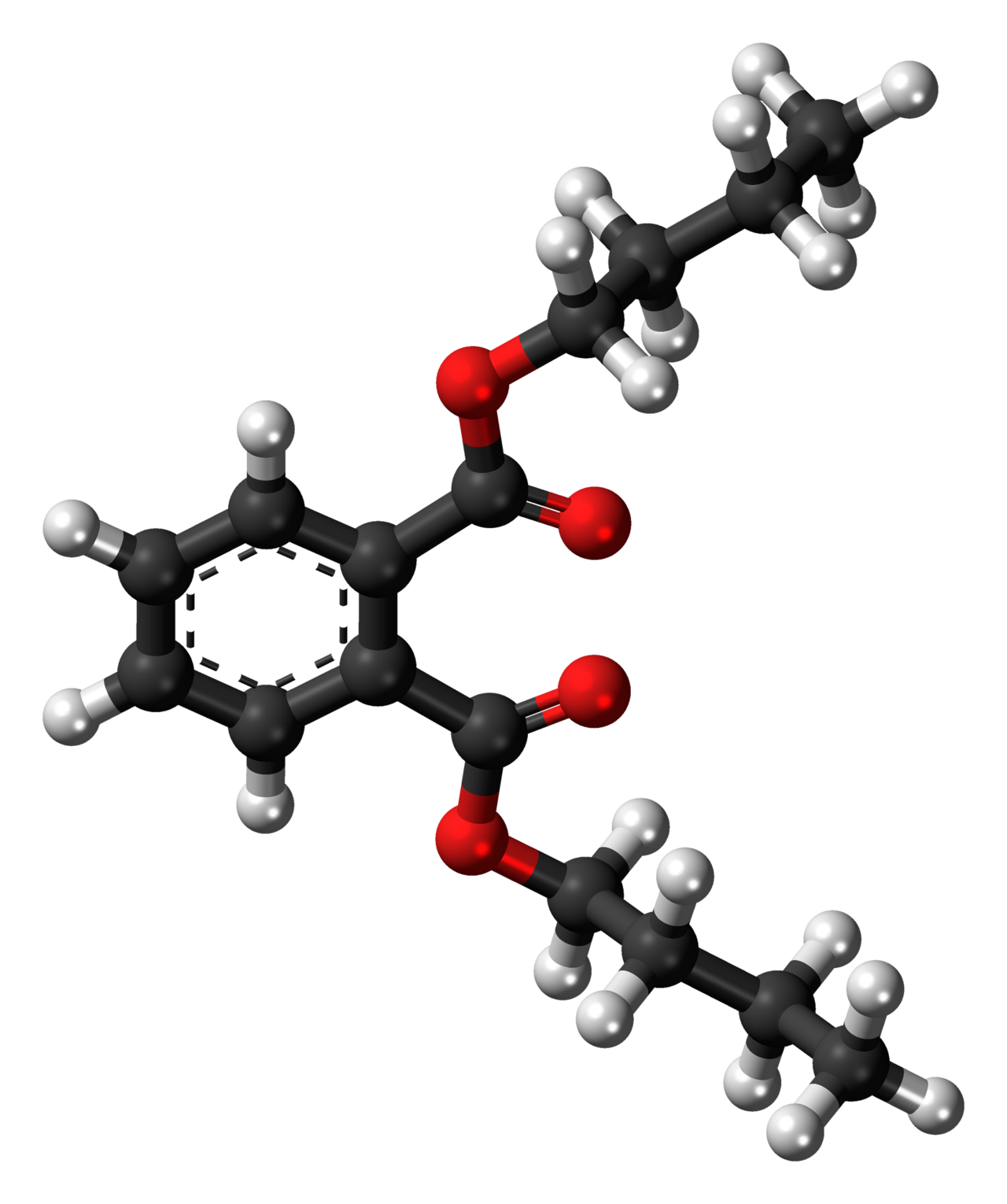
Ball-and-stick model of dibutyl phthalate (DBP).
Credit: Jynto / Wikimedia Commons

License: CC0
Wikimedia-provided scaled PNG/JPEG rendering; no content edits
What it is
DBP (CAS 84-74-2) is an odourless, oily, colourless to faint yellow liquid that does not occur naturally. [2]
What it does and why it is used
It is a plasticizer that makes materials more flexible and less brittle. [1,2]
Regulatory status and health context
Canada
The sources used here do not cover Canadian rules for DBP.
United States
Children's toys and child care articles may not contain more than 0.1% DBP. [6] DBP is not banned in cosmetics, but FDA reports it is rarely used. [1]
European Union
DBP is listed in Annex II of the Cosmetics Regulation, which prohibits it in cosmetic products. [5] Under REACH, articles containing 0.1% or more of DBP, DEHP, BBP and DIBP (alone or combined) in plasticised material are restricted, with exemptions. [4]
Environmental notes
In water, DBP mostly attaches to sediment or is broken down by bacteria; there is no evidence that it builds up in the food chain. [2]
Quick facts
- CAS: 84-74-2. [2]
- EU cosmetics: prohibited (Annex II). [5]
- US toys: 0.1% limit. [6]
- Main concern: male reproductive development. [2,3,4]
Sources
Sources were accessed on 2026-11-21. Source publication dates differ from this draft's review date. Image licences are listed with each image.
- FDA: Phthalates in cosmetics.
- ATSDR: ToxFAQs for di-n-butyl phthalate.
- Swan SH et al. Decrease in anogenital distance among male infants with prenatal phthalate exposure. Environ Health Perspect, 2005 (PubMed).
- European Commission: Regulation (EU) 2018/2005 restricting DEHP, DBP, BBP and DIBP under REACH (EUR-Lex).
- European Parliament and Council: Regulation (EC) No 1223/2009 on cosmetic products, Annex II (EUR-Lex).
- US Code: 15 U.S.C. § 2057c, prohibition on sale of certain products containing specified phthalates.