
Skin and personal careMakeup and colour
Cyclic siloxanes (D4, D5, D6): are silicones in lotions and hair products safe?
Also known as D4, D5, D6, cyclomethicone, cyclopentasiloxane, cyclotetrasiloxane, cyclohexasiloxane, and volatile silicones.
Editorial draft Last reviewed 21 November 2026 About 785 words
CC INDEX
How it works43/100 Moderate
Human health risk from cosmetic use appears low: D4 effects in rats may be species-specific and skin absorption is limited. But the EU classed these siloxanes as persistent and bioaccumulative and is phasing them out of cosmetics, and Canada lists D4 as toxic to the environment.
An editorial summary of this article’s cited evidence. It isn’t medical advice or a personal risk estimate.
Age index
What is the age index?Which age groups are more affected by this chemical’s possible health issues, based on this article’s sources.
- Pregnancy Unborn babies Not well studied
- Infants 0 to 1 Not well studied
- Young children 1 to 5 Not well studied
- Children 6 to 12 Not well studied
- Teens 13 to 19 Lower concern
- Adults 20 to 64 Lower concern
- Older adults 65 and over Not well studied
- Concern is driven mainly by environmental persistence rather than a known risk to any age group.

Illustration of silicone-containing hair and skin products. Cyclic siloxanes give a light, silky feel.
Credit: Chemical Century; AI-generated illustration
License: CC0 1.0
Illustration, not a photograph of a specific product. Resized and cropped for the web.
Cyclic siloxanes are the silky, quick-drying silicones that make hair serums, lotions, deodorants and foundations glide on and leave no greasy feel. Most of what goes on the skin evaporates quickly, and studies suggest very little is absorbed, so the risk to the person using the product appears low. The bigger concern is the environment: these chemicals persist and can build up in wildlife, which is why the European Union has restricted them in cosmetics. One of them, D4, has caused reproductive effects in female rats, though scientists think the mechanism may not apply to people.
Everyday exposure: where you meet it and how much
Cyclic siloxanes are used in leave-on cosmetics such as lotions, deodorants, hair care and makeup, and in some wash-off products. The European Commission identified wide-dispersive use in cosmetic products as the main source of their release to the environment. [1] Because they are volatile, much of the amount applied to skin evaporates into the air. [2]
Known and suspected harms
Evidence labels are editorial summaries, not individual risk predictions: established means recognized under the stated conditions; probable means a likely contribution with uncertainty; possible means limited evidence; disputed means assessors disagree.
- Established — environmental persistence: EU experts identified D4 as persistent, bioaccumulative and toxic (PBT), and D4, D5 and D6 as very persistent and very bioaccumulative (vPvB). [1]
- Disputed — reproductive effects of D4: D4 caused reproductive effects in female rats, apparently by delaying the luteinizing hormone surge needed for full ovulation, and long-term inhalation was linked to a trend in benign uterine tumours. A 2017 toxicology review argued that differences in how rats and humans control ovulation make this effect unlikely to matter for people, and that benign uterine tumours in rats are also unlikely to occur in humans. This review should be weighed alongside regulators' assessments. [2]
- Possible — limited absorption: the same review reports that skin absorption of D4 is limited because it evaporates quickly, and that most absorbed D4 is cleared from the body rapidly. [2]
Reducing avoidable exposure
If you want to avoid these ingredients, check labels for "cyclopentasiloxane," "cyclotetrasiloxane," "cyclohexasiloxane" and "cyclomethicone." Because the main concern is environmental, using less of these products also reduces release into air and water. [1]
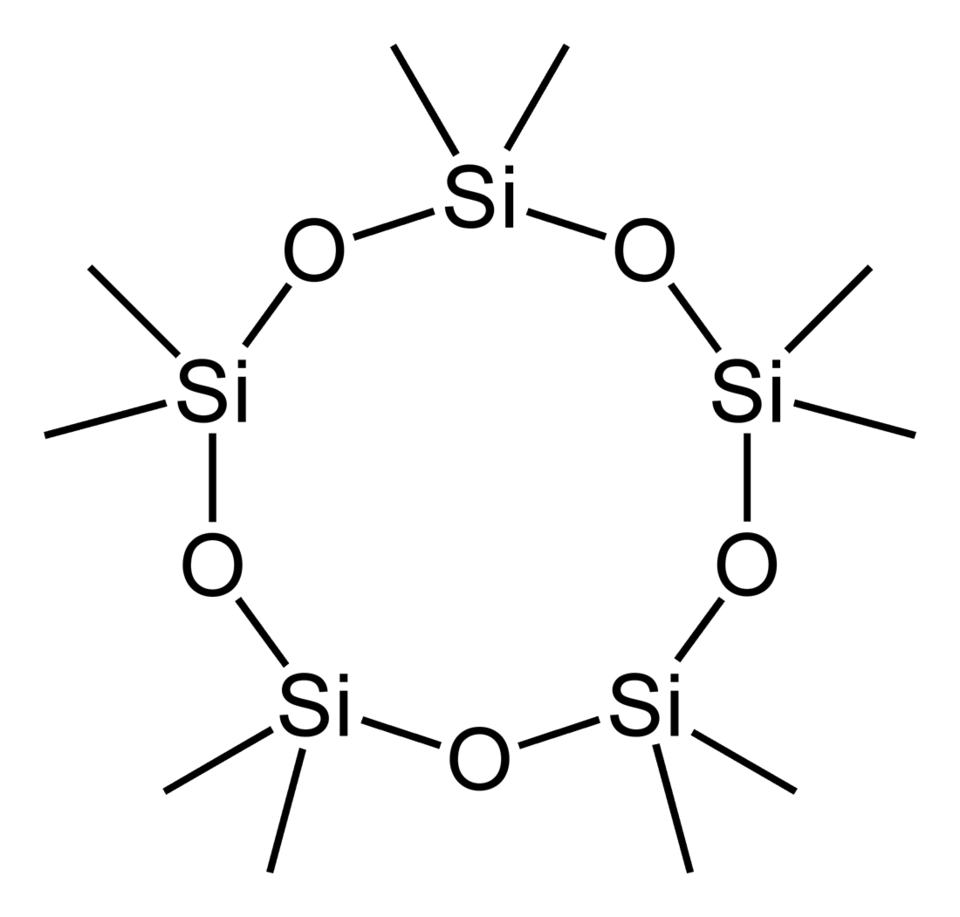
Skeletal structure of D5 (decamethylcyclopentasiloxane).
Credit: Ben Mills / Wikimedia Commons

License: Public domain
Wikimedia-provided scaled PNG/JPEG rendering; no content edits
What it is
Cyclic siloxanes are rings of alternating silicon and oxygen atoms with methyl groups attached. D4 has four silicon atoms (CAS 556-67-2), D5 has five (CAS 541-02-6) and D6 has six (CAS 540-97-6). [1]
What it does and why it is used
They give cosmetics a smooth, silky feel, help products spread and then evaporate, and carry other ingredients. They are also used to make silicone polymers and, historically, as dry-cleaning solvents. [1]
Regulatory status and health context
Canada
D4 was added to the List of Toxic Substances under the Canadian Environmental Protection Act because of potential environmental harm. For D5, Canada concluded in 2012 that it is not harmful to the environment, following an independent Board of Review. [3,4]
United States
The sources used here do not show a US restriction on cyclic siloxanes in cosmetics.
European Union
The EU restricted D4 and D5 in wash-off cosmetics from 31 January 2020. Regulation (EU) 2024/1328 extends the restriction: D4, D5 and D6 may not be placed on the market at 0.1% or more by weight after 6 June 2026, with cosmetic products other than wash-off products covered after 6 June 2027. [1]
Environmental notes
EU assessors used total environmental releases as a proxy for risk because of these chemicals' persistence and potential to build up in organisms. A 2013 review found them in air, water, soil, sediment and wildlife; some aquatic organisms showed high bioaccumulation, although measured levels in water, sediment and soil were below no-effect levels. [1,5]
Quick facts
- Members: D4, D5, D6. [1]
- Use: leave-on and wash-off cosmetics, hair care, deodorants. [1]
- Main concern: environmental persistence and bioaccumulation (established). [1]
- Human risk: appears low; rat reproductive findings disputed. [2]
- EU: 0.1% limit in leave-on cosmetics after 6 June 2027. [1]
Sources
Sources were accessed on 2026-11-21. Source publication dates differ from this draft's review date. Image licences are listed with each image.
- European Commission: Regulation (EU) 2024/1328 restricting D4, D5 and D6 under REACH (EUR-Lex).
- Franzen A et al. Toxicology of octamethylcyclotetrasiloxane (D4). Toxicol Lett, 2017 (PubMed).
- Environment and Climate Change Canada: Toxic substances list, siloxane D4.
- Government of Canada: Government of Canada concludes siloxane D5 is not harmful to the environment, 2012.
- Wang DG et al. Review of recent advances in research on the toxicity, detection, occurrence and fate of cyclic volatile methyl siloxanes in the environment. Chemosphere, 2013 (PubMed).