
Steviol glycosides: the plant-based sweetener from stevia leaves
CAS 58543-16-1.Also known as stevia, rebaudioside A, stevioside, and E960a.
Editorial draft Last reviewed 15 November 2026 About 675 words
CC INDEX
How it works38/100 Mild
High-purity steviol glycosides are accepted by FDA and permitted in Canada and the EU, and the sources reviewed describe no serious harm at permitted levels. Their use in drinks and table-top sweeteners makes exposure common. Purity requirements and WHO's caution on weight control keep regulation in view, so the score sits in the mild band.
An editorial summary of this article’s cited evidence. It isn’t medical advice or a personal risk estimate.
Age index
What is the age index?Which age groups are more affected by this chemical’s possible health issues, based on this article’s sources.
- Pregnancy Unborn babies Not well studied
- Infants 0 to 1 Not well studied
- Young children 1 to 5 Lower concern
- Children 6 to 12 Lower concern
- Teens 13 to 19 Lower concern
- Adults 20 to 64 Lower concern
- Older adults 65 and over Lower concern
- The sources reviewed do not identify any age group at special risk from purified steviol glycosides; they give little data for pregnancy or infancy.

Illustration of a stevia plant and sweetener. Steviol glycosides are extracted from stevia leaves.
Credit: Chemical Century; AI-generated illustration
License: CC0 1.0
Illustration, not a photograph of a specific product. Resized and cropped for the web.
Stevia sweeteners come from the sweet compounds in the leaves of a South American plant, purified into very sweet powders and drops. Many people like them because they add sweetness without calories and sound natural. Regulators in the US, Canada and Europe allow purified forms, though not every crude leaf extract has the same approval. As with other sugar substitutes, they may help cut sugar, but they are not a proven route to weight loss.
Everyday exposure: where you meet it and how much
Steviol glycosides are natural constituents of the leaves of Stevia rebaudiana, a plant native to parts of South America, and are reported to be 200 to 400 times sweeter than table sugar. [1] They are used as general-purpose sweeteners in foods and drinks. [1] MedlinePlus describes stevia as a zero-calorie sweetener because it is not broken down by the body for energy. [2]
Known and suspected harms
Evidence labels are editorial summaries, not individual risk predictions: established means recognized under the stated conditions; probable means a likely contribution with uncertainty; possible means limited evidence; disputed means assessors disagree. These labels do not describe how common an effect is.
- Established — accepted at high purity: FDA has evaluated many notices for high-purity (at least 95%) steviol glycosides, including rebaudioside A and stevioside, and has not questioned their generally recognized as safe status. [1] The acceptable daily intake set by the Joint FAO/WHO Expert Committee is 4 mg per kg of body weight, expressed as steviol equivalents. [1]
- Established — crude extracts treated differently: stevia leaf and crude stevia extracts are not considered generally recognized as safe in the US, and their import for use as sweeteners is not permitted. [1]
- Disputed — weight control: WHO's 2023 conditional guideline advises against using non-sugar sweeteners to control body weight and names stevia and stevia derivatives among those covered. [5]
Reducing avoidable exposure and harm
Use stevia sweeteners within normal amounts, and choose products made from purified extracts. If your goal is weight control, WHO suggests reducing sweetness overall, for example with fruit or unsweetened foods and drinks. [5]
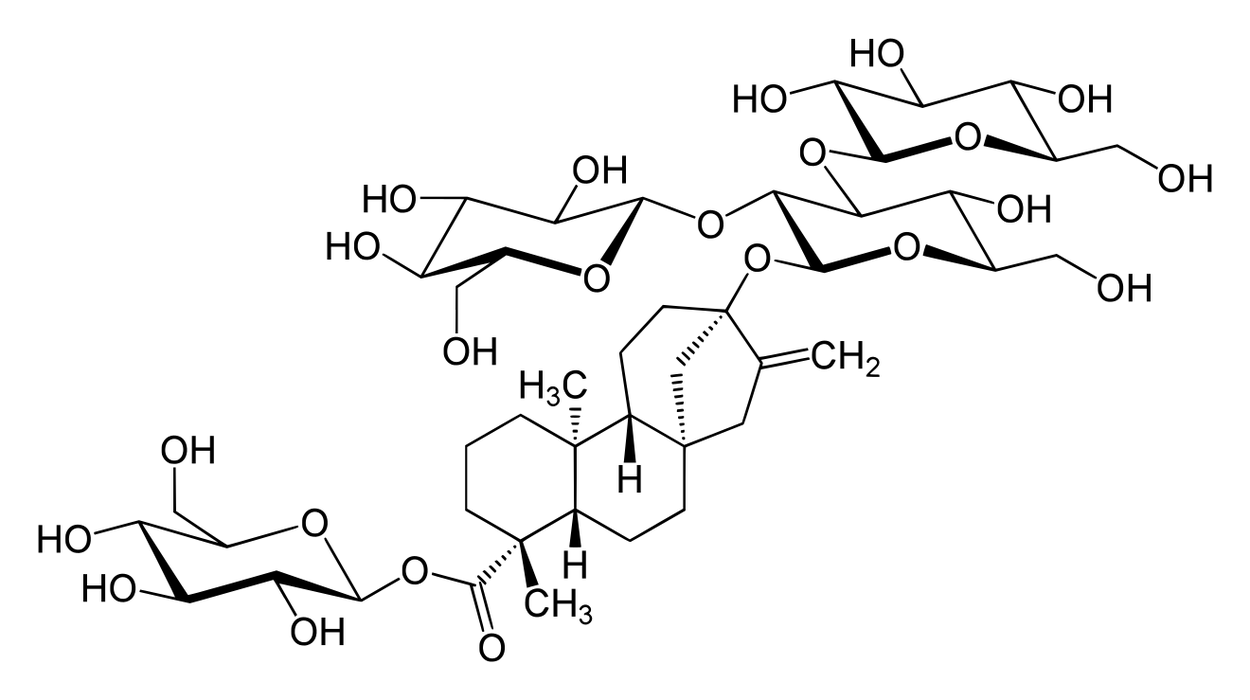
Structural formula of rebaudioside A, a common steviol glycoside.
Credit: Yikrazuul / Wikimedia Commons

License: Public domain
Rendered from SVG to PNG, whitespace trimmed and placed on white
What it is
Steviol glycosides are a family of sweet compounds, such as rebaudioside A (CAS 58543-16-1) and stevioside, from stevia leaves. [1,6]
What it does and why it is used
They provide intense sweetness with no calories in drinks, table-top sweeteners and other foods. [1,2]
Regulatory status and health context
Canada
Health Canada's List of Permitted Sweeteners includes steviol glycosides from Stevia rebaudiana Bertoni and from certain fermentation organisms, with set maximum levels in specific foods. [3]
United States
FDA has no questions about the generally recognized as safe conclusions for high-purity steviol glycosides under their intended use, but does not consider whole leaf or crude extracts generally recognized as safe. [1]
European Union
EFSA lists steviol glycosides from stevia (E 960a) as an authorized sweetener first evaluated in 2010, with enzymatically produced and glucosylated forms evaluated later. [4]
Environmental notes
The sources used for this review do not assess steviol glycosides' environmental effects, so we do not summarize them here.
Quick facts
- CAS: 58543-16-1 (rebaudioside A). [6]
- Where: table-top sweeteners, drinks and reduced-sugar foods. [1,2]
- Main concern: limited value for weight control, per WHO. [5]
- Most at risk: no group singled out by the sources reviewed. [1]
Sources
All URLs were fetched on 2026-11-15; Health Canada pages were read with a separate web-reading tool because they did not respond to this review's direct requests, and EFSA pages were read with a browser. The EU law website was not fully available that day, so EU legislation itself could not be checked. Source publication dates differ from this draft's review date.