
Sodium carbonate: washing soda cleans well but can burn the mouth and eyes
CAS 497-19-8.Also known as washing soda, soda ash, and disodium carbonate.
Editorial draft Last reviewed 15 November 2026 About 710 words
CC INDEX
How it works46/100 Moderate
Sodium carbonate can burn the mouth, throat and eyes, but MedlinePlus says small amounts are usually not very poisonous. It is common in automatic dishwashing soaps, so household contact is frequent. Containers of corrosive products face general Canadian packaging rules, so the score sits in the moderate band.
An editorial summary of this article’s cited evidence. It isn’t medical advice or a personal risk estimate.
Age index
What is the age index?Which age groups are more affected by this chemical’s possible health issues, based on this article’s sources.
- Pregnancy Unborn babies Not well studied
- Infants 0 to 1 Not well studied
- Young children 1 to 5 Higher concern
- Children 6 to 12 Moderate
- Teens 13 to 19 Moderate
- Adults 20 to 64 Moderate
- Older adults 65 and over Moderate
- Young children (higher concern): Dishwasher soaps can be swallowed or splashed into eyes by small children
- Severity depends mostly on how much is swallowed or how long it stays in contact with eyes or skin; the sources reviewed do not give age-specific data beyond the general poisoning risk for young children.

Illustration of a kitchen. Sodium carbonate, or washing soda, is found in automatic dishwashing soaps.
Credit: Chemical Century; AI-generated illustration
License: CC0 1.0
Illustration, not a photograph of a specific product. Resized and cropped for the web.
Washing soda is a close chemical cousin of baking soda, and it turns up in automatic dishwasher soaps, some bubble baths and steam iron cleaners. Small amounts usually do little harm, which is reassuring for anyone who has had a splash at the sink. Still, a mouthful or a splash in the eye can irritate or burn, and swallowing a large amount can be serious. A little care with storage and handling keeps it in the useful column.
Everyday exposure: where you meet it and how much
Sodium carbonate, or washing soda, is found in automatic dishwashing soaps, glass products, pulp and paper products, some bleaches, some bubble bath solutions and some steam iron cleaners. [1] Poisoning happens when someone swallows it or it gets into the eyes or onto the skin. [1]
It is also used in food processing in small amounts, under US rules that allow it at levels consistent with good manufacturing practice. [2]
Known and suspected harms
Evidence labels are editorial summaries, not individual risk predictions: established means recognized under the stated conditions; probable means a likely contribution with uncertainty; possible means limited evidence; disputed means assessors disagree. These labels do not describe how common an effect is.
- Established — injury when swallowed: swallowing sodium carbonate can cause severe pain in the mouth, throat, chest or abdomen, drooling, hoarseness, vomiting, diarrhea and swallowing difficulty; breathing problems from throat swelling, a rapid fall in blood pressure and collapse are possible. [1] If large amounts are swallowed, long-term effects and even death are possible without quick, aggressive treatment. [1]
- Established — eye and skin injury: contact can cause burning, drainage and pain of the skin or eyes, and vision loss. [1]
- Established — small amounts are usually less serious: MedlinePlus notes that sodium carbonate is usually not very toxic in small amounts, and that serious poisoning is rare. [1]
Reducing avoidable exposure and harm
Keep dishwasher soaps and other cleaning products in their original containers, closed and out of children's reach, and load detergent into the machine just before running it. Wear gloves for prolonged hand cleaning with washing soda and avoid splashing it into the eyes. If it gets on the skin or in the eyes, MedlinePlus advises flushing with lots of water for at least 15 minutes; if it is swallowed, contact a poison centre and do not make the person vomit unless told to. [1]
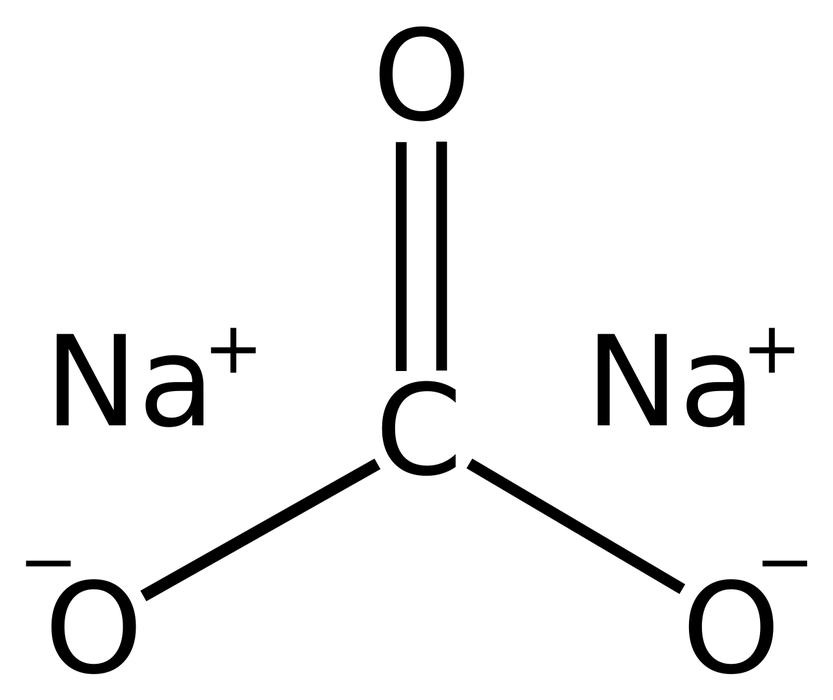
Structural formula of sodium carbonate.
Credit: Odie5533 / Wikimedia Commons

License: Public domain
Rendered from SVG to PNG, whitespace trimmed and placed on white
What it is
Sodium carbonate (CAS 497-19-8) is a white, water-soluble salt also called washing soda or soda ash. [2,3]
What it does and why it is used
In water it forms an alkaline solution that helps soften hard water and lift grease, which is why it appears in dishwashing products. [1] In food it is used as a pH control agent, curing and pickling agent, flavouring adjuvant, antioxidant and processing aid. [2]
Regulatory status and health context
Canada
Canada's Consumer Chemicals and Containers Regulations set hazard labelling and, for corrosive products, child-resistant container requirements for consumer chemical products; whether a given washing soda product is classed as corrosive depends on its formulation. [4]
United States
FDA lists sodium carbonate as generally recognized as safe as a direct food substance, used at levels consistent with good manufacturing practice. [2]
European Union
The EU law website was not fully available when this article was reviewed, so EU legal status was not checked and is not summarized here.
Environmental notes
The sources used for this review do not assess sodium carbonate's environmental effects, so we do not summarize them here.
Quick facts
- CAS: 497-19-8. [2,3]
- Where: automatic dishwashing soaps, some bleaches, bubble baths and steam iron cleaners. [1]
- Main danger: burns to the mouth, throat and eyes. [1]
- Most at risk: young children who get into cleaning products. [1]
Sources
All URLs were fetched on 2026-11-15. The EU law website was not fully available that day, so EU legislation could not be checked for this review. Source publication dates differ from this draft's review date.