
Skin and personal careMedicines and health
Salicylic acid: the acne and wart treatment that should not be overused
CAS 69-72-7.Also known as 2-hydroxybenzoic acid, salicylate, and benzoic acid, 2-hydroxy-.
Editorial draft Last reviewed 15 November 2026 About 756 words
CC INDEX
How it works54/100 Moderate
Topical salicylic acid usually causes only irritation, but overuse or swallowing can cause salicylate poisoning with possible permanent kidney damage. It is common in acne, dandruff and wart products, so exposure is frequent. EU cosmetics law sets limits and child restrictions, so the score sits in the moderate band.
An editorial summary of this article’s cited evidence. It isn’t medical advice or a personal risk estimate.
Age index
What is the age index?Which age groups are more affected by this chemical’s possible health issues, based on this article’s sources.
- Pregnancy Unborn babies Not well studied
- Infants 0 to 1 Higher concern
- Young children 1 to 5 Higher concern
- Children 6 to 12 Moderate
- Teens 13 to 19 Moderate
- Adults 20 to 64 Lower concern
- Older adults 65 and over Lower concern
- Infants (higher concern): EU rules bar most salicylic acid products for children under 3
- Young children (higher concern): Swallowed wart removers can cause serious salicylate poisoning
- Children and teenagers with chickenpox or flu should not use topical salicylic acid unless told to by a doctor because of the risk of Reye's syndrome. EU rules restrict its use for children under 3.

Illustration of a bathroom shelf. Salicylic acid is used in some acne cleansers, dandruff shampoos and wart treatments.
Credit: Chemical Century; AI-generated illustration
License: CC0 1.0
Illustration, not a photograph of a specific product. Resized and cropped for the web.
Salicylic acid is the active ingredient in many acne washes, dandruff shampoos and corn and wart treatments, where it helps loosen and shed dead skin. Used on small areas as directed, it is a familiar and generally helpful product. Problems are more likely when it is spread over large areas, used under bandages for long periods or swallowed, because the body can absorb enough to cause poisoning. Children and teens with chickenpox or flu are also advised to avoid it unless a doctor says otherwise.
Everyday exposure: where you meet it and how much
Topical salicylic acid is used to clear and prevent acne blemishes and to treat scaling skin conditions such as psoriasis, ichthyoses, dandruff, corns, calluses and warts on the hands or feet. [1] It is also used in cosmetics, including hair products, within set limits in the EU. [3] Wart removers are a source of salicylates that can cause poisoning if swallowed or overused. [2]
Known and suspected harms
Evidence labels are editorial summaries, not individual risk predictions: established means recognized under the stated conditions; probable means a likely contribution with uncertainty; possible means limited evidence; disputed means assessors disagree. These labels do not describe how common an effect is.
- Established — skin irritation: salicylic acid may cause skin irritation and stinging where it is applied. [1]
- Established — salicylate poisoning: too much can cause confusion, dizziness, extreme tiredness or weakness, headache, fast breathing, ringing in the ears, hearing loss, nausea, vomiting and diarrhea. [1] Wart remover poisoning can also cause seizures, hallucinations, breathing problems and kidney failure, and kidney damage can be permanent. [2]
- Established — Reye's syndrome risk: children and teenagers with chickenpox or flu should not use topical salicylic acid unless told to by a doctor because of the risk of Reye's syndrome, a serious condition. [1]
- Established — allergic reactions: rarely, hives, itching, throat tightness, breathing difficulty, faintness or swelling of the face and lips require stopping the product and getting emergency help. [1]
Reducing avoidable exposure and harm
Apply salicylic acid only to the affected area and not to large areas of the body, broken, irritated or infected skin, or under a bandage, unless a doctor says so. [1] Do not use wart removers on the face, genitals, moles or birthmarks. [1] Keep products away from the eyes, nose and mouth, and store them out of children's reach. [1,2] Ask a clinician before use if you have diabetes or blood vessel, kidney or liver disease. [1]
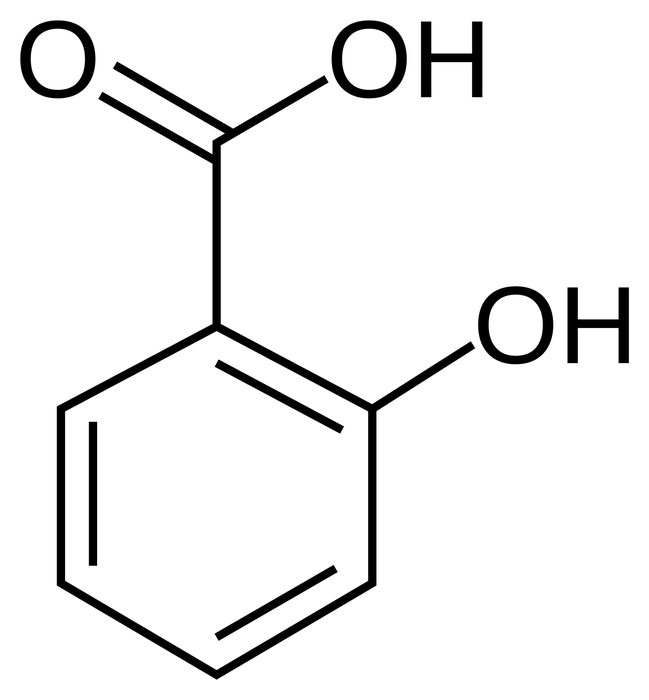
Skeletal structure of salicylic acid.
Credit: Benjah-bmm27 and Booyabazooka / Wikimedia Commons

License: Public domain
Rendered from SVG to PNG, whitespace trimmed and placed on white
What it is
Salicylic acid (CAS 69-72-7), also called 2-hydroxybenzoic acid, is an organic acid used on the skin in cloths, creams, lotions, liquids, gels, ointments and shampoos. [1,3,4]
What it does and why it is used
It belongs to a class of medicines called keratolytic agents. [1] It treats acne by reducing swelling and redness and unplugging blocked pores, and treats scaling conditions by softening the skin so that scales can be shed. [1]
Regulatory status and health context
Canada
The sources used for this review do not cover salicylic acid's status in Canada, so we do not summarize it here.
United States
The sources used for this review describe US product directions and warnings but do not summarize US regulatory limits, so we do not summarize them here. [1]
European Union
The EU cosmetics regulation allows salicylic acid up to 3% in rinse-off hair products and 2% in other products, not in preparations for children under 3 except shampoos, and separately allows it as a preservative at up to 0.5%. [3]
Environmental notes
The sources used for this review do not assess salicylic acid's environmental effects, so we do not summarize them here.
Quick facts
- CAS: 69-72-7. [3,4]
- Where: acne washes, dandruff shampoos, corn, callus and wart treatments. [1]
- Main danger: salicylate poisoning from overuse or swallowing. [1,2]
- Most at risk: young children; children and teens with chickenpox or flu. [1,2]
Sources
All URLs were fetched on 2026-11-15, except the EU cosmetics regulation: the EU law website was not fully available that day, so it was read from a copy fetched for earlier Chemical Century articles in November 2026. That copy is the regulation as originally published, and later amendments were not checked. Source publication dates differ from this draft's review date.