
Cleaning and laundryHousehold materials
Potassium hydroxide: the lye in drain cleaners and cuticle removers, and why it burns
CAS 1310-58-3.Also known as lye, potash, caustic potash, and KOH.
Editorial draft Last reviewed 15 November 2026 About 635 words
CC INDEX
How it works50/100 Moderate
Potassium hydroxide causes severe burns to skin, eyes and the digestive tract, and swallowing it can cause damage that keeps developing for weeks. It is found in some drain cleaners, paint removers and cuticle removers. US rules require child-resistant packaging for many household products that contain it, so the score sits in the moderate band.
An editorial summary of this article’s cited evidence. It isn’t medical advice or a personal risk estimate.
Age index
What is the age index?Which age groups are more affected by this chemical’s possible health issues, based on this article’s sources.
- Pregnancy Unborn babies Lower concern
- Infants 0 to 1 Moderate
- Young children 1 to 5 Moderate
- Children 6 to 12 Lower concern
- Teens 13 to 19 Lower concern
- Adults 20 to 64 Lower concern
- Older adults 65 and over Lower concern
- The sources used for this review do not give age-specific advice, but US rules require child-resistant packaging for household products with set amounts of potassium hydroxide.

Illustration of a drain cleaner by a sink. Some drain cleaners contain potassium hydroxide.
Credit: Chemical Century; AI-generated illustration
License: CC0 1.0
Illustration, not a photograph of a specific product. Resized and cropped for the web.
Potassium hydroxide, commonly called lye or potash, is a caustic chemical found in some drain cleaners, paint removers and cuticle removers. It can cause severe burns on contact with skin or eyes and serious damage if swallowed. Damage to the throat and stomach may keep developing for weeks after it is swallowed. US rules require child-resistant packaging for many household products that contain it.
Everyday exposure: where you meet it and how much
Potassium hydroxide comes as a powder, flakes or pellets. [1] It is found in cuticle removal products, drain cleaners, leather tanning chemicals, fertilizers, herbicides, paint removers and button or disc batteries. [1]
Known and suspected harms
Evidence labels are editorial summaries, not individual risk predictions: established means recognized under the stated conditions; probable means a likely contribution with uncertainty; possible means limited evidence; disputed means assessors disagree. These labels do not describe how common an effect is.
- Established — swallowing: symptoms include burns and severe pain in the mouth and throat, throat swelling that makes breathing difficult, drooling, severe abdominal pain, chest pain, vomiting that is often bloody, and a rapid drop in blood pressure. [1]
- Established — skin and eyes: contact can cause burning, severe pain and vision loss. [1]
- Established — delayed damage: damage to the esophagus and stomach continues for several weeks after swallowing, holes in these organs can lead to serious infections, and death from complications may occur months later. [1]
- Established — hazard classification: 99.4% of reports classify it as causing severe skin burns and eye damage and 96.1% as harmful if swallowed. [3] Percentages are shares of company reports to the European Chemicals Agency's classification inventory, as compiled by PubChem.
Reducing avoidable exposure and harm
If it gets on the skin or in the eyes, flush with lots of water (at least 2 quarts or 1.9 liters) for at least 15 minutes and seek medical help. [1] If it is swallowed, get medical help right away and do not make the person throw up unless poison control or a health care provider says to. [1] US rules require child-resistant packaging for dry household products with 10% or more free potassium or sodium hydroxide and other household products with 2% or more. [2]
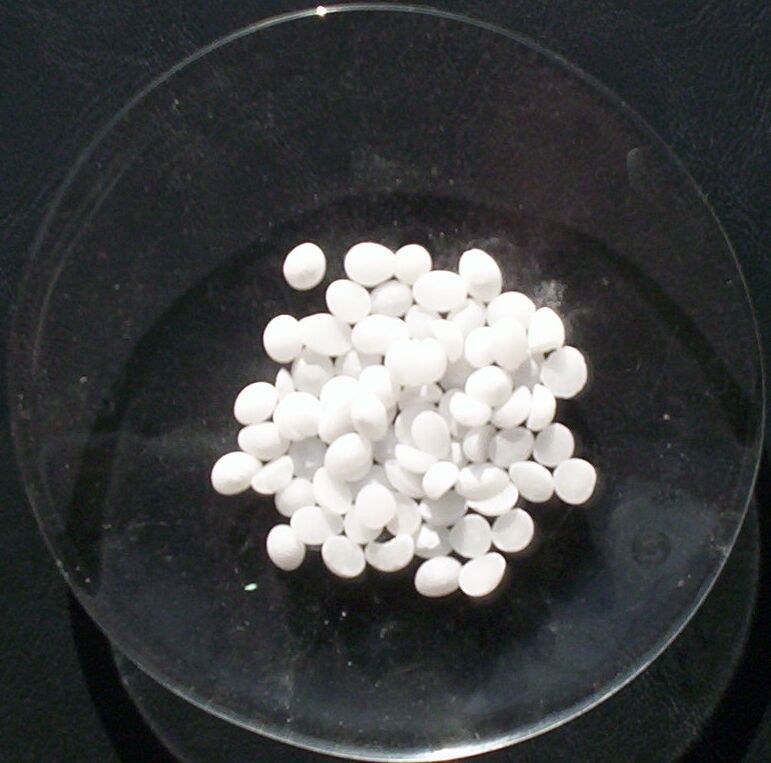
Potassium hydroxide pellets.
Credit: Walkerma / Wikimedia Commons

License: Public domain
Resized for the web; no content edits
What it is
Potassium hydroxide (CAS 1310-58-3) is a caustic chemical. [1,4]
What it does and why it is used
If it contacts tissues, it can cause severe damage such as burning or ulcers. [1]
Regulatory status and health context
Canada
The sources used for this review do not summarize Canadian rules for potassium hydroxide, so we do not describe them here.
United States
Under 16 CFR 1700.14, household substances in dry form with 10% or more free sodium or potassium hydroxide, and other household substances with 2% or more, must be in child-resistant packaging. [2]
European Union
The EU law website was not fully available when this article was reviewed, so EU legal status was not checked and is not summarized here.
Environmental notes
The sources used for this review do not assess potassium hydroxide's environmental effects, so we do not summarize them here.
Quick facts
- CAS: 1310-58-3. [4]
- Where: drain cleaners, paint removers, cuticle removers. [1]
- Main concern: severe burns to skin, eyes and digestive tract. [1]
- Most at risk: anyone handling the product; children if it is within reach. [1,2]
Sources
All URLs were fetched on 2026-11-15. The EU law website was not fully available that day, so EU legislation could not be checked for this review. Source publication dates differ from this draft's review date.