
Medicines and healthHousehold materials
Permethrin: the lice and scabies treatment that also guards clothing against ticks
CAS 52645-53-1.Also known as pyrethroid insecticide, permethrin cream, and permethrin-treated clothing.
Editorial draft Last reviewed 15 November 2026 About 744 words
CC INDEX
How it works40/100 Mild
Permethrin usually causes only mild skin effects as used, though very large amounts can affect the nervous system and animal studies at high doses raise a possible cancer question. It is used in lice and scabies treatments and treated clothing, so exposure is occasional. Health Canada limits treated clothing to people 16 and older, so the score sits in the mild band.
An editorial summary of this article’s cited evidence. It isn’t medical advice or a personal risk estimate.
Age index
What is the age index?Which age groups are more affected by this chemical’s possible health issues, based on this article’s sources.
- Pregnancy Unborn babies Not well studied
- Infants 0 to 1 Higher concern
- Young children 1 to 5 Moderate
- Children 6 to 12 Moderate
- Teens 13 to 19 Lower concern
- Adults 20 to 64 Lower concern
- Older adults 65 and over Lower concern
- Infants (higher concern): Not for babies under 2 months; avoid them chewing treated fabric
- MedlinePlus says permethrin treatments are for adults and children 2 months and older. Health Canada says permethrin-treated clothing is for adults, including pregnant women, and is not available for children under 16.

Illustration of outdoor clothing and a lice comb. Permethrin is used in lice and scabies treatments and in insect-repellent clothing.
Credit: Chemical Century; AI-generated illustration
License: CC0 1.0
Illustration, not a photograph of a specific product. Resized and cropped for the web.
Permethrin is a synthetic insecticide used in head-lice rinses, scabies creams and outdoor clothing treated to keep ticks and mosquitoes away. Used as directed, it is a well-established treatment, and the main side effects are usually itching, redness or tingling of the skin. Very large exposures can affect the nerves, but that is unlikely from normal use. It is also very toxic to fish, so it should be kept out of drains and waterways.
Everyday exposure: where you meet it and how much
Permethrin is used to treat scabies and, in over-the-counter products, head lice, in adults and children 2 months of age and older. [1] It belongs to a group of insecticides called pyrethroids, and ATSDR describes it as the most frequently used pyrethroid in the United States. [2]
In Canada, clothing treated with permethrin is sold to protect against mosquitoes and ticks. [3] ATSDR estimated average dietary intake of permethrin for an adult at about 3.2 micrograms a day, about 1,000 times below the acceptable daily intake set by FAO and WHO. [2]
Known and suspected harms
Evidence labels are editorial summaries, not individual risk predictions: established means recognized under the stated conditions; probable means a likely contribution with uncertainty; possible means limited evidence; disputed means assessors disagree. These labels do not describe how common an effect is.
- Established — skin effects: permethrin may cause itching, redness, numbness or tingling, and rash where it is applied. [1] ATSDR notes that getting a large amount of a pyrethroid on the skin can cause numbness, itching, burning, stinging, tingling or warmth for a few hours. [2]
- Established — nerve effects at large doses: very large amounts entering the body might cause dizziness, headache and nausea, and even larger amounts muscle twitching, convulsions and loss of consciousness; ATSDR says normal exposure is unlikely to reach these levels. [2]
- Possible — cancer: some animal studies suggest pyrethroids might be able to cause cancer, but those animals ate very large amounts. [2]
- Established — no human evidence of birth defects: ATSDR reports no evidence that pyrethrins or pyrethroids cause birth defects in humans or affect fertility. [2]
Reducing avoidable exposure and harm
Use lice and scabies treatments exactly as directed and only for people 2 months and older. [1] Tell your doctor if you are pregnant or breastfeeding, or have skin conditions or sensitivities. [1] Adults wearing permethrin-treated clothing can hug young children but should avoid prolonged contact, such as carrying a child who may suck or chew on the fabric. [3] Keep products away from drains and water, since many pyrethroids are extremely toxic to fish. [2]
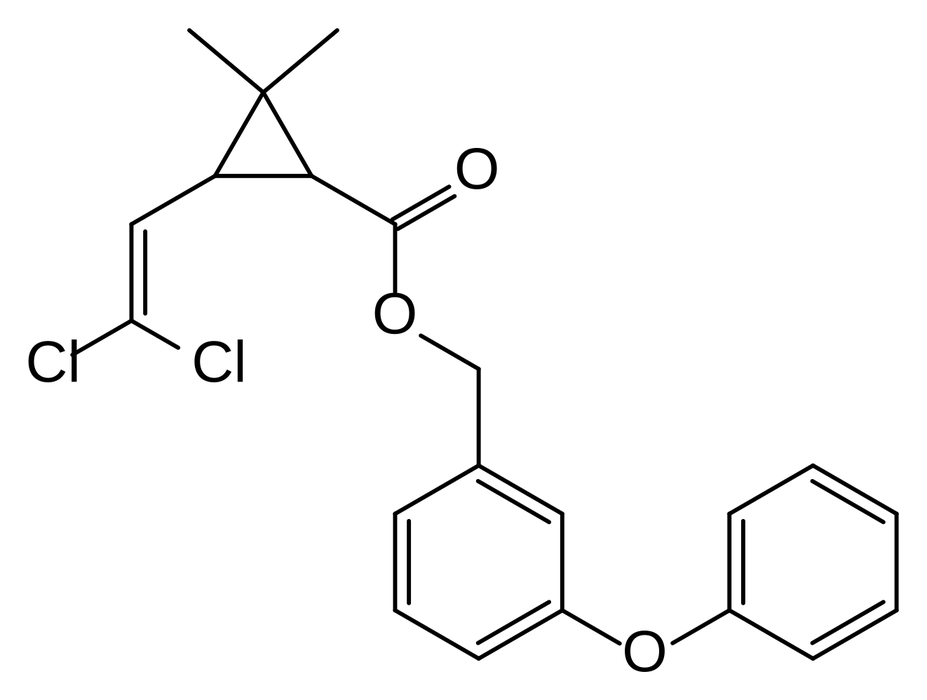
Structural formula of permethrin.
Credit: Blech / Wikimedia Commons

License: Public domain
Rendered from SVG to PNG, whitespace trimmed and placed on white
What it is
Permethrin (CAS 52645-53-1) is a synthetic pyrethroid insecticide. [2,4]
What it does and why it is used
Pyrethroids interfere with the way nerves work, which kills or repels insects; permethrin is used as a scabicide, a lice treatment and a clothing treatment. [1,2,3]
Regulatory status and health context
Canada
Health Canada permits permethrin-treated clothing for adults, including pregnant women, but says it is not available for children under 16. [3] The clothing can stay effective for a number of washes, as stated on the label. [3]
United States
MedlinePlus describes prescription permethrin for scabies and over-the-counter permethrin for lice. [1] The sources used for this review do not summarize US regulatory limits.
European Union
The EU law website was not fully available when this article was reviewed, so EU legal status was not checked and is not summarized here.
Environmental notes
ATSDR says many pyrethroids are extremely toxic to fish, so they are usually not sprayed directly onto water, though they can reach lakes and rivers in runoff; they bind strongly to soil. [2]
Quick facts
- CAS: 52645-53-1. [4]
- Where: lice and scabies treatments; insect-repellent clothing. [1,3]
- Main concern: skin irritation; nerve effects only at very large doses. [1,2]
- Most at risk: babies under 2 months; fish and other aquatic life. [1,2]
Sources
All URLs were fetched on 2026-11-15; Health Canada pages were read with a separate web-reading tool because they did not respond to this review's direct requests. The EU law website was not fully available that day, so EU legislation could not be checked. Source publication dates differ from this draft's review date.