
Water, air and residuesHousehold materials
Nitrogen dioxide: the traffic and gas-stove gas that irritates airways
CAS 10102-44-0.Also known as NO2, nitrogen oxides, and NOx.
Editorial draft Last reviewed 15 November 2026 About 862 words
CC INDEX
How it works64/100 High
Nitrogen dioxide irritates the airways and worsens asthma, and longer exposure may contribute to developing asthma. Nearly everyone breathes some from traffic, and homes with gas appliances can have more. Outdoor limits and indoor guidelines exist, so the score sits in the high band.
An editorial summary of this article’s cited evidence. It isn’t medical advice or a personal risk estimate.
Age index
What is the age index?Which age groups are more affected by this chemical’s possible health issues, based on this article’s sources.
- Pregnancy Unborn babies Not well studied
- Infants 0 to 1 Moderate
- Young children 1 to 5 Higher concern
- Children 6 to 12 Higher concern
- Teens 13 to 19 Moderate
- Adults 20 to 64 Moderate
- Older adults 65 and over Higher concern
- Young children (higher concern): Low levels may raise the risk of respiratory infections in young children
- Children (higher concern): EPA lists children among those at greater risk
- Older adults (higher concern): EPA lists older adults among those at greater risk
- EPA says people with asthma, children and older adults are generally at greater risk from nitrogen dioxide. Health Canada's long-term indoor guideline is based on respiratory symptoms seen in children with asthma.

Illustration of cooking on a gas stove. Gas stoves and other fuel-burning appliances are a main indoor source of nitrogen dioxide.
Credit: Chemical Century; AI-generated illustration
License: CC0 1.0
Illustration, not a photograph of a specific product. Resized and cropped for the web.
Nitrogen dioxide forms whenever fuel burns, so it comes from busy roads outdoors and from gas stoves, heaters and fireplaces indoors. At high enough levels it irritates the airways, and it can make asthma symptoms worse. Children, older adults and people with asthma tend to be the most affected. Good ventilation, especially running a vented hood fan while cooking with gas, is one of the simplest ways to keep indoor levels down.
Everyday exposure: where you meet it and how much
Nitrogen dioxide gets into outdoor air mainly from burning fuel, including emissions from cars, trucks, buses, power plants and off-road equipment. [1] Indoors, the main sources are gas stoves and other unvented fuel-burning appliances, kerosene heaters, poorly installed vented appliances, welding and tobacco smoke. [2]
Homes without fuel-burning appliances usually have about half the outdoor level, while homes with gas stoves, kerosene heaters or unvented gas space heaters often have more indoors than outdoors. [2] In studies of homes in Canadian cities, median indoor levels were generally 4 to 10 µg/m³, and 9 to 22 µg/m³ in homes with gas stoves. [3]
Known and suspected harms
Evidence labels are editorial summaries, not individual risk predictions: established means recognized under the stated conditions; probable means a likely contribution with uncertainty; possible means limited evidence; disputed means assessors disagree. These labels do not describe how common an effect is.
- Established — airway irritation and asthma: high concentrations can irritate the airways, and short exposures can aggravate respiratory diseases, especially asthma, leading to coughing, wheezing, difficulty breathing, hospital admissions and emergency visits. [1]
- Probable — longer exposure: longer exposures to elevated levels may contribute to the development of asthma and potentially increase susceptibility to respiratory infections. [1] EPA notes that low-level exposure may increase the risk of respiratory infections, especially in young children. [2]
- Established — very high exposure: extremely high doses, as in a building fire, can cause fluid in the lungs and widespread lung injury, and continued exposure to high levels can contribute to bronchitis. [2]
- Established — other pollutants: nitrogen dioxide reacts with other chemicals in the air to form particulate matter and ozone, which are also harmful to breathe. [1]
Reducing avoidable exposure and harm
Vent fuel-burning appliances to the outdoors and make sure they are correctly installed, used and maintained. [2] When cooking on a gas stove, use a hood fan that vents outside on a higher setting, and favour the back burners. [3] Do not idle a car in an attached garage, and do not use gas, propane or kerosene equipment in poorly ventilated enclosed spaces. [2,3]
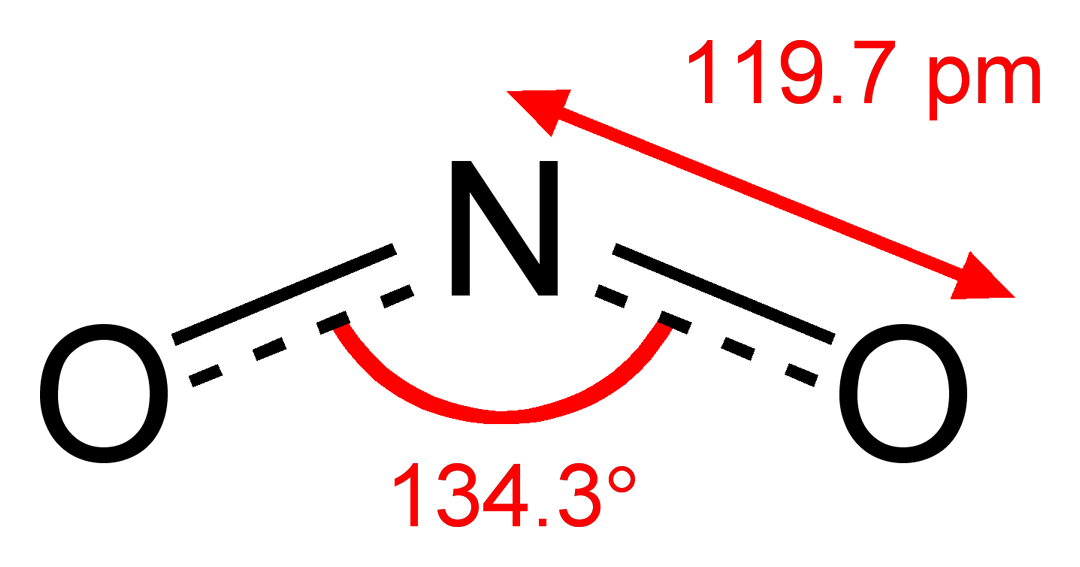
Structural formula of nitrogen dioxide (NO2).
Credit: Ben Mills / Wikimedia Commons

License: Public domain
Whitespace trimmed and placed on white
What it is
Nitrogen dioxide (CAS 10102-44-0) is a reddish-brown gas and one of a group of highly reactive gases called nitrogen oxides. [1,3,6] It is used as the indicator for the larger group. [1]
What it does and why it is used
It is not added to consumer products; it forms when fuel is burned. [1]
Regulatory status and health context
Canada
Health Canada's residential indoor air guideline sets a short-term (one hour) limit of 170 µg/m³ and a long-term limit of 20 µg/m³ for nitrogen dioxide. [3] It says nearly all homes can meet these, although some homes with a gas stove may briefly exceed the short-term value after cooking. [3]
United States
EPA's national outdoor air standards for nitrogen dioxide are 100 ppb over 1 hour and 53 ppb as an annual mean. [4] EPA notes that no standards have been agreed upon for nitrogen oxides in indoor air. [2]
European Union
The EU air quality directive, as originally published in 2008, set limit values for nitrogen dioxide in outdoor air of 200 µg/m³ over 1 hour, not to be exceeded more than 18 times a year, and 40 µg/m³ as an annual average, both to be met by 1 January 2010. [5] Later changes were not checked for this review.
Environmental notes
Nitrogen dioxide and other nitrogen oxides help form acid rain, which harms sensitive lakes and forests, and they contribute to haze and to nutrient pollution in coastal waters. [1]
Quick facts
- CAS: 10102-44-0. [6]
- Where: traffic exhaust, gas stoves and other fuel-burning appliances. [1,2]
- Main danger: airway irritation and worse asthma. [1]
- Most at risk: people with asthma, children and older adults. [1]
Sources
All URLs were fetched on 2026-11-15; Health Canada pages were read with a separate web-reading tool because they did not respond to this review's direct requests. The EU law website was not fully available that day, so the EU air quality directive was read from a copy fetched for earlier Chemical Century articles in November 2026; that copy is the directive as originally published in 2008, and later amendments or replacements were not checked. Source publication dates differ from this draft's review date.
- US EPA: Basic information about NO2.
- US EPA: Nitrogen dioxide's impact on indoor air quality.
- Health Canada: Residential indoor air quality guideline for nitrogen dioxide.
- US EPA: NAAQS table.
- EUR-Lex: Directive 2008/50/EC on ambient air quality and cleaner air for Europe, as originally published.
- PubChem PUG REST: nitrogen dioxide synonyms.