
Naproxen: a common pain reliever with heart, stomach and pregnancy warnings
CAS 22204-53-1.Also known as naproxen sodium.
Editorial draft Last reviewed 14 November 2026 About 836 words
CC INDEX
How it works68/100 High
Naproxen carries a boxed warning for heart attack, stroke and gastrointestinal bleeding, and FDA warns about kidney problems in unborn babies from 20 weeks of pregnancy. It is widely used for everyday aches, so exposure is common. Packaging and labelling rules apply, so the score sits in the high band.
An editorial summary of this article’s cited evidence. It isn’t medical advice or a personal risk estimate.
Age index
What is the age index?Which age groups are more affected by this chemical’s possible health issues, based on this article’s sources.
- Pregnancy Unborn babies Higher concern
- Infants 0 to 1 Not well studied
- Young children 1 to 5 Not well studied
- Children 6 to 12 Not well studied
- Teens 13 to 19 Not well studied
- Adults 20 to 64 Moderate
- Older adults 65 and over Higher concern
- Pregnancy (higher concern): Rare kidney problems in the unborn baby from 20 weeks onward
- Older adults (higher concern): Higher risk of ulcers and bleeding in older age
- Risks of stomach bleeding and heart problems also rise with long use, higher doses, smoking and heavy drinking at any adult age.

Illustration of tablets, a pill organiser and a knee sleeve. Naproxen is used for arthritis, aches and menstrual pain.
Credit: Chemical Century; AI-generated illustration
License: CC0 1.0
Illustration, not a photograph of a specific product. Resized and cropped for the web.
Naproxen is a common pain and fever reliever, reached for after a sore back, a toothache, menstrual cramps or an arthritis flare. Like other drugs in its class, it carries real risks that tend to grow with higher doses and longer use: stomach ulcers and bleeding, and a higher chance of heart attack or stroke. Older adults, people who smoke or drink heavily and people taking blood thinners need to be especially careful. Pregnancy is another reason for caution, since use from about the middle of pregnancy onward has been linked to rare but serious kidney problems in the unborn baby.
Everyday exposure: where you meet it and how much
Nonprescription naproxen is used to reduce fever and relieve mild pain from headaches, muscle aches, arthritis, menstrual periods, the common cold, toothaches and backaches. [1] Prescription naproxen treats pain, swelling and stiffness from several kinds of arthritis, as well as shoulder pain from bursitis or tendinitis, gout attacks, menstrual pain and other pain. [1]
It belongs to the nonsteroidal anti-inflammatory drugs (NSAIDs), along with medicines such as ibuprofen and aspirin. [1,3]
Known and suspected harms
Evidence labels are editorial summaries, not individual risk predictions: established means recognized under the stated conditions; probable means a likely contribution with uncertainty; possible means limited evidence; disputed means assessors disagree. These labels do not describe how common an effect is.
- Established — ulcers and bleeding: NSAIDs such as naproxen may cause ulcers, bleeding or holes in the esophagus, stomach or intestine, which may happen without warning and may cause death; the risk may be higher with long use, higher doses, older age, poor health, smoking or heavy drinking. [1]
- Established — heart attack and stroke: people who take NSAIDs other than aspirin may have a higher risk of heart attack or stroke, which may happen without warning and may cause death; the risk may be higher with long use or higher doses. [1]
- Established — pregnancy: FDA warns that NSAID use around 20 weeks of pregnancy or later may cause rare but serious kidney problems in the unborn baby, leading to low amniotic fluid; around 30 weeks, NSAIDs can also cause a heart problem in the unborn baby. [3] Among 35 such cases reported to FDA through 2017, all were serious. [3]
- Established — medicine interactions: MedlinePlus advises telling a doctor about blood thinners, aspirin, other NSAIDs, oral steroids and certain antidepressants before taking naproxen. [1]
- Established — overdose: symptoms can include drowsiness, severe headache, confusion, ringing in the ears, stomach pain with possible bleeding, slow breathing, seizures and coma. [2]
Reducing avoidable exposure and harm
Follow the package or prescription directions, keeping in mind that the risks of bleeding and heart problems may be higher with long use or higher doses. [1] Do not take naproxen if you recently had a heart attack unless a doctor says to, and get emergency help for chest pain, shortness of breath, weakness on one side of the body or slurred speech. [1] Avoid NSAIDs from 20 weeks of pregnancy unless a health care professional advises otherwise. [3] Check labels so you do not take two NSAIDs at once, and keep medicines in their child-resistant packaging. [1,4]
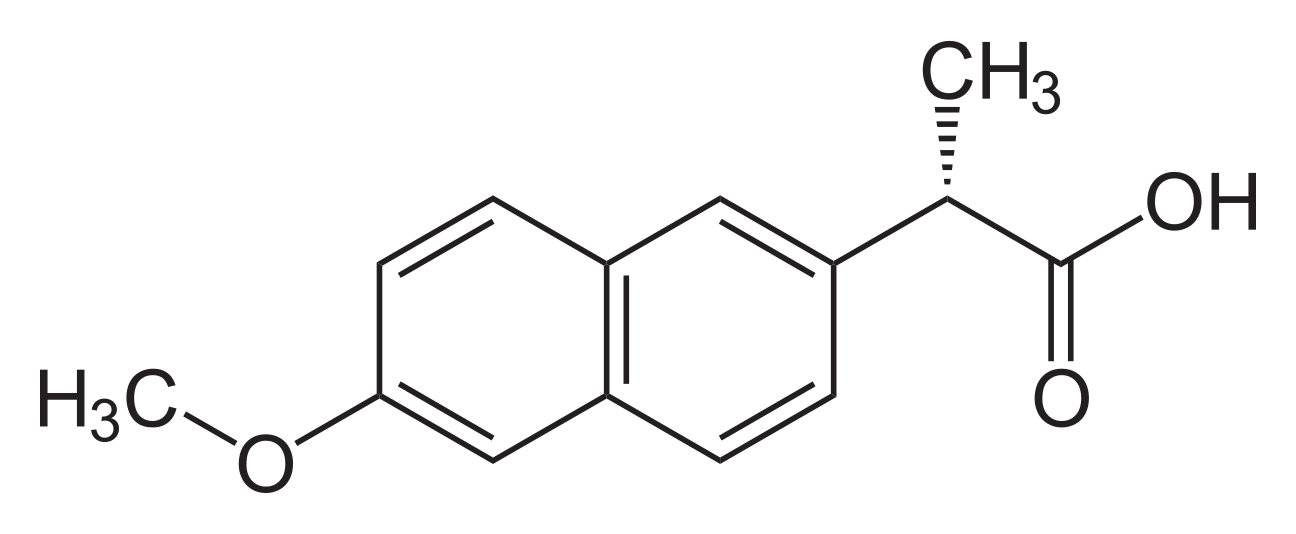
Skeletal structure of naproxen.
Credit: NEUROtiker / Wikimedia Commons

License: Public domain
Rendered from SVG to PNG, whitespace trimmed and placed on white
What it is
Naproxen (CAS 22204-53-1) is an NSAID, available with and without a prescription, including as naproxen sodium. [1,2,5]
What it does and why it is used
It works by stopping the body's production of a substance that causes pain, fever and inflammation. [1]
Regulatory status and health context
Canada
The sources used for this review do not cover naproxen's status in Canada, so we do not summarize it here.
United States
Prescription naproxen carries a boxed warning about heart attack, stroke and gastrointestinal bleeding. [1] FDA required NSAID labels to describe the risk of kidney problems in unborn babies and recommends avoiding NSAIDs at 20 weeks of pregnancy or later, rather than the 30 weeks previously described. [3] Naproxen products with 250 milligrams or more in a single retail package must use child-resistant packaging. [4]
European Union
The sources used for this review do not cover naproxen's status in the European Union, so we do not summarize it here.
Environmental notes
The sources used for this review do not assess naproxen's environmental effects, so we do not summarize them here.
Quick facts
- CAS: 22204-53-1. [5]
- Where: nonprescription and prescription pain and fever relievers. [1]
- Main danger: stomach bleeding, heart attack and stroke; kidney problems in the unborn baby. [1,3]
- Most at risk: older adults, people with heart disease, people from 20 weeks of pregnancy. [1,3]
Sources
All URLs were fetched on 2026-11-14. Source publication dates differ from this draft's review date.
- MedlinePlus: Naproxen.
- MedlinePlus: Naproxen sodium overdose.
- US FDA: FDA recommends avoiding use of NSAIDs in pregnancy at 20 weeks or later because they can result in low amniotic fluid.
- eCFR: 16 CFR 1700.14, substances requiring special (child-resistant) packaging.
- PubChem PUG REST: naproxen synonyms.