
Loperamide: the diarrhea tablet that is safe at label doses and dangerous far above them
CAS 53179-11-6.Also known as loperamide hydrochloride and antidiarrheal.
Editorial draft Last reviewed 15 November 2026 About 736 words
CC INDEX
How it works58/100 Moderate
Taken far above the label, loperamide can cause serious heart rhythm problems and death, though label doses usually cause only constipation or tiredness. It is a common travel and household medicine. FDA warnings and age limits guide use, so the score sits in the moderate band.
An editorial summary of this article’s cited evidence. It isn’t medical advice or a personal risk estimate.
Age index
What is the age index?Which age groups are more affected by this chemical’s possible health issues, based on this article’s sources.
- Pregnancy Unborn babies Not well studied
- Infants 0 to 1 Higher concern
- Young children 1 to 5 Moderate
- Children 6 to 12 Moderate
- Teens 13 to 19 Moderate
- Adults 20 to 64 Lower concern
- Older adults 65 and over Lower concern
- Infants (higher concern): Should not be given to children younger than 2 years
- MedlinePlus says loperamide should not be given to children younger than 2 and that older children's doses should follow the package chart by weight or age.

Illustration of packing for a trip. Loperamide is used to control sudden diarrhea, including travellers' diarrhea.
Credit: Chemical Century; AI-generated illustration
License: CC0 1.0
Illustration, not a photograph of a specific product. Resized and cropped for the web.
Loperamide is an anti-diarrhea medicine that can help control a sudden bout of loose stools, including travellers' diarrhea. Used as the label directs, it usually causes little more than constipation or tiredness. The real danger comes from taking far more than the label allows, which can upset the heart's rhythm. Diarrhea that lasts more than a couple of days, or comes with fever or blood, is a reason to see a doctor.
Everyday exposure: where you meet it and how much
Non-prescription loperamide is used to control acute diarrhea, including travellers' diarrhea; prescription loperamide is also used for ongoing diarrhea with inflammatory bowel disease. [1] It comes as a tablet, a capsule and a liquid, usually taken after each loose stool up to the 24-hour maximum on the label. [1] FDA gives the maximum approved adult dose as 8 mg a day for non-prescription use and 16 mg a day on prescription. [2]
Known and suspected harms
Evidence labels are editorial summaries, not individual risk predictions: established means recognized under the stated conditions; probable means a likely contribution with uncertainty; possible means limited evidence; disputed means assessors disagree. These labels do not describe how common an effect is.
- Established — heart rhythm problems at high doses: FDA warns that taking more than the recommended dose, including through misuse or abuse, can cause serious heart problems that can lead to death. [2] From 1976 through 2015 FDA received reports of 48 such cases, 31 hospitalizations and 10 deaths, mostly in people taking far more than the recommended dose. [2]
- Established — interactions: the risk of heart rhythm problems may be higher when high doses are taken with medicines that interact with loperamide. [2]
- Established — common side effects: constipation and fatigue; loperamide may also cause drowsiness and dizziness. [1]
- Established — warning signs: rash, blistering skin, wheezing, fever, stomach pain or swelling, or bloody stools need a doctor or emergency care; fainting, a fast or irregular heartbeat, or unresponsiveness need emergency help. [1,2]
Reducing avoidable exposure and harm
Never take more than the dose on the label or prescribed by a doctor. [2] Stop and call a doctor if symptoms get worse or diarrhea lasts longer than 48 hours. [1] Drink plenty of water or clear fluids to replace what diarrhea takes out of the body. [1] Ask a doctor first if you have a fever, blood or mucus in the stool, black stools or colitis. [1]
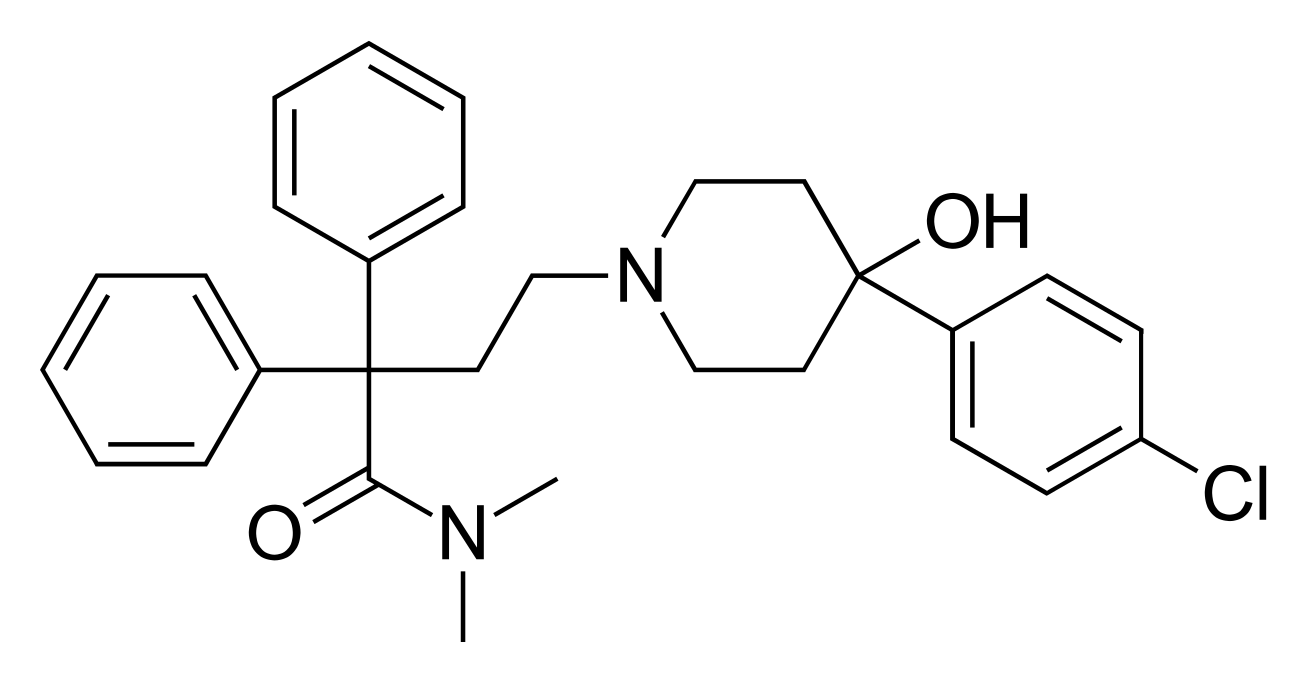
Structural formula of loperamide.
Credit: Yikrazuul / Wikimedia Commons

License: Public domain
Rendered from SVG to PNG, whitespace trimmed and placed on white
What it is
Loperamide (CAS 53179-11-6) is an antidiarrheal medicine, usually sold as loperamide hydrochloride (CAS 34552-83-5). [1,3,4]
What it does and why it is used
It decreases the flow of fluids and electrolytes into the bowel and slows the movement of the bowel, reducing the number of bowel movements. [1]
Regulatory status and health context
Canada
The sources used for this review do not summarize Canadian rules for loperamide, so we do not describe them here.
United States
Loperamide is sold both without a prescription and on prescription in the United States. [2] FDA warned in 2016 that high doses can cause serious heart problems, and said many reported cases involved people taking very high doses to self-treat opioid withdrawal or to get high. [2]
European Union
The EU law website was not fully available when this article was reviewed, so EU legal status was not checked and is not summarized here.
Environmental notes
The sources used for this review do not assess loperamide's environmental effects, so we do not summarize them here. MedlinePlus advises using a medicine take-back program rather than flushing unneeded medicine. [1]
Quick facts
- CAS: 53179-11-6. [3]
- Where: diarrhea tablets, capsules and liquids. [1]
- Main concern: heart rhythm problems at doses far above the label. [2]
- Most at risk: children under 2; people who take too much. [1,2]
Sources
All URLs were fetched on 2026-11-15; the FDA safety communication was read from a copy hosted on a US government regulations site because the original FDA address no longer resolved. The EU law website was not fully available that day, so EU legislation could not be checked. Source publication dates differ from this draft's review date.