
Water, air and residuesFood and drink
Imidacloprid: neonicotinoid residues on fruits and vegetables
CAS 138261-41-3.Also known as neonicotinoid, neonic, imidacloprid insecticide, and 5-hydroxy-imidacloprid (metabolite).
Editorial draft Last reviewed 21 November 2026 About 802 words
CC INDEX
How it works46/100 Moderate
Exposure is widespread, but human health studies are few and methodologically weak, and Health Canada found no dietary risk of concern. Environmental harm to pollinators led the EU to restrict it to greenhouses and Canada and the US to cut some uses.
An editorial summary of this article’s cited evidence. It isn’t medical advice or a personal risk estimate.
Age index
What is the age index?Which age groups are more affected by this chemical’s possible health issues, based on this article’s sources.
- Pregnancy Unborn babies Not well studied
- Infants 0 to 1 Not well studied
- Young children 1 to 5 Not well studied
- Children 6 to 12 Not well studied
- Teens 13 to 19 Not well studied
- Adults 20 to 64 Lower concern
- Older adults 65 and over Not well studied
- US biomonitoring found young children more likely than adults to have high levels of one neonicotinoid breakdown product, but health effects at any age are not established.

Illustration of produce and a pollinator. Imidacloprid residues can be found in fruits and vegetables; its strongest effects are on insects.
Credit: Chemical Century; AI-generated illustration
License: CC0 1.0
Illustration, not a photograph of a specific product. Resized and cropped for the web.
Imidacloprid is one of the most widely used insecticides in the world, sprayed on crops, coated on seeds, used on lawns and in flea treatments for pets. Because the plant takes it up into its tissues, small residues can end up inside fruits and vegetables rather than only on the surface. Nearly half of Americans tested had at least one neonicotinoid in their urine, but the few studies of human health effects are weak and do not show clear harm. The clearest damage is to bees and other insects, which is why Europe now limits its use to permanent greenhouses.
Everyday exposure: where you meet it and how much
Neonicotinoids are used in agriculture, landscaping and on household pets, and have replaced older organophosphate and carbamate insecticides. [1] In the 2015–2016 US national health survey, 49.1% of people aged 3 and older had at least one of six neonicotinoid markers in their urine. Children aged 3 to 5 were more likely than adults to have high levels of one acetamiprid breakdown product. [1]
In two studies of fruit and vegetable samples, imidacloprid was found in 52% (US Congressional cafeteria) and 66% (Hangzhou, China) of samples; US Department of Agriculture testing found it far less often, in 7.3% of samples. [2] Because imidacloprid is systemic, meaning it moves into plant tissues, washing may remove less of it than surface residues, although the sources used here do not measure this.
Known and suspected harms
Evidence labels are editorial summaries, not individual risk predictions: established means recognized under the stated conditions; probable means a likely contribution with uncertainty; possible means limited evidence; disputed means assessors disagree.
- Possible — developmental and neurological effects: a systematic review found only eight human studies. Four general-population studies reported associations between chronic neonicotinoid exposure and outcomes including a heart defect (tetralogy of Fallot), anencephaly, autism spectrum disorder and a symptom cluster with memory loss and finger tremor, but the authors called the findings "suggestive but methodologically weak." Poisoning studies reported two deaths among 1,280 cases. [3]
- Established — harm to pollinators: the EU restricted imidacloprid because of risks to bees, and EPA proposed measures to reduce pollinator exposure and to cancel spray uses on residential turf. [4,6]
Health Canada's 2021 re-evaluation found no dietary risk of concern for people. [5]
Reducing avoidable exposure
Keep eating a variety of fruits and vegetables. Rinsing produce is a sensible habit, though it may not remove residues inside plant tissue. Avoid using neonicotinoid products on home lawns and gardens; EPA proposed label language advising homeowners not to use them. [6]
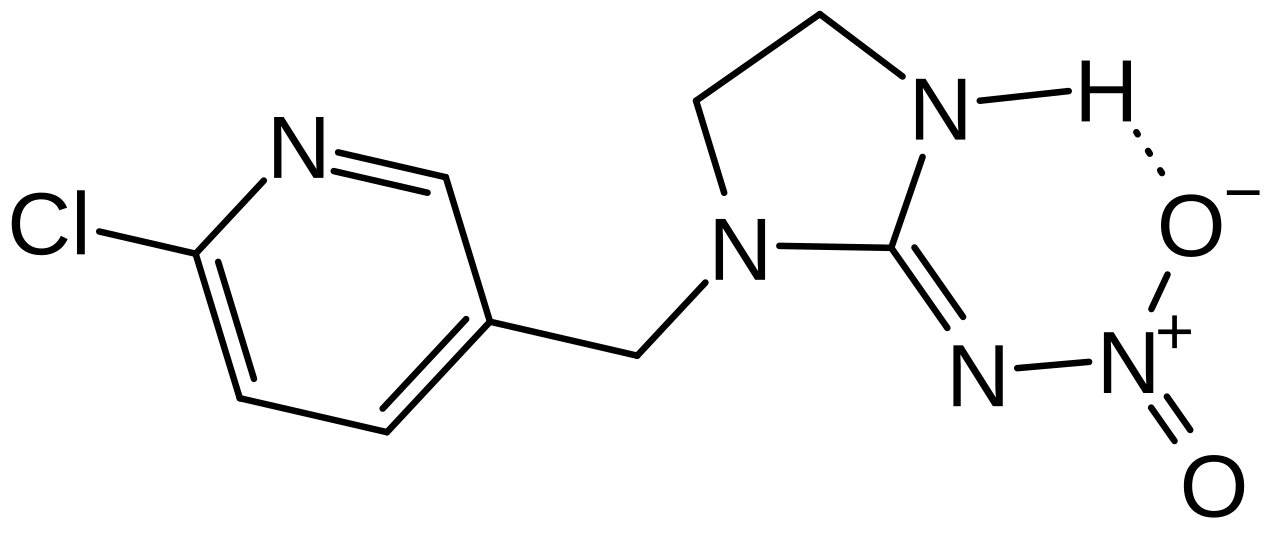
Structural formula of imidacloprid.
Credit: Steffen 962 / Wikimedia Commons

License: Public domain
Wikimedia-provided scaled PNG/JPEG rendering; no content edits
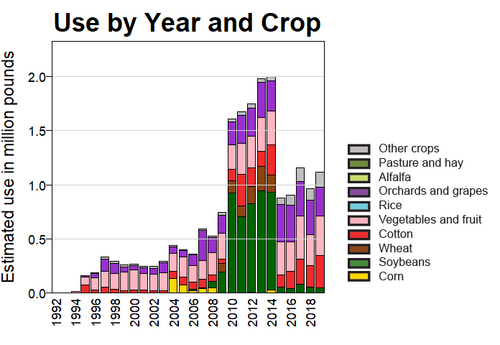
Estimated agricultural use of imidacloprid in the United States (US Geological Survey).
Credit: US Geographical Survey / Wikimedia Commons

License: Public domain
Wikimedia-provided scaled PNG rendering of a US Geological Survey map; no content edits
What it is
Imidacloprid (CAS 138261-41-3) is a neonicotinoid insecticide. Its breakdown product 5-hydroxy-imidacloprid is one of the markers measured in urine. [1]
What it does and why it is used
It is used on a wide variety of crops, turf, ornamental plants and pets (for fleas), and in residential and commercial indoor and outdoor uses. [6]
Regulatory status and health context
Canada
In its 2021 re-evaluation decision, Health Canada found no dietary risk of concern and cancelled some uses because of risks to the environment. [5]
United States
In 2020, EPA proposed interim decisions for imidacloprid and other neonicotinoids, including restrictions on application to blooming crops, label advice against homeowner use and cancellation of spray uses on residential turf. [6]
European Union
Implementing Regulation (EU) 2018/783 prohibited all outdoor uses and limited imidacloprid to permanent greenhouses, with the crop required to stay in the greenhouse for its entire life cycle. [4]
Environmental notes
Imidacloprid's main documented harm is to bees and other non-target insects, which drove restrictions in the EU, Canada and the US. [4,5,6]
Quick facts
- CAS: 138261-41-3. [1]
- US exposure: about half of people tested had a neonicotinoid marker. [1]
- Human evidence: few studies, methodologically weak (possible). [3]
- Health Canada: no dietary risk of concern. [5]
- EU: greenhouse use only since 2018. [4]
Sources
Sources were accessed on 2026-11-21. Source publication dates differ from this draft's review date. Image licences are listed with each image.
- Ospina M et al. Exposure to neonicotinoid insecticides in the U.S. general population: NHANES 2015–2016. Environ Res, 2019 (PubMed).
- Lu C et al. Neonicotinoid residues in fruits and vegetables: an integrated dietary exposure assessment approach. Environ Sci Technol, 2018 (PubMed).
- Cimino AM et al. Effects of neonicotinoid pesticide exposure on human health: a systematic review. Environ Health Perspect, 2017 (PubMed).
- European Commission: Implementing Regulation (EU) 2018/783 on imidacloprid (EUR-Lex).
- Health Canada: Re-evaluation decision RVD2021-05, imidacloprid and its associated end-use products.
- US EPA: EPA actions to protect pollinators.