
Hydrogen sulfide: the rotten-egg gas you should never ignore
CAS 7783-06-4.Also known as H2S, sewer gas, and sour gas.
Editorial draft Last reviewed 15 November 2026 About 775 words
CC INDEX
How it works54/100 Moderate
Very high concentrations can cause rapid unconsciousness, and higher levels irritate the eyes and airways. Typical environmental levels are unlikely to cause harm, and dangerous exposures mostly happen in enclosed work or farm spaces. The sources reviewed show few consumer limits, so the score sits in the moderate band.
An editorial summary of this article’s cited evidence. It isn’t medical advice or a personal risk estimate.
Age index
What is the age index?Which age groups are more affected by this chemical’s possible health issues, based on this article’s sources.
- Pregnancy Unborn babies Not well studied
- Infants 0 to 1 Not well studied
- Young children 1 to 5 Moderate
- Children 6 to 12 Moderate
- Teens 13 to 19 Moderate
- Adults 20 to 64 Moderate
- Older adults 65 and over Moderate
- ATSDR says children may have effects similar to adults, but it is not known whether they are more sensitive. Animal studies suggest low concentrations during pregnancy do not cause birth defects.

Illustration of a sulfur hot spring. Hot springs, swamps, sewers and manure storage are natural and farm sources of hydrogen sulfide.
Credit: Chemical Century; AI-generated illustration
License: CC0 1.0
Illustration, not a photograph of a specific product. Resized and cropped for the web.
Hydrogen sulfide is the gas behind the rotten-egg smell of hot springs, swamps and sewers, and our own gut bacteria make small amounts too. At the low levels found in everyday air it is unlikely to cause health problems. In enclosed spaces such as manure pits, sewers or industrial tanks, though, it can build up to dangerous levels very quickly. One tricky feature is that strong concentrations can dull your sense of smell, so a fading odour is not a sign of safety.
Everyday exposure: where you meet it and how much
Hydrogen sulfide occurs naturally in gases from volcanoes, sulfur springs, swamps, stagnant water, crude petroleum and natural gas. [1] It is also linked to sewers and sewage treatment plants, manure handling, pulp and paper mills, refineries, natural gas plants, food processing plants and tanneries. [1] Bacteria in the mouth and gut produce it while digesting protein. [1]
Families living near hot springs, manure holding tanks or pulp and paper mills may be exposed to more than average, but these levels are generally not high enough to make people sick. [1]
Known and suspected harms
Evidence labels are editorial summaries, not individual risk predictions: established means recognized under the stated conditions; probable means a likely contribution with uncertainty; possible means limited evidence; disputed means assessors disagree. These labels do not describe how common an effect is.
- Established — irritation and nervous system effects: at levels at least 100 times higher than typical environmental levels, effects can include eye, nose and throat irritation, breathing difficulty in people with asthma, headaches, poor memory, tiredness and balance problems. [1]
- Established — sudden collapse: brief exposure to very high concentrations can cause unconsciousness; some people recover fully, while others have lasting headaches, poor attention, poor memory or poor motor function. [1] OSHA notes that this rapid unconsciousness, called knockdown, often causes falls that can seriously injure workers. [2]
- Established — loss of smell: at high concentrations people may lose the ability to smell it and wrongly think it is gone. [1]
- Established — fire and explosion: hydrogen sulfide is highly flammable and explosive, and burning it produces other toxic gases such as sulfur dioxide. [2]
- Established — no human cancer link shown: ATSDR says it has not been shown to cause cancer in humans and has not been classified for carcinogenicity. [1]
Reducing avoidable exposure and harm
Avoid areas that are sources of hydrogen sulfide, such as manure storage areas on farms. [1] Never rely on smell to judge safety, since high concentrations can deaden it. [1] Workers in sewers, tanks and other confined spaces should follow workplace safety rules for hydrogen sulfide. [2]
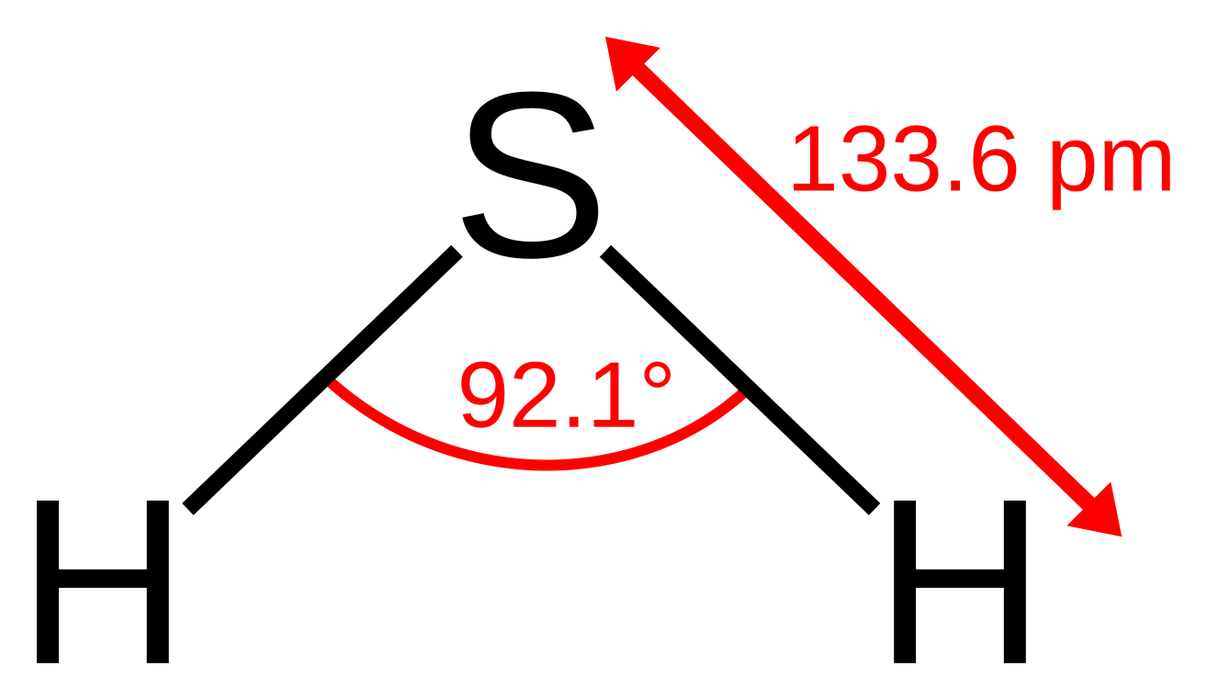
Structure of hydrogen sulfide (H2S), with bond dimensions.
Credit: Benjah-bmm27 / Wikimedia Commons

License: Public domain
Rendered from SVG to PNG, whitespace trimmed and placed on white
What it is
Hydrogen sulfide (CAS 7783-06-4) is a flammable, colourless gas that smells like rotten eggs; most people can smell it at very low concentrations. [1,4]
What it does and why it is used
It is used mainly to produce sulfur and sulfuric acid, and to make other chemicals such as sodium sulfide and sodium hydrosulfide. [1]
Regulatory status and health context
Canada
Canada's drinking water guidelines set an aesthetic objective of 0.05 mg/L or less for sulphide, based on taste and odour; levels above it would make water unpalatable. [3]
United States
ATSDR notes that federal agencies, including OSHA, set workplace and environmental limits for toxic substances; OSHA provides specific hydrogen sulfide safety guidance for workers. [1,2]
European Union
The EU law website was not fully available when this article was reviewed, so EU legal status was not checked and is not summarized here.
Environmental notes
Most hydrogen sulfide in the environment comes from natural sources such as volcanoes, swamps and sulfur springs. [1] The sources used for this review do not assess its wider environmental effects in detail, so we do not summarize them here.
Quick facts
- CAS: 7783-06-4. [4]
- Where: sewers, manure pits, hot springs and some industries. [1]
- Main danger: sudden collapse in enclosed spaces at very high levels. [1,2]
- Most at risk: workers in confined spaces and farm manure areas. [1,2]
Sources
All URLs were fetched on 2026-11-15; Health Canada pages were read with a separate web-reading tool because they did not respond to this review's direct requests. The EU law website was not fully available that day, so EU legislation could not be checked for this review. Source publication dates differ from this draft's review date.