
Skin and personal careMakeup and colour
Dihydroxyacetone (DHA): the sunless tanning ingredient, and what spray booths change
CAS 96-26-4.Also known as DHA, sunless tanner, and self-tanner.
Editorial draft Last reviewed 15 November 2026 About 648 words
CC INDEX
How it works36/100 Mild
FDA has reports of rashes and, mainly with spray booths, coughing, dizziness and fainting, though the cause is uncertain. Self-tanning products are sold as everyday cosmetics. DHA is limited to external use in the US, so the score sits in the mild band.
An editorial summary of this article’s cited evidence. It isn’t medical advice or a personal risk estimate.
Age index
What is the age index?Which age groups are more affected by this chemical’s possible health issues, based on this article’s sources.
- Pregnancy Unborn babies Lower concern
- Infants 0 to 1 Lower concern
- Young children 1 to 5 Lower concern
- Children 6 to 12 Lower concern
- Teens 13 to 19 Lower concern
- Adults 20 to 64 Lower concern
- Older adults 65 and over Lower concern
- The sources used for this review do not give age-specific advice on DHA.

Illustration of self-tanning. DHA is the colour additive in many sunless tanners.
Credit: Chemical Century; AI-generated illustration
License: CC0 1.0
Illustration, not a photograph of a specific product. Resized and cropped for the web.
Dihydroxyacetone, usually called DHA, is a commonly used ingredient in self-tanning products that turns skin brown by reacting with its outer layer. US regulators allow it only on the outside of the body, not on the lips, eyes or other moist tissues. Lotions are easy to use that way, but all-over spray booths can make it harder to avoid breathing it in or getting it in the eyes. A sunless tan also does not protect skin from the sun unless the product contains sunscreen.
Everyday exposure: where you meet it and how much
DHA is a colour additive used in sunless tanners, products that give a tanned look without sun or ultraviolet exposure. [1] Retail creams and lotions are meant for external application, and consumers can easily avoid inhaling them or applying them to the eye area. [1] In commercial spray booths, DHA is applied as an all-over spray or mist, which can make it harder to avoid exposing the eyes, lips and mucous membranes, or breathing it in. [1]
Known and suspected harms
Evidence labels are editorial summaries, not individual risk predictions: established means recognized under the stated conditions; probable means a likely contribution with uncertainty; possible means limited evidence; disputed means assessors disagree. These labels do not describe how common an effect is.
- Possible — reactions reported to FDA: consumers have reported rashes and, mainly with spray booths, coughing, dizziness and fainting; FDA says it is uncertain which ingredients, if any, caused these events. [1]
- Established — not approved for eyes, lips or inhaling: the industry has not provided safety data for DHA on the lips, mucous membranes or eye area, or for misting in tanning booths, so FDA has not approved those uses. [1]
- Established — no sun protection: sunless tanners protect from the sun only if they contain sunscreen and carry an SPF number; tanning products without sunscreen must carry a warning that they do not protect against sunburn. [1]
Reducing avoidable exposure and harm
Use DHA lotions on the skin only, away from the eyes and lips. [1] At a spray-tanning booth, FDA advises asking for measures that protect your eyes and mucous membranes and prevent inhalation. [1] Keep using sunscreen, since a sunless tan is not sun protection. [1]
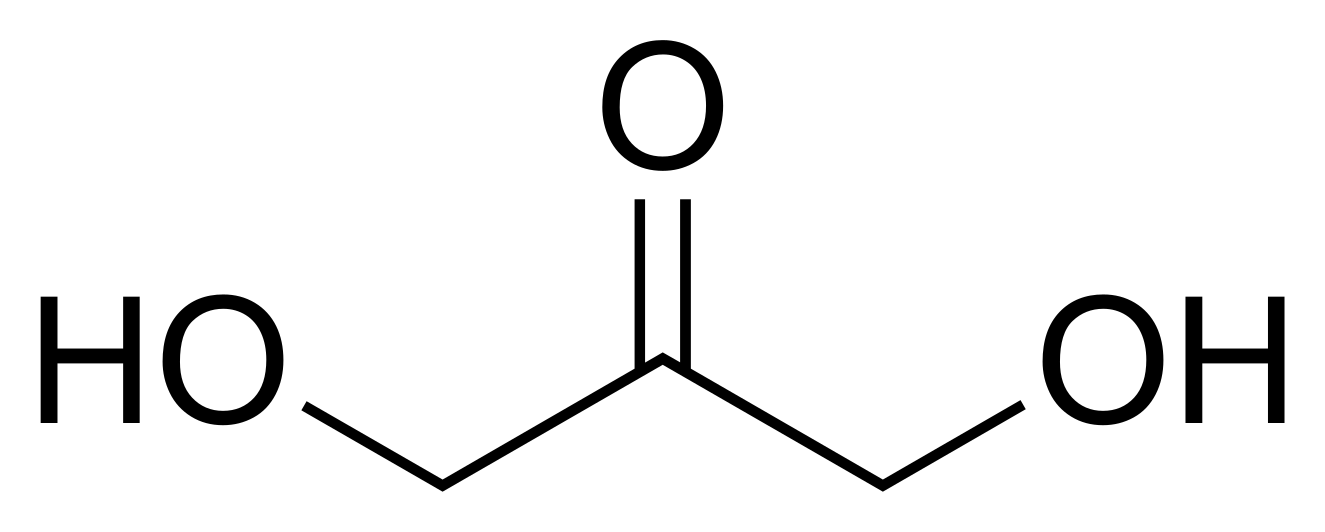
Structural formula of dihydroxyacetone.
Credit: Emeldir / Wikimedia Commons

License: Public domain
Rendered from SVG to PNG, whitespace trimmed and placed on white
What it is
Dihydroxyacetone (CAS 96-26-4) is a colour additive. [1,3]
What it does and why it is used
It darkens the skin by reacting with amino acids in the skin's surface. [1]
Regulatory status and health context
Canada
The sources used for this review do not summarize Canadian rules for dihydroxyacetone in cosmetics, so we do not describe them here.
United States
Under 21 CFR 73.2150, DHA may be used in externally applied cosmetics meant to colour the body, in amounts consistent with good manufacturing practice, and batches are exempt from certification. [2] FDA's definition of externally applied excludes the lips and any body surface covered by mucous membrane, and DHA is not permitted in the eye area. [1]
European Union
The EU law website was not fully available when this article was reviewed, so EU legal status was not checked and is not summarized here.
Environmental notes
The sources used for this review do not assess dihydroxyacetone's environmental effects, so we do not summarize them here.
Quick facts
- CAS: 96-26-4. [3]
- Where: self-tanning lotions and spray-tanning booths. [1]
- Main concern: eye, lip and inhalation exposure in spray booths. [1]
- Most at risk: spray-booth users without eye and breathing protection. [1]
Sources
All URLs were fetched on 2026-11-15. The EU law website was not fully available that day, so EU legislation could not be checked for this review. Source publication dates differ from this draft's review date.