
Medicines and healthSkin and personal care
Chlorhexidine: the pre-surgery skin antiseptic and gum rinse, and its rare allergic reactions
CAS 55-56-1.Also known as chlorhexidine gluconate and CHG.
Editorial draft Last reviewed 15 November 2026 About 684 words
CC INDEX
How it works38/100 Mild
Chlorhexidine can rarely cause serious allergic reactions, and the mouth rinse can stain teeth. Many people meet it before surgery, injections or dental treatment. FDA asked makers to add an allergy warning to over-the-counter antiseptic labels, so the score sits in the mild band.
An editorial summary of this article’s cited evidence. It isn’t medical advice or a personal risk estimate.
Age index
What is the age index?Which age groups are more affected by this chemical’s possible health issues, based on this article’s sources.
- Pregnancy Unborn babies Not well studied
- Infants 0 to 1 Not well studied
- Young children 1 to 5 Not well studied
- Children 6 to 12 Lower concern
- Teens 13 to 19 Lower concern
- Adults 20 to 64 Lower concern
- Older adults 65 and over Lower concern
- MedlinePlus asks people to tell their doctor or dentist if they are pregnant or breastfeeding before using the rinse. The sources used for this review do not give age-specific advice for babies and young children.

Illustration of dental care. Chlorhexidine is a prescription mouth rinse for gum inflammation.
Credit: Chemical Century; AI-generated illustration
License: CC0 1.0
Illustration, not a photograph of a specific product. Resized and cropped for the web.
Chlorhexidine is a bacteria-reducing ingredient used to clean skin before surgery and injections, and as a prescription mouth rinse for gum inflammation. The rinse can stain teeth and change how food tastes. Rarely, chlorhexidine can cause a serious allergic reaction within minutes, so anyone who has reacted to an antiseptic before should say so. US regulators asked makers to add an allergy warning to over-the-counter antiseptic labels.
Everyday exposure: where you meet it and how much
Over-the-counter chlorhexidine gluconate products are mainly used to clean and prepare the skin before surgery and injections, and they come as solutions, washes, sponges and swabs. [1] Chlorhexidine is also a prescription mouthwash for gingivitis and a prescription oral chip for periodontal disease, and it is used in some medical devices such as dressings and intravenous lines. [1] The mouth rinse is used twice a day after brushing: 15 mL is swished for 30 seconds and spat out, not swallowed. [2]
Known and suspected harms
Evidence labels are editorial summaries, not individual risk predictions: established means recognized under the stated conditions; probable means a likely contribution with uncertainty; possible means limited evidence; disputed means assessors disagree. These labels do not describe how common an effect is.
- Established — serious allergic reactions: FDA warned in 2017 that rare but serious allergic reactions have been reported with chlorhexidine skin antiseptics and that the number of reports had increased over several years; symptoms include wheezing or difficulty breathing, swelling of the face, hives, severe rash or shock, and they can start within minutes. [1]
- Established — staining and tartar: the mouth rinse may stain the teeth, tongue and dental repairs, may permanently stain front-tooth fillings, and can increase tartar build-up. [2]
- Established — taste changes: the rinse can change the taste of food and drinks. [2]
- Established — allergic symptoms with the rinse: rash, itching, swelling of the mouth or throat, difficulty breathing, light-headedness or a rapid heart rate need immediate medical attention. [2]
Reducing avoidable exposure and harm
Tell your health care provider if you have ever had an allergic reaction to any antiseptic; FDA suggests alternatives such as povidone-iodine or alcohols when a chlorhexidine allergy is known or suspected. [1] Stop using a chlorhexidine product and get emergency help if allergy symptoms appear. [1] With the rinse, brush and floss daily, see a dentist at least every 6 months to remove stain or tartar, and do not swallow it. [2]
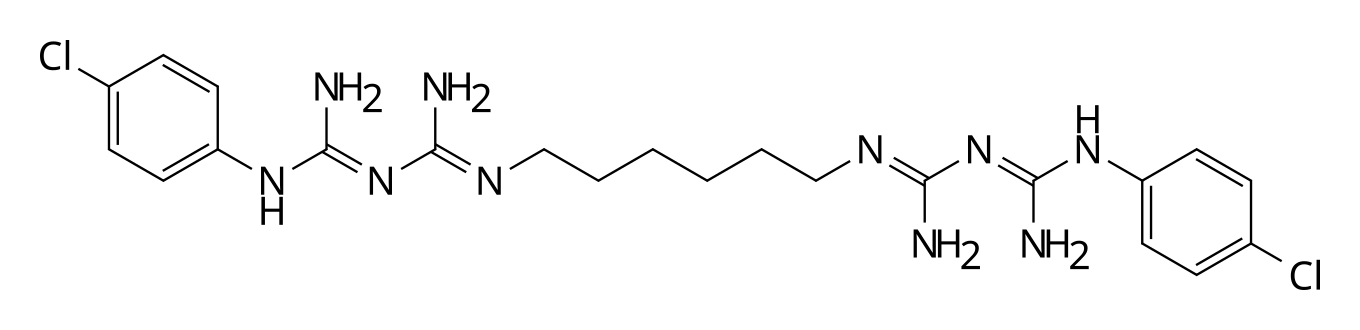
Skeletal formula of chlorhexidine.
Credit: Fuse809 / Wikimedia Commons

License: CC BY-SA 4.0
Rendered from SVG to PNG, whitespace trimmed and placed on white
What it is
Chlorhexidine (CAS 55-56-1) is an anti-infectant agent; many products use its gluconate form. [1,2,3]
What it does and why it is used
It works by decreasing the amount of bacteria in the mouth or on the skin. [1,2]
Regulatory status and health context
Canada
The sources used for this review do not summarize Canadian rules for chlorhexidine, so we do not describe them here.
United States
In 2017 FDA asked makers of over-the-counter chlorhexidine gluconate antiseptics to add a warning about serious allergic reactions to the Drug Facts label; prescription mouthwashes and oral chips already carried such a warning. [1]
European Union
The EU law website was not fully available when this article was reviewed, so EU legal status was not checked and is not summarized here.
Environmental notes
The sources used for this review do not assess chlorhexidine's environmental effects, so we do not summarize them here.
Quick facts
- CAS: 55-56-1. [3]
- Where: pre-surgery skin cleansers, prescription gum rinse. [1]
- Main concern: rare serious allergic reactions; tooth staining. [1,2]
- Most at risk: people with a past antiseptic allergy. [1]
Sources
All URLs were fetched on 2026-11-15. FDA's 2017 safety alert was read from an Internet Archive copy because the original FDA address no longer loads. The EU law website was not fully available that day, so EU legislation could not be checked. Source publication dates differ from this draft's review date.