
Castor oil: the old-fashioned laxative, and how it differs from ricin
Also known as ricinus oil.
Editorial draft Last reviewed 15 November 2026 About 507 words
CC INDEX
How it works24/100 Mild
Castor oil is not considered very toxic and recovery from an overdose is very likely, though uncontrolled diarrhea can upset body salts and heart rhythm. It is a common laxative, so the score sits in the mild band.
An editorial summary of this article’s cited evidence. It isn’t medical advice or a personal risk estimate.
Age index
What is the age index?Which age groups are more affected by this chemical’s possible health issues, based on this article’s sources.
- Pregnancy Unborn babies Lower concern
- Infants 0 to 1 Moderate
- Young children 1 to 5 Moderate
- Children 6 to 12 Lower concern
- Teens 13 to 19 Lower concern
- Adults 20 to 64 Lower concern
- Older adults 65 and over Lower concern
- The sources used for this review do not give age-specific advice; MedlinePlus advises keeping chemicals and medicines out of children's reach.

Illustration of castor plant pods, seeds and oil. Castor oil comes from the seeds of the castor oil plant.
Credit: Chemical Century; AI-generated illustration
License: CC0 1.0
Illustration, not a photograph of a specific product. Resized and cropped for the web.
Castor oil is a yellowish liquid from the seeds of the castor oil plant, often used as a lubricant and in laxatives. It is not considered very toxic, and recovery after taking too much is very likely. An overdose usually causes cramps, diarrhea and nausea, and allergic reactions are possible. The castor plant's seeds also contain ricin, a separate and highly toxic substance.
Everyday exposure: where you meet it and how much
Castor oil is a yellowish liquid often used as a lubricant and in laxatives. [1] It comes from the seeds of the castor oil plant. [1]
Known and suspected harms
Evidence labels are editorial summaries, not individual risk predictions: established means recognized under the stated conditions; probable means a likely contribution with uncertainty; possible means limited evidence; disputed means assessors disagree. These labels do not describe how common an effect is.
- Established — overdose: symptoms include abdominal cramps, chest pain, diarrhea, dizziness, fainting, nausea, shortness of breath, skin rash, throat tightness and, rarely, hallucinations. [1]
- Established — fluid loss: if nausea, vomiting and diarrhea are not controlled, serious dehydration and electrolyte imbalances may occur, which can cause heart rhythm disturbances. [1]
- Possible — allergy: allergic reactions are possible. [1]
- Established — ricin in seeds: the castor oil plant contains the toxin ricin; seeds swallowed whole with the hard shell intact typically prevent absorption of significant toxin, but purified ricin is highly toxic and lethal in small doses. [1]
Reducing avoidable exposure and harm
Call 911 or poison control for treatment information after an overdose. [1] Keep chemicals and medicines in their original containers and out of the reach of children. [1]
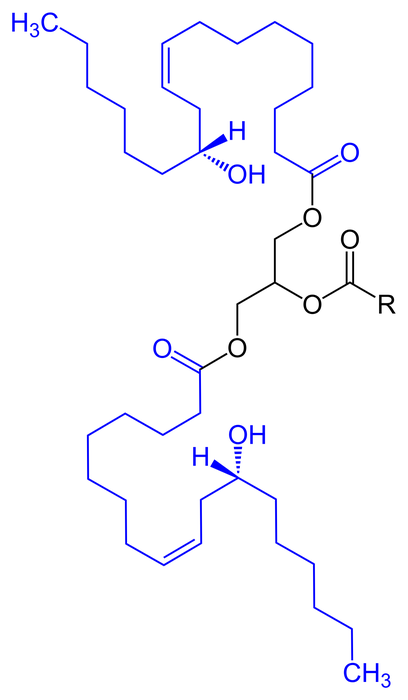
Schematic structure of a triglyceride found in castor oil.
Credit: Jü / Wikimedia Commons

License: Public domain
Rendered from SVG to PNG, whitespace trimmed and placed on white
What it is
Castor oil is a yellowish oil from the seeds of the castor oil plant. [1]
What it does and why it is used
It acts as a laxative and is also used as a lubricant. [1]
Regulatory status and health context
Canada
The sources used for this review do not summarize Canadian rules for castor oil, so we do not describe them here.
United States
The sources used for this review do not summarize US rules for castor oil, so we do not describe them here.
European Union
The EU law website was not fully available when this article was reviewed, so EU legal status was not checked and is not summarized here.
Environmental notes
The sources used for this review do not assess castor oil's environmental effects, so we do not summarize them here.
Quick facts
- CAS: no single CAS number verified. [1]
- Where: laxatives, lubricants. [1]
- Main concern: low; dehydration from uncontrolled diarrhea. [1]
- Note: ricin is a separate toxin in the seeds. [1]
Sources
All URLs were fetched on 2026-11-15. The EU law website was not fully available that day, so EU legislation could not be checked for this review. Source publication dates differ from this draft's review date.