
Food and drinkMakeup and colour
Caramel colour: the most-used brown food colouring and the 4-MEI question
Also known as caramel coloring and caramel.
Editorial draft Last reviewed 15 November 2026 About 682 words
CC INDEX
How it works44/100 Moderate
High doses of 4-MEI, a by-product in some caramel colours, caused lung tumours in mice, but FDA does not expect risks at food levels. Exposure is very common because caramel colour is used in many foods. FDA is still reviewing possible limits, so the score sits in the moderate band.
An editorial summary of this article’s cited evidence. It isn’t medical advice or a personal risk estimate.
Age index
What is the age index?Which age groups are more affected by this chemical’s possible health issues, based on this article’s sources.
- Pregnancy Unborn babies Lower concern
- Infants 0 to 1 Lower concern
- Young children 1 to 5 Lower concern
- Children 6 to 12 Lower concern
- Teens 13 to 19 Lower concern
- Adults 20 to 64 Lower concern
- Older adults 65 and over Lower concern
- The sources used for this review do not single out an age group.

Illustration of brown foods and drinks. Caramel colour is used to colour many foods.
Credit: Chemical Century; AI-generated illustration
License: CC0 1.0
Illustration, not a photograph of a specific product. Resized and cropped for the web.
Caramel colour gives many breads, vinegars, drinks and other foods their brown shade, and some types are the most widely used food colours by volume. It is made by carefully heating sugars, sometimes with acids, alkalis or salts. Some types can contain small amounts of a by-product called 4-MEI, which caused lung tumours in mice at very high doses. US regulators say they have no reason to think the levels in food pose short-term risks and are not advising people to change their diets.
Everyday exposure: where you meet it and how much
US rules allow caramel colour to be used to colour foods generally. [1] Class III and Class IV caramel colours are the most commonly used food colours by volume. [2] Health Canada permits caramel in foods such as bread, brown bread, malt vinegar and flavoured milk. [3]
Known and suspected harms
Evidence labels are editorial summaries, not individual risk predictions: established means recognized under the stated conditions; probable means a likely contribution with uncertainty; possible means limited evidence; disputed means assessors disagree. These labels do not describe how common an effect is.
- Possible — 4-MEI in some types: 4-MEI forms at low levels when Class III and Class IV caramel colours are made, and also when coffee is roasted or meat is grilled. [2] A US National Toxicology Program study found more lung tumours in mice given 4-MEI for two years; a rat study was inconclusive. [2]
- Possible — reproductive effects in rats: a 2020 study found reproductive and developmental effects in rats, but at doses far above estimated human exposure from food. [2]
- Established — FDA view: FDA has no reason to believe 4-MEI poses immediate or short-term risks at the levels expected in food and is not recommending diet changes. [2]
Reducing avoidable exposure and harm
Labels do not say which class of caramel colour is used, so you cannot tell from the label whether a food contains 4-MEI; Class I and Class II caramel colours do not contain it. [2] Caramel colour must still be declared on labels, by name or with a general term such as "color added". [2]
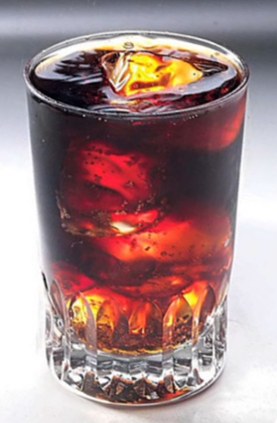
A glass of cola, a drink that can be coloured with caramel.
Credit: Skoot13 / Wikimedia Commons

License: CC BY-SA 3.0
Resized for the web; no content edits
What it is
Caramel colour is a dark-brown liquid or solid made by carefully controlled heating of food-grade carbohydrates such as sucrose, dextrose, molasses or malt syrup. [1] Food-grade acids, alkalis and salts, including ammonium and sulfite salts, may be used to help the process. [1]
What it does and why it is used
It adds a brown colour to foods and drinks. [1]
Regulatory status and health context
Canada
Caramel is on Health Canada's List of Permitted Food Colours, mostly at good manufacturing practice, for many foods including bread, malt vinegar and flavoured milks. [3]
United States
US rules allow caramel to colour foods generally and exempt it from batch certification, with limits of 10 ppm lead, 3 ppm arsenic and 0.1 ppm mercury. [1] FDA is reviewing 4-MEI data and says it could set a limit for Class III and IV caramel colours. [2]
European Union
The EU law website was not fully available when this article was reviewed, so EU legal status was not checked and is not summarized here.
Environmental notes
The sources used for this review do not assess caramel colour's environmental effects, so we do not summarize them here.
Quick facts
- CAS: no single CAS number verified. [1]
- Where: breads, vinegars, flavoured milks and many other foods. [3]
- Main concern: 4-MEI by-product in some types. [2]
- Most at risk: no specific group identified. [2]
Sources
All URLs were fetched on 2026-11-15; Health Canada pages were read with a separate web-reading tool because they did not respond to this review's direct requests. The EU law website was not fully available that day, so EU legislation could not be checked. Source publication dates differ from this draft's review date.