
Food and drinkSkin and personal care
Butylated hydroxyanisole (BHA): the fat-preserving antioxidant under fresh review
CAS 25013-16-5.Also known as BHA, E320, and tert-butyl-4-hydroxyanisole.
Editorial draft Last reviewed 15 November 2026 About 782 words
CC INDEX
How it works50/100 Moderate
BHA caused forestomach tumours in rodents and the US lists it as reasonably anticipated to be a human carcinogen, but EFSA found no genotoxicity concern and intakes below its safe level. It is used in many fat-containing foods, so exposure is common at low levels. Use is limited in Canada and the US, so the score sits in the moderate band.
An editorial summary of this article’s cited evidence. It isn’t medical advice or a personal risk estimate.
Age index
What is the age index?Which age groups are more affected by this chemical’s possible health issues, based on this article’s sources.
- Pregnancy Unborn babies Not well studied
- Infants 0 to 1 Not well studied
- Young children 1 to 5 Not well studied
- Children 6 to 12 Not well studied
- Teens 13 to 19 Not well studied
- Adults 20 to 64 Not well studied
- Older adults 65 and over Not well studied
- The sources reviewed do not give age-specific data for dietary BHA; the cancer concern comes from animal studies.

Illustration of everyday packaged foods. BHA is used to keep fats in some cereals, snacks and gum from going stale.
Credit: Chemical Century; AI-generated illustration
License: CC0 1.0
Illustration, not a photograph of a specific product. Resized and cropped for the web.
BHA is a preservative that keeps fats and oils from going stale, so it may turn up in cereals, snack foods, chewing gum, fats and some cosmetics. It is allowed only in small amounts, and European food-safety scientists judged typical intakes to be below their safe daily level. Even so, it caused stomach tumours in rodents, and the US government lists it as reasonably anticipated to be a human carcinogen. The US food regulator has begun a new review, so this is one to watch rather than one to panic about.
Everyday exposure: where you meet it and how much
BHA has been added to edible fats and fat-containing foods since 1947 for its antioxidant properties. [1] It is used in foods such as butter, lard, meats, cereals, baked goods, sweets, beer, vegetable oils, potato chips, snack foods, nuts, dehydrated potatoes, flavourings, chewing gum and active dry yeast. [1] It is also used as a preservative in some medicines and cosmetics containing fats and oils. [1]
Known and suspected harms
Evidence labels are editorial summaries, not individual risk predictions: established means recognized under the stated conditions; probable means a likely contribution with uncertainty; possible means limited evidence; disputed means assessors disagree. These labels do not describe how common an effect is.
- Possible — cancer: BHA caused benign and malignant tumours of the forestomach in rats, male mice and hamsters fed it in their diet, and the US National Toxicology Program lists it as reasonably anticipated to be a human carcinogen based on animal evidence. [1]
- Established — intakes below the safe level in Europe: EFSA concluded in 2011 that BHA does not raise concern for genotoxicity, set an acceptable daily intake of 1.0 mg per kg of body weight, and found that refined intake estimates at current use levels are generally below that level. [2]
- Disputed — safety at current use, now under US review: FDA has begun a post-market assessment of the safety of BHA in food and food-contact materials and has asked for data on dietary exposure and toxicity. [3]
Reducing avoidable exposure and harm
If you prefer to limit BHA, check ingredient lists on cereals, snack foods, chewing gum and fats for 'BHA' or 'butylated hydroxyanisole'. A diet with more fresh, less processed foods naturally lowers intake. The sources reviewed do not describe health effects at typical intakes. [2]
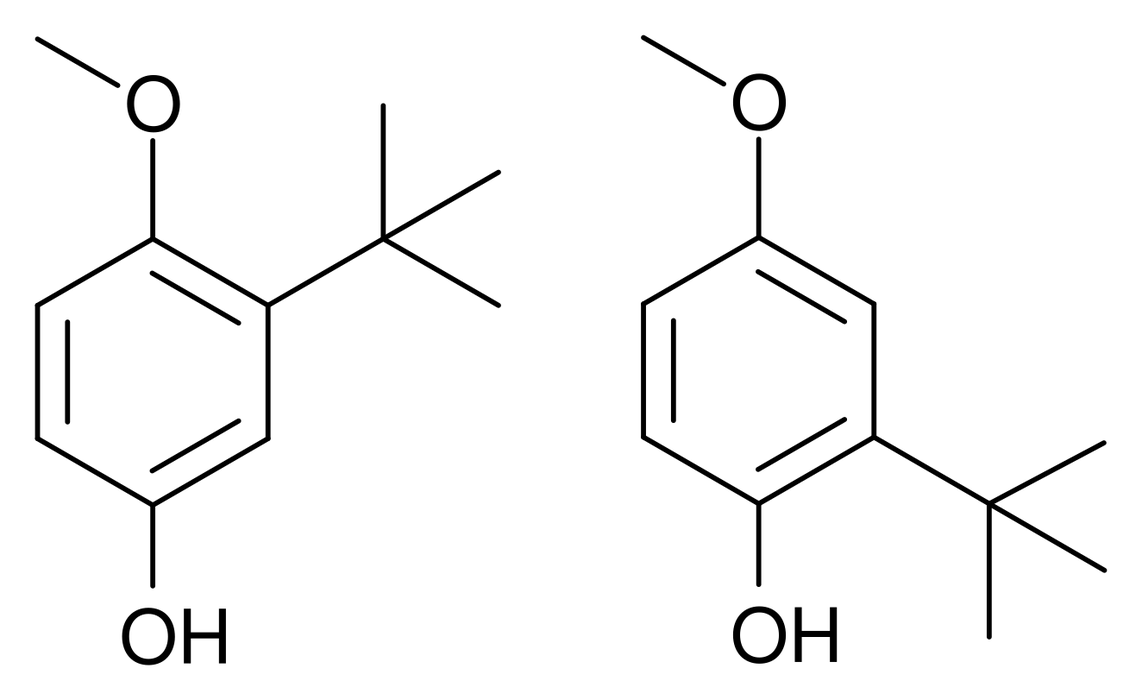
Structural formulas of the two isomers that make up butylated hydroxyanisole.
Credit: Darkness3560 / Wikimedia Commons

License: CC0 1.0
Rendered from SVG to PNG, whitespace trimmed and placed on white
What it is
BHA (CAS 25013-16-5) is a mixture of two isomers, mostly 3-tert-butyl-4-hydroxyanisole with some 2-tert-butyl-4-hydroxyanisole. [1,3]
What it does and why it is used
As an antioxidant it slows the oxidation of fats and oils, which delays rancidity, and it remains active in baked and fried foods. [1]
Regulatory status and health context
Canada
Health Canada's List of Permitted Preservatives allows BHA in specific foods with set limits, such as 200 ppm in fats and oils and 50 ppm in dried breakfast cereals, often as a combined limit with other antioxidants. [6]
United States
FDA lists BHA as generally recognized as safe when total antioxidant content does not exceed 0.02% of a food's fat or oil, and separately allows it in specified foods with set limits. [4,5] FDA has begun a post-market assessment of BHA in food and food-contact materials. [3]
European Union
EFSA re-evaluated BHA (E 320) in 2011, raising its acceptable daily intake to 1.0 mg per kg of body weight a day. [2] EU legislation itself could not be checked for this review.
Environmental notes
The sources used for this review do not assess BHA's environmental effects, so we do not summarize them here.
Quick facts
- CAS: 25013-16-5. [1,3]
- Where: fats, cereals, snack foods, chewing gum, some cosmetics and medicines. [1]
- Main concern: forestomach tumours in rodents; US lists it as reasonably anticipated to be a human carcinogen. [1]
- Most at risk: no group singled out by the sources reviewed. [1,2]
Sources
All URLs were fetched on 2026-11-15; Health Canada pages were read with a separate web-reading tool because they did not respond to this review's direct requests, and the EFSA opinion was read with a browser. The EU law website was not fully available that day, so EU legislation itself could not be checked. Source publication dates differ from this draft's review date.
- National Toxicology Program, Report on Carcinogens: Butylated hydroxyanisole profile.
- EFSA: Scientific opinion on the re-evaluation of butylated hydroxyanisole (E 320) as a food additive (2011).
- FDA: List of select chemicals in the food supply under FDA review.
- eCFR: 21 CFR 172.110, BHA.
- eCFR: 21 CFR 182.3169, butylated hydroxyanisole.
- Health Canada: List of Permitted Preservatives.