
Brominated vegetable oil: the citrus-soda additive the US has banned
Also known as BVO and brominated soybean oil.
Editorial draft Last reviewed 15 November 2026 About 652 words
CC INDEX
How it works44/100 Moderate
FDA-led rodent studies linked BVO to bromine build-up and thyroid effects at high exposure, and FDA revoked its use. Exposure was limited to a few citrus drinks and is now low in the US. The revocation keeps regulation in focus, so the score sits in the moderate band.
An editorial summary of this article’s cited evidence. It isn’t medical advice or a personal risk estimate.
Age index
What is the age index?Which age groups are more affected by this chemical’s possible health issues, based on this article’s sources.
- Pregnancy Unborn babies Lower concern
- Infants 0 to 1 Lower concern
- Young children 1 to 5 Lower concern
- Children 6 to 12 Lower concern
- Teens 13 to 19 Lower concern
- Adults 20 to 64 Lower concern
- Older adults 65 and over Lower concern
- The sources used for this review do not single out an age group.

Illustration of a citrus soft drink. BVO was once used to keep citrus flavouring mixed in some sodas.
Credit: Chemical Century; AI-generated illustration
License: CC0 1.0
Illustration, not a photograph of a specific product. Resized and cropped for the web.
Brominated vegetable oil, or BVO, was once used in small amounts to keep citrus flavouring evenly mixed in some soft drinks. It is vegetable oil with bromine attached, and by recent years only a few US drinks still contained it. The United States revoked its approval in 2024 after animal studies suggested that high exposure can affect the thyroid and that bromine builds up in body tissues. Most people are now unlikely to come across it in US drinks.
Everyday exposure: where you meet it and how much
BVO was used in small amounts to keep citrus flavouring from floating to the top in some drinks, and it had to be listed in the ingredients. [2] It had been used as a food ingredient since the 1920s, and few US drinks still contained it when FDA acted. [1,2]
Known and suspected harms
Evidence labels are editorial summaries, not individual risk predictions: established means recognized under the stated conditions; probable means a likely contribution with uncertainty; possible means limited evidence; disputed means assessors disagree. These labels do not describe how common an effect is.
- Probable — thyroid effects: a 2022 FDA rodent study found that eating BVO increased bromine levels in tissues and that at high exposure the thyroid was a target of potential harm. [1]
- Established — potential for human harm: FDA concluded the intended use of BVO is no longer considered safe after studies with the National Institutes of Health found the potential for adverse health effects in humans. [1,2]
- Established — earlier heart questions resolved: animal studies in the 1960s raised concerns about effects on the heart at doses far above typical intake, and FDA says later studies resolved those concerns. [1]
Reducing avoidable exposure and harm
Check ingredient lists of citrus-flavoured drinks, especially imported ones, for BVO or brominated soybean oil. [2]
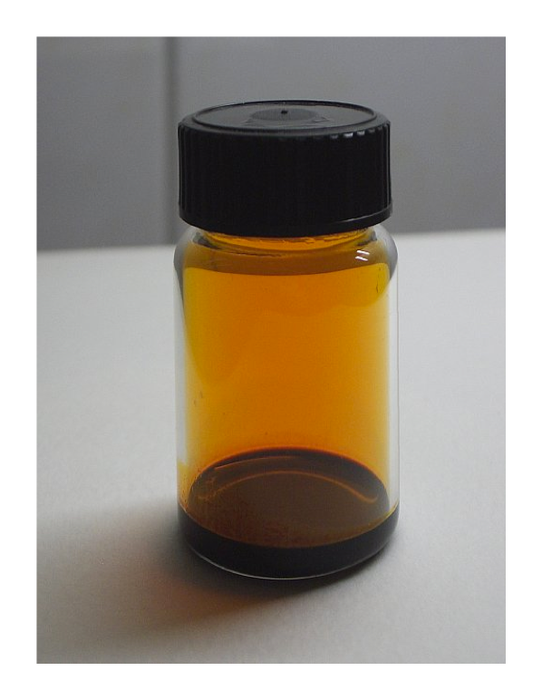
Liquid bromine, the element added to vegetable oil to make BVO.
Credit: W. Oelen / Wikimedia Commons

License: CC BY-SA 3.0
Whitespace trimmed and placed on white
What it is
BVO is vegetable oil modified with bromine: a mixture of plant-derived fats reacted so that bromine atoms are bonded to the molecules. [1,2]
What it does and why it is used
It made citrus oils dense enough to stay evenly mixed in a drink instead of floating to the top. [2]
Regulatory status and health context
Canada
Brominated vegetable oil is not listed on Health Canada's List of Permitted Emulsifying, Gelling, Stabilizing or Thickening Agents read for this review. [3] Other Canadian additive lists were not checked for BVO, so this review does not state its full Canadian status.
United States
FDA removed BVO from the generally recognized as safe list in 1970 and later allowed it only on an interim basis in fruit-flavoured drinks at up to 15 ppm. [1] On July 3, 2024, FDA revoked that regulation; the rule took effect August 2, 2024, with a compliance date one year later. [1,2]
European Union
The EU law website was not fully available when this article was reviewed, so EU legal status was not checked and is not summarized here.
Environmental notes
The sources used for this review do not assess brominated vegetable oil's environmental effects, so we do not summarize them here.
Quick facts
- CAS: no single CAS number. [1]
- Where: formerly some citrus-flavoured soft drinks. [2]
- Main concern: bromine build-up and thyroid effects at high exposure. [1]
- Most at risk: no specific group identified. [1]
Sources
All URLs were fetched on 2026-11-15; Health Canada pages were read with a separate web-reading tool because they did not respond to this review's direct requests. The EU law website was not fully available that day, so EU legislation could not be checked. Source publication dates differ from this draft's review date.