
Cleaning and laundryMedicines and health
Boric acid: the roach powder and old-fashioned antiseptic that is risky for babies
CAS 10043-35-3.Also known as boracic acid, orthoboric acid, and borates.
Editorial draft Last reviewed 15 November 2026 About 811 words
CC INDEX
How it works64/100 High
Boric acid poisoning can be severe, and MedlinePlus notes a high death rate among poisoned infants, though such poisonings are now rarer. Exposure comes from pest powders, some eye washes and medicated powders, plus small natural amounts of boron in food. Canada bars it from accessible toy parts and the EU restricts it in cosmetics, so the score sits in the high band.
An editorial summary of this article’s cited evidence. It isn’t medical advice or a personal risk estimate.
Age index
What is the age index?Which age groups are more affected by this chemical’s possible health issues, based on this article’s sources.
- Pregnancy Unborn babies Not well studied
- Infants 0 to 1 Higher concern
- Young children 1 to 5 Higher concern
- Children 6 to 12 Moderate
- Teens 13 to 19 Moderate
- Adults 20 to 64 Moderate
- Older adults 65 and over Moderate
- Infants (higher concern): Infant deaths from boric acid poisoning have been reported historically
- Young children (higher concern): Pest powders and medicated powders can be swallowed by curious children
- ATSDR says children would likely show the same effects as adults but does not know whether they are more susceptible; the higher ratings reflect historic infant poisonings and accidental swallowing.

Illustration of a kitchen cabinet. Boric acid is used in some roach and ant powders.
Credit: Chemical Century; AI-generated illustration
License: CC0 1.0
Illustration, not a photograph of a specific product. Resized and cropped for the web.
Boric acid is a white powder found in some roach and ant killers, eyewashes, medicated powders and craft glazes. It has a long history as a household antiseptic, and small, everyday exposures through food and water are part of normal life because boron occurs naturally. Swallowing larger amounts is a different story, and babies have historically been the most vulnerable. Keeping pest powders well away from children and pets, and using boric acid products only as labelled, can usually prevent harm.
Everyday exposure: where you meet it and how much
Boric acid is found in antiseptics and astringents, enamels and glazes, medicated powders, skin lotions, some paints, some rodent and ant pesticides, photography chemicals, powders to kill roaches and some eye wash products. [1] It is also an ingredient in some vaginal suppositories, though MedlinePlus notes this is not a standard treatment. [1]
Everyone is also exposed to small amounts of boron, the element in boric acid, through vegetables, fruits and drinking water; ATSDR gives an average adult intake of about 1 mg a day. [2]
Known and suspected harms
Evidence labels are editorial summaries, not individual risk predictions: established means recognized under the stated conditions; probable means a likely contribution with uncertainty; possible means limited evidence; disputed means assessors disagree. These labels do not describe how common an effect is.
- Established — poisoning when swallowed: the main symptoms are blue-green vomit, diarrhea and a bright red skin rash; others include blisters, peeling skin, drowsiness, twitching, seizures, low blood pressure, greatly reduced urine and coma. [1]
- Established — danger to infants: MedlinePlus reports a high death rate among infants poisoned by boric acid, although poisoning is now much rarer because it is no longer used as a disinfectant in nurseries. [1]
- Established — delayed damage: after a large swallowed amount, damage to the oesophagus and stomach can continue for weeks, and death from complications may occur months later. [1]
- Possible — reproductive effects: in dogs, rats and mice, large amounts of boron affected the testes, at doses more than 1,800 times the average US adult intake; ATSDR does not know whether boron causes birth defects in people. [2]
- Established — no cancer in a lifetime mouse study: mice fed boric acid throughout their lifetime showed no evidence of cancer. [2]
Reducing avoidable exposure and harm
Use pest powders and baits only where children and pets cannot reach them, and follow the label. ATSDR advises storing household chemicals in their original labelled containers, out of reach of young children, and never in old drink bottles. [2] If boric acid is on the skin, wash it off thoroughly; if it gets in the eyes, rinse with cool water for 15 minutes; if it is swallowed, seek medical treatment immediately. [1]
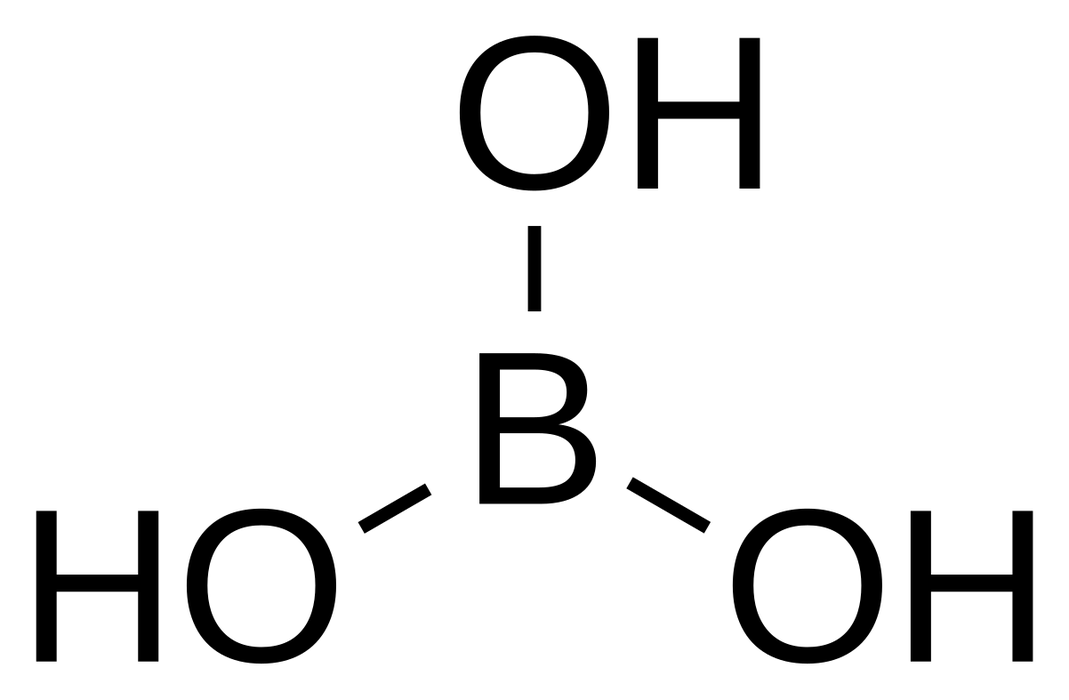
Structural formula of boric acid.
Credit: AlyInWikiWonderland / Wikimedia Commons

License: CC0 1.0
Rendered from SVG to PNG, whitespace trimmed and placed on white
What it is
Boric acid (CAS 10043-35-3) is a weak acid of boron, usually a white powder or crystals; its salts are called borates. [2,5]
What it does and why it is used
It is used in roach and ant powders, antiseptics and astringents, medicated powders, some eye washes, enamels and glazes, and photography chemicals. [1] Boron combines with oxygen in nature to form borates. [2]
Regulatory status and health context
Canada
Canada's Toys Regulations prohibit boric acid and salts of boric acid in toys if they could become accessible to a child under reasonably foreseeable circumstances. [3]
United States
The sources used for this review do not summarize US limits for boric acid in consumer products, so we do not summarize them here.
European Union
The EU cosmetics regulation limits boric acid, borates and tetraborates to 5% (as boric acid) in talc and 0.1% in oral products, among other conditions, and says talc products containing it must not be used for children under 3 or on peeling or irritated skin. [4]
Environmental notes
ATSDR notes that boron occurs naturally in rocks, soil and water, and that groundwater concentrations can be high in areas with natural boron-rich deposits. [2]
Quick facts
- CAS: 10043-35-3. [5]
- Where: roach and ant powders, some eye washes, medicated powders, glazes. [1]
- Main danger: poisoning with blue-green vomit, red rash and organ damage if swallowed. [1]
- Most at risk: infants and young children. [1]
Sources
All URLs were fetched on 2026-11-15, except the EU cosmetics regulation: the EU law website was not fully available that day, so it was read from a copy fetched for earlier Chemical Century articles in November 2026. That copy is the regulation as originally published, and later amendments were not checked. Source publication dates differ from this draft's review date.