
Bisphenol S (BPS): is “BPA-free” plastic really safer?
CAS 80-09-1.Also known as BPS, 4,4'-sulfonyldiphenol, 4,4'-sulphonyldiphenol, BPA substitute, and BPA-free.
Editorial draft Last reviewed 21 November 2026 About 922 words
CC INDEX
How it works55/100 Moderate
A systematic review found BPS about as hormonally active as BPA in laboratory and animal studies, and a US national survey detected it in nearly nine in ten urine samples. Human disease from ordinary exposure is not established, but the EU has acted against hazardous bisphenols in food contact materials.
An editorial summary of this article’s cited evidence. It isn’t medical advice or a personal risk estimate.
Age index
What is the age index?Which age groups are more affected by this chemical’s possible health issues, based on this article’s sources.
- Pregnancy Unborn babies Higher concern
- Infants 0 to 1 Moderate
- Young children 1 to 5 Moderate
- Children 6 to 12 Moderate
- Teens 13 to 19 Not well studied
- Adults 20 to 64 Lower concern
- Older adults 65 and over Not well studied
- Pregnancy (higher concern): Hormone-like activity during development (lab and animal studies)
- Infants (moderate): Developing hormone systems (general principle)
- Young children (moderate): Detected in children's urine; developing bodies
- Ratings reflect laboratory and animal hormone findings plus widespread detection in people; human illness from ordinary exposure has not been established.

Illustration of plastic food containers and a bottle. A “BPA-free” label does not say which substitute, if any, was used.
Credit: Chemical Century; AI-generated illustration
License: CC0 1.0
Illustration, not a photograph of a specific product. Resized and cropped for the web.
Many people switched to water bottles, food containers and canned goods labelled “BPA-free” to feel safer in the kitchen. In some products the replacement is a close chemical cousin called bisphenol S, and it also turns up on the coated paper used for till receipts. Laboratory and animal studies suggest it can act on hormone systems in much the same way as BPA, which matters most for pregnant women and young children whose bodies are still developing. Nobody has shown that ordinary contact causes illness in people, but the evidence was strong enough for the European Union to move against hazardous bisphenols in food packaging.
Everyday exposure: where you meet it and how much
As makers moved away from bisphenol A (BPA), some products switched to bisphenol S (BPS), a closely related chemical. The European Union notes that BPS has been authorised for use in plastic food contact materials. [4] A large share of everyday contact comes from paper: when researchers tested 111 thermal till receipts, every one contained BPS, and it was also found on 87% of banknotes tested. The same study estimated that handling paper adds only a small daily dose through the skin. [3]
Exposure is common. In the 2013–2014 US national health survey (NHANES), BPS was found in 89.4% of urine samples, compared with 95.7% for BPA. Typical BPS levels were lower than BPA levels in both adults and children. [2]
Known and suspected harms
Evidence labels are editorial summaries, not individual risk predictions: established means recognized under the stated conditions; probable means a likely contribution with uncertainty; possible means limited evidence; disputed means assessors disagree.
- Probable — hormone-like activity similar to BPA: a systematic review of 32 studies (25 laboratory-only and 7 in animals) found BPS and bisphenol F were in the same range of hormonal potency as BPA, with estrogen-like and anti-androgen effects, and concluded they "have endocrine-disrupting effects." These are laboratory and animal findings, not measurements of disease in people. [1]
- Established — widespread exposure: BPS is detected in most people tested in the US, including children, so any hazard applies to a large population. [2]
- Possible — effects on reproduction and development: the same review reported altered organ weights and reproductive end points in animal studies. Human studies are too limited to say whether everyday BPS exposure harms fertility or child development. [1]
The European Commission noted that the full set of toxicity data for BPS had not yet been considered by EFSA and listed BPS among bisphenols with hazardous properties that are being restricted in food contact materials. [4] NIEHS explains that BPA itself is studied for effects on the brain, behaviour and prostate of fetuses, infants and children, which is why its substitutes are being watched closely. [6]
Reducing avoidable exposure
A "BPA-free" label does not tell you what replaced BPA. To lower exposure to bisphenols in general: decline paper receipts when you can, wash hands after handling them and before eating, avoid heating food in plastic containers, and choose glass, stainless steel or ceramic for hot or acidic foods. These are precautionary steps; they are not proven to prevent any particular illness. [3,6]
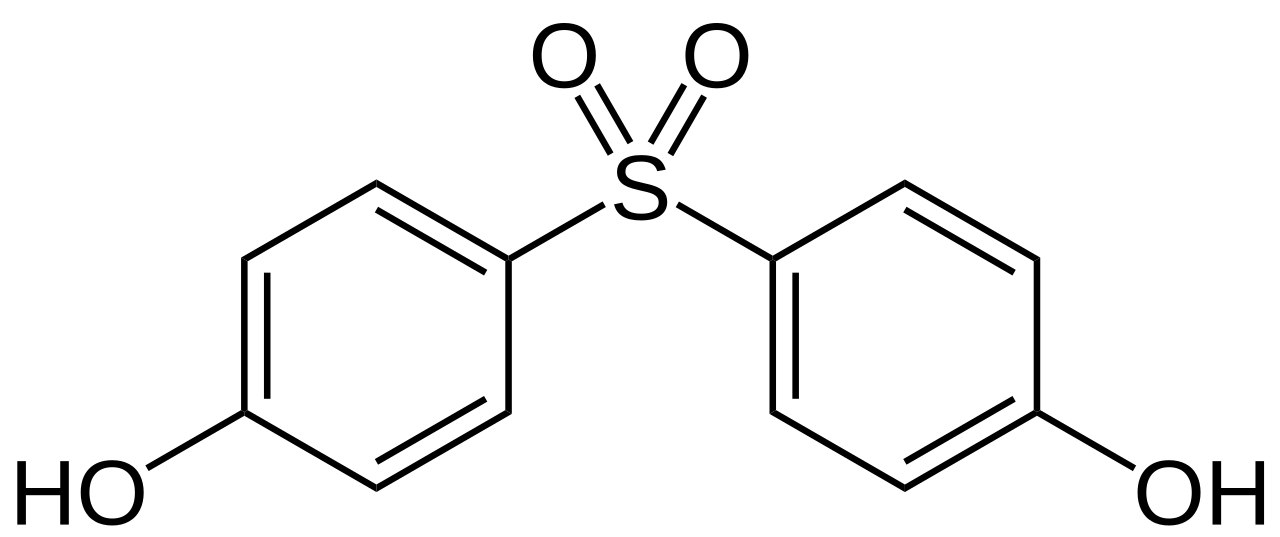
Structural formula of bisphenol S.
Credit: Roland Mattern / Wikimedia Commons

License: Public domain
Wikimedia-provided scaled PNG/JPEG rendering; no content edits
What it is
Bisphenol S is 4,4′-sulfonyldiphenol, CAS 80-09-1. Like BPA it has two phenol rings, but they are joined by a sulfonyl (sulfur-oxygen) group. [4]
What it does and why it is used
BPS is used to make some plastics and resins and as a colour developer in heat-sensitive receipt paper, where it has replaced BPA in many samples. [3,4]
Regulatory status and health context
Canada
The Government of Canada has grouped BPA "structural analogues and functional alternatives," including BPS, for assessment and has consulted on how to subgroup them. A final Canadian decision on BPS was not found in the sources used here. [5]
United States
The sources used here do not show a US rule specific to BPS. US exposure data come from the CDC-run NHANES survey. [2]
European Union
Regulation (EU) 2024/3190 bans BPA in food contact materials and also covers other hazardous bisphenols. It specifically discusses BPS, which had been authorised for plastic food contact materials. [4]
Environmental notes
BPS from paper and plastics can enter recycling and waste streams. The sources used here do not provide enough data for a rating of its environmental impact. [3]
Quick facts
- CAS: 80-09-1. [4]
- Main uses: some plastics and resins, thermal receipt paper. [3,4]
- Exposure: detected in 89.4% of US urine samples (2013–2014). [2]
- Main concern: BPA-like hormone activity in laboratory and animal studies (probable). [1]
- Uncertainty: human health effects at everyday levels are not established. [1]
Sources
Sources were accessed on 2026-11-21. Source publication dates differ from this draft's review date. Image licences are listed with each image.
- Rochester JR, Bolden AL. Bisphenol S and F: a systematic review and comparison of the hormonal activity of bisphenol A substitutes. Environ Health Perspect, 2015 (PubMed).
- Lehmler HJ et al. Exposure to bisphenol A, bisphenol F, and bisphenol S in U.S. adults and children: NHANES 2013–2014. ACS Omega, 2018 (PubMed).
- Liao C, Liu F, Kannan K. Bisphenol S in paper products and currency bills and its association with bisphenol A residues. Environ Sci Technol, 2012 (PubMed).
- European Commission: Regulation (EU) 2024/3190 on the use of bisphenol A and other bisphenols and bisphenol derivatives in food contact materials (EUR-Lex).
- Government of Canada: Technical consultation on the proposed subgrouping of BPA structural analogues and functional alternatives.
- NIEHS: Bisphenol A (BPA).