
Nutrients and supplementsMedicines and health
Berberine for blood sugar: what the evidence shows and who should avoid it
CAS 2086-83-1.Also known as berberine HCl, berberine hydrochloride, goldenseal, barberry extract, and Coptis.
Editorial draft Last reviewed 21 November 2026 About 609 words
CC INDEX
How it works44/100 Moderate
Berberine is a popular supplement with possible glucose benefits from mixed-quality trials. Gut side effects, drug interactions and the infant risk drive the score.
An editorial summary of this article’s cited evidence. It isn’t medical advice or a personal risk estimate.
Age index
What is the age index?Which age groups are more affected by this chemical’s possible health issues, based on this article’s sources.
- Pregnancy Unborn babies Higher concern
- Infants 0 to 1 Higher concern
- Young children 1 to 5 Not well studied
- Children 6 to 12 Not well studied
- Teens 13 to 19 Not well studied
- Adults 20 to 64 Moderate
- Older adults 65 and over Moderate
- Pregnancy (higher concern): Avoid: linked to harmful bilirubin buildup in infants
- Infants (higher concern): Linked to bilirubin buildup that can cause brain damage
- Adults (moderate): Gut side effects; interactions with medicines
- Older adults (moderate): More likely to take interacting medicines
- The older-adult rating is an editorial judgement based on NCCIH's interaction warnings, not a separate study in older people.

Illustration of berberine capsules and barberry, one of its plant sources.
Credit: Chemical Century; AI-generated illustration
License: CC0 1.0
Illustration, not a photograph of a specific product. Resized and cropped for the web.
Berberine is a yellow plant compound found in barberry, goldenseal, goldthread and Oregon grape, now widely sold as a supplement for blood sugar and weight. Reviews of trials, mostly from China, suggest it may lower blood glucose and improve cholesterol in people with type 2 diabetes, but the studies vary in quality and do not support using it in place of prescribed treatment. It often causes stomach upset and can interact with medicines. It should not be used in pregnancy, while breastfeeding or for babies.
Everyday exposure: where you meet it and how much
Berberine occurs in plants such as barberry, goldenseal, goldthread, Oregon grape and tree turmeric, and has been used in Ayurvedic and traditional Chinese medicine for thousands of years. [1] It is sold as a dietary supplement. NCCIH describes doses used in clinical settings as 200 to 1,000 mg two to three times a day. [1]
Known and suspected harms
Evidence labels are editorial summaries, not individual risk predictions: established means recognized under the stated conditions; probable means a likely contribution with uncertainty; possible means limited evidence; disputed means assessors disagree.
- Established — not for pregnancy, breastfeeding or infants: exposure to berberine has been linked to a harmful buildup of bilirubin in infants, which can cause brain damage. [1,2]
- Established — gut side effects: common side effects include mild-to-moderate nausea, diarrhoea, bloating and constipation. [1]
- Probable — interactions with medicines: berberine has been shown to interact with cyclosporine, a transplant drug. [2] Goldenseal, a berberine-containing herb, lowered metformin levels by about 25% in healthy adults in an NCCIH-funded study, enough to potentially hinder glucose control. [3]
What the research shows on blood sugar
A 2021 meta-analysis of 46 trials (4,158 participants) found berberine, alone or added to standard treatment, lowered HbA1c by an average of 0.73 percentage points and also reduced fasting and after-meal glucose and blood fats. [1,4] NCCIH notes the trials were mostly in Chinese patients, results varied widely, and some studies were of poor quality. It warns against replacing medical treatment for diabetes with unproven products. [1]
Reducing avoidable exposure
If you are considering berberine, talk to your clinician or pharmacist first, especially if you take any medicine. Do not use it if you are pregnant or breastfeeding, and never give it to a baby. [1,2]
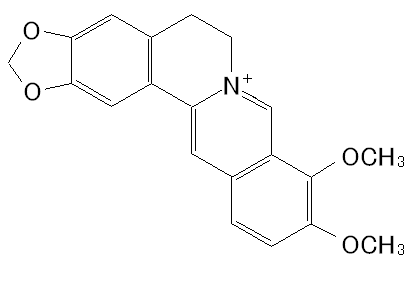
Structural formula of berberine.
Credit: Luh / Wikimedia Commons

License: Public domain
Wikimedia-provided scaled PNG/JPEG rendering; no content edits
What it is
Berberine is a plant alkaloid, a nitrogen-containing compound responsible for the yellow colour of several medicinal plants. [1,4]
What it does and why it is used
It is marketed for blood sugar, cholesterol and weight. [1,2]
Regulatory status and health context
International
The sources used here do not cover international regulation of berberine.
United States
Berberine is sold as a dietary supplement. FDA warns consumers about illegally marketed products that claim to cure diabetes or replace diabetes medicine. [1]
European Union
The sources used here do not cover EU rules for berberine.
Environmental notes
The sources used here do not provide enough environmental data for a rating.
Quick facts
- CAS: 2086-83-1.
- Plant sources: barberry, goldenseal, goldthread, Oregon grape. [1]
- Average HbA1c change in trials: −0.73 percentage points. [4]
- Avoid: pregnancy, breastfeeding, infants. [1]
Sources
Sources were accessed on 2026-11-21. Source publication dates differ from this draft's review date. Image licences are listed with each image.
- NCCIH: Diabetes and dietary supplements: what you need to know.
- NCCIH: Berberine and weight loss: what you need to know.
- NCCIH: Goldenseal.
- Guo J et al. The effect of berberine on metabolic profiles in type 2 diabetic patients: a systematic review and meta-analysis of randomized controlled trials. Oxid Med Cell Longev, 2021 (PubMed).