
Food and drinkHousehold materials
Azodicarbonamide: the dough conditioner banned from food in Europe
CAS 123-77-3.Also known as ADA, ADCA, azodiformamide, 1,1'-azobisformamide, E927a, and diazene-1,2-dicarboxamide.
Editorial draft Last reviewed 21 November 2026 About 698 words
CC INDEX
How it works56/100 Moderate
Azodicarbonamide is classified in the EU as a respiratory sensitiser and not authorised in food there. FDA considers bread uses safe and says semicarbazide exposure is far below doses that affected mice.
An editorial summary of this article’s cited evidence. It isn’t medical advice or a personal risk estimate.
Age index
What is the age index?Which age groups are more affected by this chemical’s possible health issues, based on this article’s sources.
- Pregnancy Unborn babies Not well studied
- Infants 0 to 1 Not well studied
- Young children 1 to 5 Lower concern
- Children 6 to 12 Lower concern
- Teens 13 to 19 Lower concern
- Adults 20 to 64 Moderate
- Older adults 65 and over Lower concern
- Adults (moderate): Workers handling powder: occupational asthma
- Food exposure is low; the established harm is asthma in people who work with the powder.

Illustration of white bread and buns. Azodicarbonamide is approved in the US as a flour whitener and dough conditioner.
Credit: Chemical Century; AI-generated illustration
License: CC0 1.0
Illustration, not a photograph of a specific product. Resized and cropped for the web.
Azodicarbonamide is a whitening and dough-conditioning agent added to some flour and bread in the United States, and the same chemical is used to puff up foam plastics and rubber. During baking it breaks down into semicarbazide, which caused tumours in female mice at high doses. FDA says the amounts in bread are far below those levels, but the EU does not allow it in food and has listed it as a substance of very high concern because breathing its dust can cause asthma in workers. For shoppers, it is easy to avoid by reading bread labels.
Everyday exposure: where you meet it and how much
In the United States, azodicarbonamide may be used as an ageing and bleaching ingredient in cereal flour and as a dough conditioner in bread, at no more than 45 parts per million of flour. [1] It is also authorised as a blowing agent in sealing caps for food containers. [2] FDA says it must be listed on ingredient labels and is not necessary to make bread. [2] Workers making the chemical or using it to foam plastics can inhale its dust. [5]
Known and suspected harms
Evidence labels are editorial summaries, not individual risk predictions: established means recognized under the stated conditions; probable means a likely contribution with uncertainty; possible means limited evidence; disputed means assessors disagree.
- Established — occupational asthma: azodicarbonamide is classified in the EU as a respiratory sensitiser. The EU's support document describes occupational asthma with symptoms such as rhinitis, wheezing, cough and chest tightness, sometimes persisting for years after exposure stops; in one factory study, 18.5% of 151 workers were diagnosed with asthma caused by it. [5]
- Disputed — strength of the asthma evidence: a 2017 review argued that the clinical reports often lacked properly controlled diagnostic tests and that the data do not justify classifying it as a respiratory allergen. [6]
- Possible — semicarbazide: during bread making, azodicarbonamide breaks down, forming semicarbazide among other chemicals. At high levels, semicarbazide increased tumours in female mice, but not male mice or rats. FDA says these doses far exceed estimated human exposure and does not recommend diet changes. [2] EU food safety scientists concluded that semicarbazide has weak carcinogenic activity in animals and that its risk to humans could not be determined. [4]
Reducing avoidable exposure
Check bread and bun ingredient lists for "azodicarbonamide." Workers should follow workplace controls to avoid inhaling the powder. [2,5]
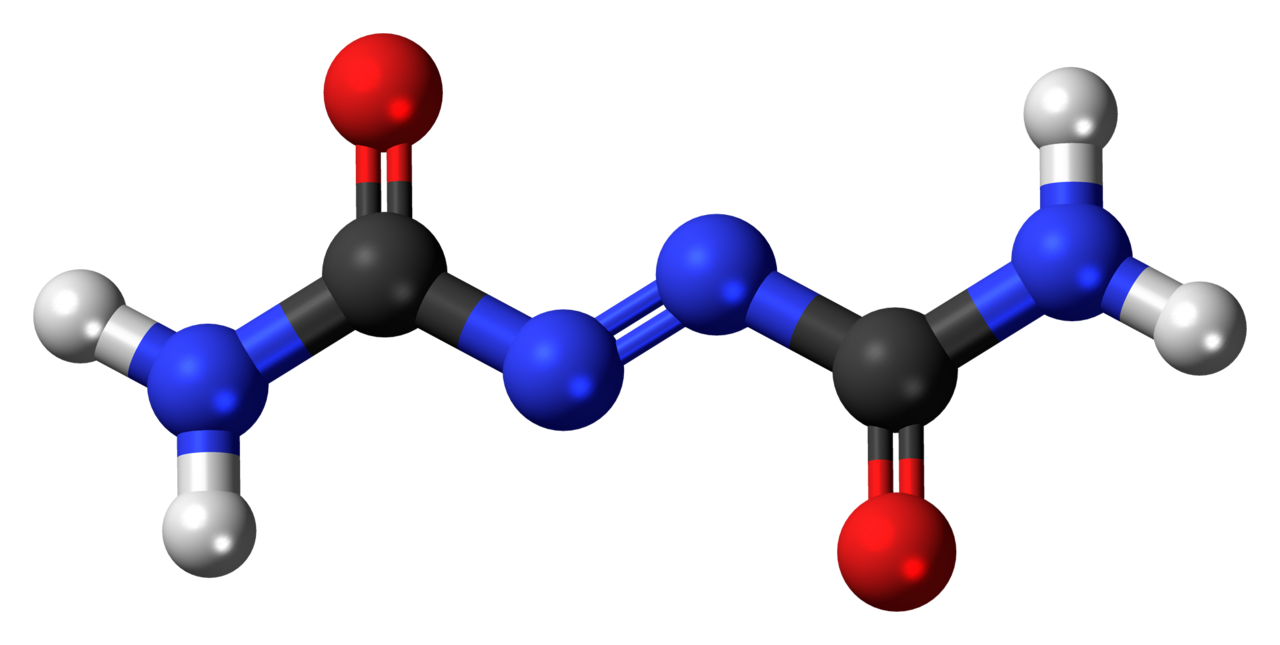
Ball-and-stick model of azodicarbonamide.
Credit: Jynto / Wikimedia Commons

License: CC0
Wikimedia-provided scaled PNG/JPEG rendering; no content edits
What it is
Azodicarbonamide (CAS 123-77-3) is a small molecule with two amide groups joined by a nitrogen-nitrogen double bond. [5]
What it does and why it is used
It whitens flour and strengthens dough, and when heated it releases gases that foam plastics and rubber. [1,2,5]
Regulatory status and health context
Canada
The sources used here do not cover Canadian rules for azodicarbonamide.
United States
FDA permits up to 45 ppm in flour and considers ADA safe at regulated levels. [1,2]
European Union
Azodicarbonamide is not authorised as a food additive in the EU. [3] Its use as a blowing agent in plastic food-contact gaskets was suspended from August 2005 because of semicarbazide. [4] It was identified as a substance of very high concern under REACH in 2012. [5]
Environmental notes
The sources used here do not provide enough environmental data for a rating.
Quick facts
- CAS: 123-77-3. [5]
- US limit: 45 ppm of flour. [1]
- EU: not authorised in food; SVHC since 2012. [3,5]
- Main harm: occupational asthma (established in EU classification; disputed by one review). [5,6]
- Breakdown product: semicarbazide. [2]
Sources
Sources were accessed on 2026-11-21. Source publication dates differ from this draft's review date. Image licences are listed with each image.
- eCFR: 21 CFR 172.806, azodicarbonamide.
- FDA: Azodicarbonamide (ADA) frequently asked questions.
- European Union: Comments to the Codex Committee on Food Additives, 51st session, 2019 (PDF).
- European Commission: Directive 2004/1/EC suspending the use of azodicarbonamide as a blowing agent (EUR-Lex).
- ECHA: Member State Committee support document for identification of ADCA as a substance of very high concern, 2012 (PDF).
- Arts J. Azodicarbonamide (ADCA): a reconsideration of classification as a respiratory sensitiser. Regul Toxicol Pharmacol, 2017 (PubMed).