
Allulose: the rare sugar that doesn't count as added sugar on US labels
CAS 551-68-8.Also known as D-allulose, D-psicose, psicose, and rare sugar.
Editorial draft Last reviewed 21 November 2026 About 674 words
CC INDEX
How it works26/100 Mild
The sources show stomach upset only at large doses and no serious harm. Allulose is growing in low-sugar foods. It is not approved for general food use in Canada or the EU, which adds regulatory uncertainty.
An editorial summary of this article’s cited evidence. It isn’t medical advice or a personal risk estimate.
Age index
What is the age index?Which age groups are more affected by this chemical’s possible health issues, based on this article’s sources.
- Pregnancy Unborn babies Not well studied
- Infants 0 to 1 Not well studied
- Young children 1 to 5 Lower concern
- Children 6 to 12 Not well studied
- Teens 13 to 19 Not well studied
- Adults 20 to 64 Lower concern
- Older adults 65 and over Not well studied
- Young children (lower concern): Small study: tolerated in drinks at 2.5–4.3 g
- The main known effect at any age is stomach upset from large single doses.

Illustration of a granular sweetener with coffee and dried fruit. Allulose occurs naturally in small amounts in some foods.
Credit: Chemical Century; AI-generated illustration
License: CC0 1.0
Illustration, not a photograph of a specific product. Resized and cropped for the web.
Allulose is a rare sugar that tastes like table sugar but supplies very few calories, so it is used in low-sugar pastries, sweets, ice cream, drinks, yogurt and cereals and sold as a bulk sweetener. In the United States it does not have to be counted as added sugar on the label. Small human studies suggest it may slightly blunt blood sugar rises after a meal, but large doses cause bloating and diarrhoea. It is not approved for general food use in Canada or the European Union, so labels and availability differ by country.
Everyday exposure: where you meet it and how much
Allulose is a low-calorie sugar sold as a bulk sweetener and added to baked goods, sweets, ice cream, drinks, yogurt and cereals in the United States. [5] FDA lets manufacturers leave allulose out of "Total Sugars" and "Added Sugars" on Nutrition Facts labels and count it at 0.4 calories per gram. [1]
Known and suspected harms
Evidence labels are editorial summaries, not individual risk predictions: established means recognized under the stated conditions; probable means a likely contribution with uncertainty; possible means limited evidence; disputed means assessors disagree.
- Established — stomach upset at large doses: in adults, no severe gut symptoms occurred up to a single dose of 0.4 g per kg of body weight, but severe diarrhoea appeared at 0.5 g/kg. The researchers suggested a maximum single dose of 0.4 g/kg and a daily maximum of 0.9 g/kg. Allulose caused more diarrhoea, bloating and abdominal pain than sugar at comparable doses. [2] For a 70 kg adult, 0.4 g/kg is about 28 g.
- Lower concern — children at modest doses: a study in young children found allulose well tolerated at 2.5 g and 4.3 g in a 120 ml drink. [4]
Possible benefit
In a randomized crossover trial in 30 people without diabetes, 7.5 g and 10 g of allulose taken with a 50 g sucrose drink lowered blood glucose 30 minutes later compared with placebo. Allulose is about 70% as sweet as sucrose. [3] This is a short-term finding and does not show long-term health benefits.
Reducing avoidable exposure
If you are new to allulose, start with small amounts and spread them through the day to limit stomach upset. [2]
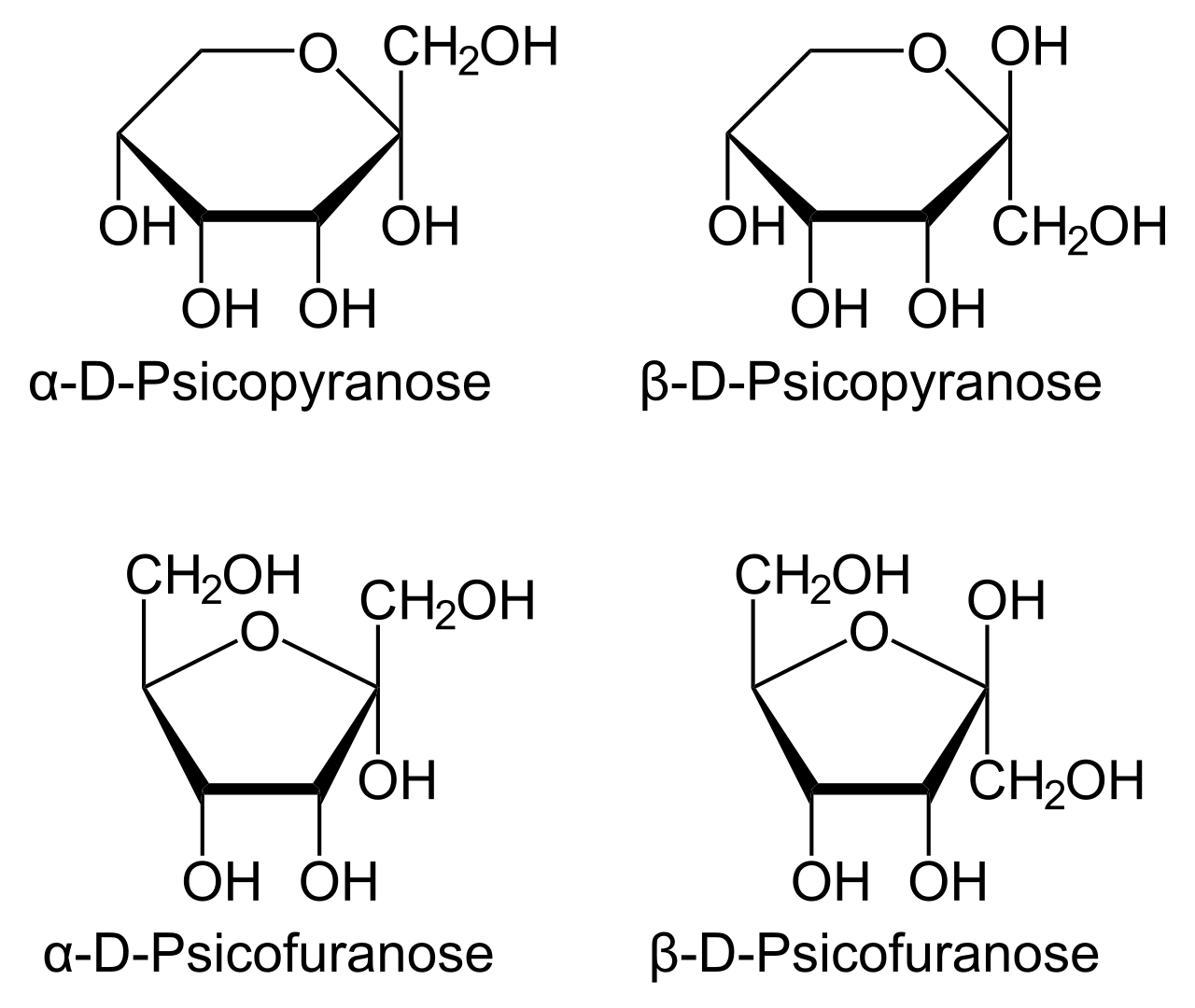
Structural formula of D-allulose (D-psicose).
Credit: NEUROtiker / Wikimedia Commons

License: Public domain
Wikimedia-provided scaled PNG/JPEG rendering; no content edits
What it is
Allulose (D-psicose) is a six-carbon sugar closely related to fructose. [3,5]
What it does and why it is used
It adds sweetness and bulk similar to sugar with far fewer calories. [1,3]
Regulatory status and health context
Canada
As of 2022, allulose was considered a novel food in Canada that had not completed Health Canada's pre-market safety assessment. [5]
United States
FDA accepted allulose as generally recognized as safe after a 2012 notification and allows it to be excluded from sugar totals on labels. [1,5]
European Union
As of 2022, allulose had not been approved in the EU. [5]
Environmental notes
The sources used here do not provide enough environmental data for a rating.
Quick facts
- Label calories (US): 0.4 kcal per gram. [1]
- Sweetness: about 70% of sucrose. [3]
- Gut tolerance: up to 0.4 g/kg in one dose in a human study. [2]
- Canada and EU: not approved for general food use (as of 2022). [5]
Sources
Sources were accessed on 2026-11-21. Source publication dates differ from this draft's review date. Image licences are listed with each image.
- FDA: Guidance for industry: the declaration of allulose and calories from allulose on Nutrition and Supplement Facts labels.
- Han Y et al. Gastrointestinal tolerance of D-allulose in healthy and young adults: a non-randomized controlled trial. Nutrients, 2018 (PubMed).
- Franchi F et al. Effects of D-allulose on glucose tolerance and insulin response to a standard oral sucrose load: a randomized crossover study. BMJ Open Diabetes Res Care, 2021 (PubMed).
- Risso D et al. Gastrointestinal tolerance of D-allulose in children: an acute, randomised, double-blind, placebo-controlled, cross-over study. Food Funct, 2024 (PubMed).
- McGill University Office for Science and Society: The allure of allulose, 2022.